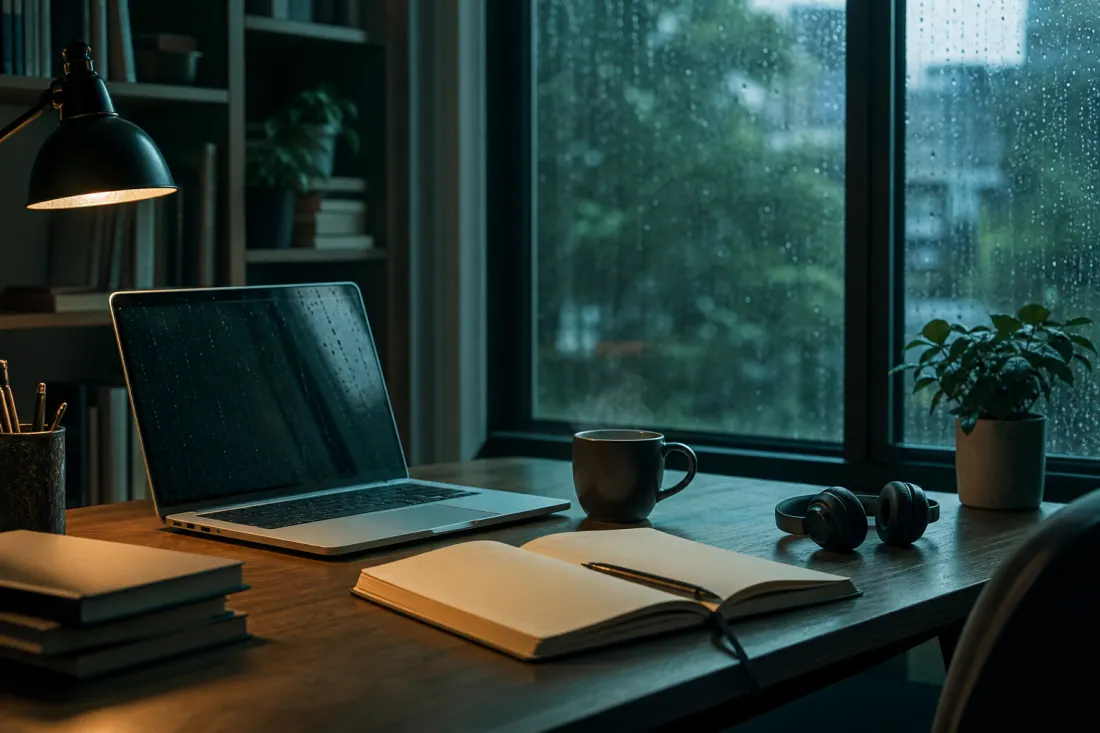

Code is verbal — speech is the enemy
Banbury's irrelevant speech effect degrades serial recall — isomorphic to holding a seven-step refactor in head.[1] Hongisto models predict near-linear performance loss as colleague speech clarifies.[2] Jahncke showed open-plan noise impairs memory tasks and slows recovery — the exact profile of deep debugging afternoons.[3] Engle's working-memory framework treats attention as limited capacity; intelligible standups in background consume it.[7]
When noise helps programmers
Söderlund's ADHD noise benefit suggests suboptimal arousal states gain from low white noise — some engineers with attention variability report similar.[5] Mehta's moderate noise aids divergent thinking — useful for architecture whiteboarding, not line-level bug hunts.[6] Szalma's meta-analysis: match noise to task complexity.[4]
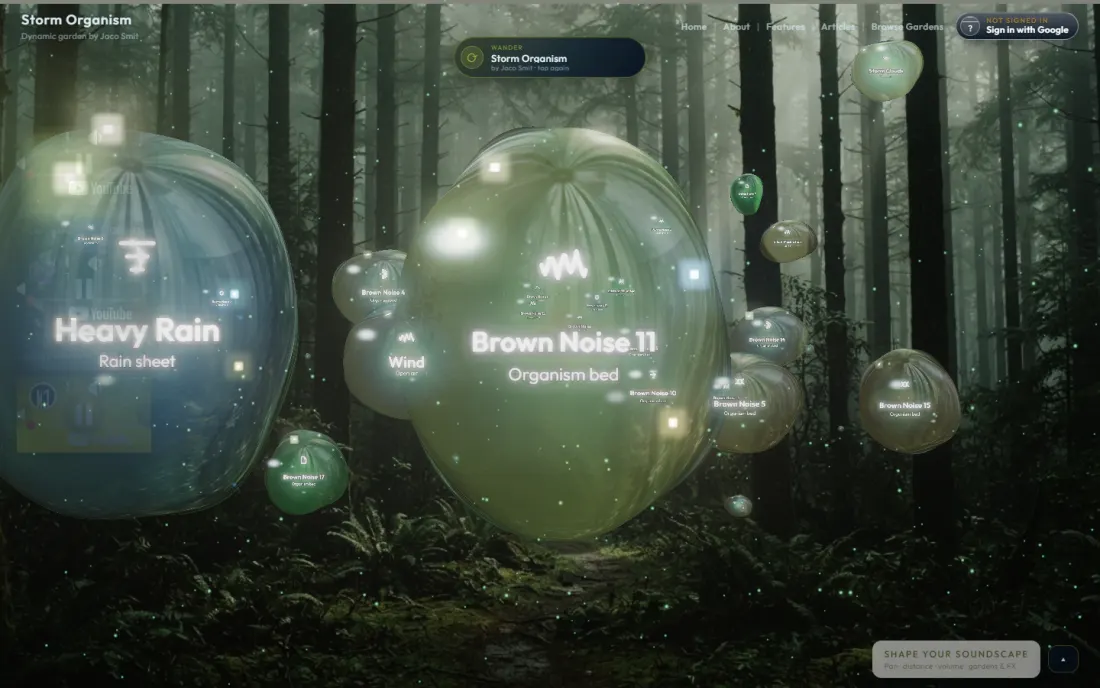
Task-specific gardens
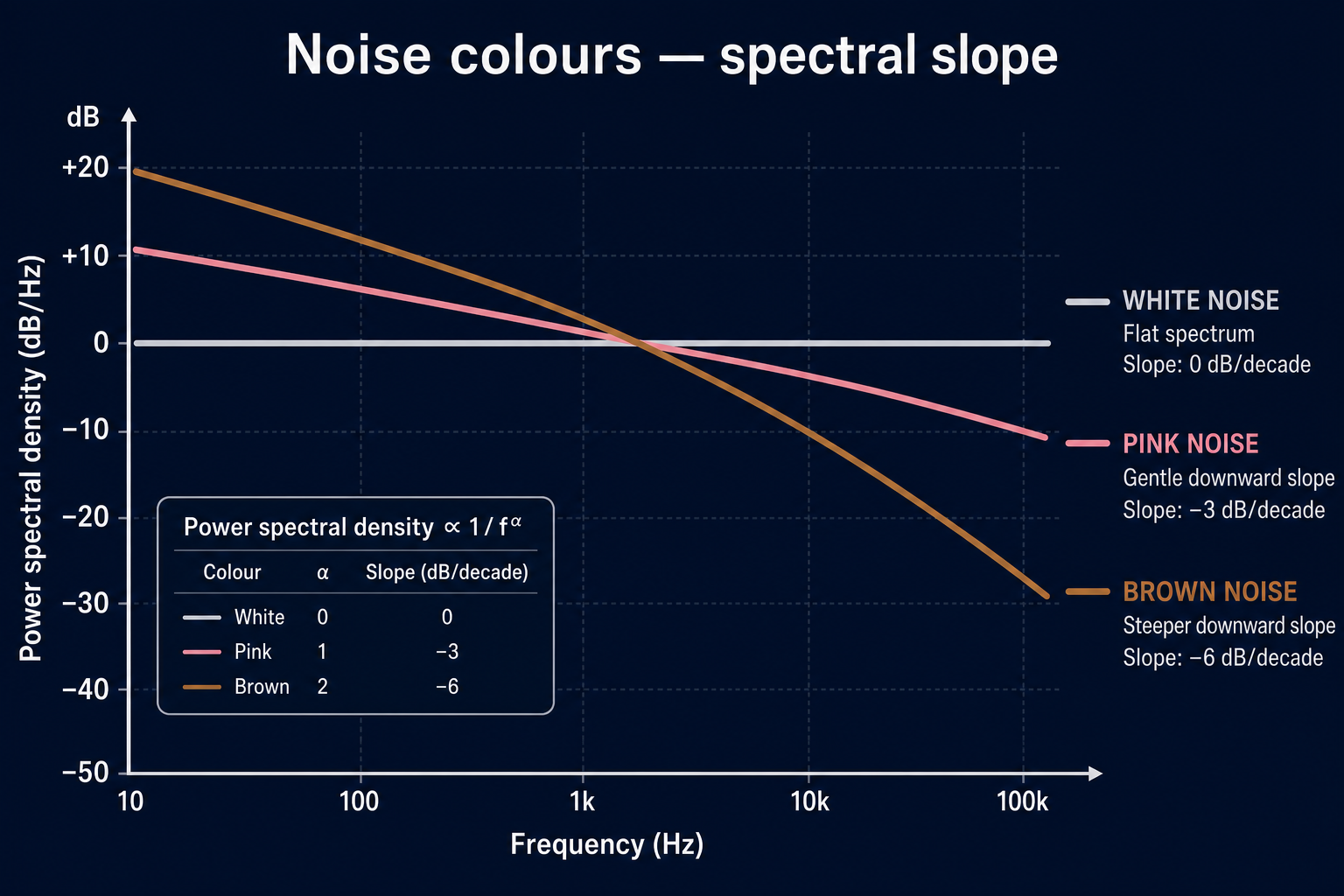
Deep debug / race conditions: brown or pink floor, high Falloff, zero speech.[1][15]
Boilerplate / CRUD: moderate café murmur acceptable.[6]
Pair programming: drop masking — intelligibility required for collaboration.[2]
On-call pages: never mask alert tones; garden off during incident.
Masking mechanics for home and open plan
Continuous beds raise threshold against unpredictable spikes — Stanchina logic applied to Slack notification sounds and hallway doors.[22] Spatial placement per Bregman keeps rain "outside window," brown "in room."[14] TimeLine prevents habituation that leads to 85 dB loops — Basner warns dose accumulates.[8][9][21]
Headphones, speakers, and hearing health
CDC NIOSH guidance applies to all-day engineering sessions.[21] Prefer lower volume with closer Falloff over max volume compensating for thin masks. Take silent breaks — auditory rest is real recovery.
Anti-patterns
- True crime podcasts while refactoring legacy PHP — worst-case speech load.[1]
- Notification sounds plus masking garden — double salience.[11]
- Same brown loop 10 hours — seam detection breaks flow.[13]
Remote work, async standups, and focus blocks
Distributed teams live in calendar fragmentation — focus blocks shrink below 90 minutes. Start garden at block open, not morning login, to bind context faster.[7] Async video standups reintroduce intelligible speech asynchronously; schedule them outside deep-work windows, not as background. Jahncke's recovery data suggest even brief open-plan exposure delays return to baseline — treat meetings as contamination events requiring five-minute quiet reset.[3]
Language, framework churn, and learning new stacks
Learning Rust while thinking in JavaScript loads working memory similarly to foreign-language study — reduce noise when syntax is unfamiliar.[1][4] Once patterns automatise, moderate café noise may return for scaffolded exercises. Document the transition point personally; senior engineers often forget beginner load.[7]
Security-sensitive and on-call work
Security reviews and threat modelling demand serial hypothesis tracking — treat like debugging with maximum quiet.[1] On-call engineers should pre-save a low-salience brown garden for pager-adjacent triage but never mask tones that must remain supra-threshold. Basner's dose framework still applies during 12-hour incident bridges.[8][21]
Code review and pull-request quality
Reviewing diffs is serial memory work — variable names and logic branches must stay in mind across files. Hongisto predicts nearby standup conversation collapses review quality more than typing speed.[2] Schedule review blocks with brown-noise gardens and Slack DND; reserve café layers for greenfield scaffolding only.[1][3]
Keyboard choice and acoustic feedback
Mechanical keyboards add non-speech transients that some engineers find focusing — others treat them as deviance events per Marsh.[7] Garden beds should not compete with keyboard loudness; if keys dominate, lower masking or switch switches before raising volume.[9] Pair programming remains speech-first — never mask your partner's voice during active collaboration.[2]
Companion listening in Sound Bubbles
Research above concerns clinical and laboratory sound — not a playlist guarantee. Sound Bubbles offers adjustable living gardens: spatial layers, coloured noise beds, Medical & Wellbeing rooms, and easy mute. Use recommended gardens as environmental support alongside medical care when appropriate.[20]
Not treatment. See clinicians for diagnosis, medication, CBT, neurologic music therapy, or tinnitus programmes. Keep volume comfortable; stop if symptoms worsen.
Why this supports Sound Bubbles — not just "any ambient app"
Most ambient apps deliver one file. The studies above rarely study "a loop." They study continuous floors against irregular noise, unintelligible speech against memory tasks, nature scenes against stress markers, spatial streams against glued mashups, and slow environmental change against habituation.[9][14][22][23][24]
Sound Bubbles maps onto those findings deliberately: brown/noise beds for masking floors, nature and library layers for restorative structure, distance/Falloff for speech intelligibility control, and TimeLine motion so the garden keeps the statistics of a place instead of the statistics of a four-minute loop.[12][15][16][25] That is the practical reason the product feels different after the first hour — and the scientific reason the difference matters.
How to apply this inside Sound Bubbles
- Open a related garden (or New Garden) and press Start playing so audio unlocks.[9]
- Expand Shape your soundscape → Sounds: set Master Volume, then Falloff while watching the audible-core guide.[10]
- Select a bubble; drag and scroll depth. Prefer raising one bubble's Volume over blasting the whole room.[11]
- Add library rain, nature, or noise layers; keep speech-like content distant — or remove it — when you need reading or coding focus.[12]
- TimeLine: choose Drift, Tide, or Orbit when you want the garden to keep evolving without grabbing attention.[13]
- Brown Noise tab: shape a warm floor, optionally Release as bubble so it becomes spatial.[14]
- Save gardens that still feel kind after an hour — public gardens should stay soft, not startling.[15]
Limits, safety, and honest uncertainty
We do not claim Sound Bubbles replaces clinical care, sleep medicine, occupational health programmes, or psychiatric treatment.[1][7] What the product does offer is a listening architecture that matches how hearing and attention actually work: layered sources, spatial distance, and slow change instead of one brittle loop.[18][19]
If sound worsens symptoms, stop. If you need medical advice, see a clinician. If you want a softer room, open a garden, place the bubbles kindly, and stay honest about what sound can — and cannot — do.[20][21]
How this article was researched
We combine first-hand experience placing and tuning Sound Bubbles gardens with citations from peer-reviewed journals, reviews, and institutional pages (including NIH/NCBI, sleep and hearing literature, acoustics, and attention research). Where evidence is mixed or early, we say so. On wellbeing topics we stay cautious: these are companion soundscapes, not cures.
References
Sources cited in this article. Prefer primary literature and institutional guidance; Sound Bubbles is not a medical device and these citations do not imply clinical endorsement.
- (2001). Auditory distraction and memory. Human Factors. doi:10.1518/001872001775992390
- (2005). Speech intelligibility and performance. Indoor Air. doi:10.1111/j.1600-0668.2005.00391.x
- (2011). Open-plan office noise. Journal of Environmental Psychology. doi:10.1016/j.jenvp.2011.07.002
- (2011). Noise effects meta-analysis. Psychological Bulletin. doi:10.1037/a0023987
- (2007). White noise and ADHD cognition. J Child Psychol Psychiatry. doi:10.1111/j.1469-7610.2007.01749.x
- (2012). Ambient noise and creativity. Journal of Consumer Research. doi:10.1086/665048
- (2002). Working memory and executive attention. Trends in Cognitive Sciences.
- (2014). Noise and health. The Lancet. doi:10.1016/S0140-6736(13)61613-X
- (2009). Habituation revisited. Neurobiology of Learning and Memory. doi:10.1016/j.nlm.2008.09.015
- (2009). Habituation: a history. Neurobiology of Learning and Memory.
- (1963). Perception and the conditioned reflex. Pergamon Press.
- (2010). The free-energy principle. Nature Reviews Neuroscience. doi:10.1038/nrn2787
- (2013). Whatever next? Predictive brains. Behavioral and Brain Sciences. doi:10.1017/S0140525X12000477
- (1990). Auditory Scene Analysis. MIT Press.
- (2012). An Introduction to the Psychology of Hearing. Brill.
- (2024). Colors of noise. Encyclopedic.
- (2013). Acoustical terminology (masking). ANSI.
- (2014). Auditory and non-auditory effects of noise on health. The Lancet. doi:10.1016/S0140-6736(13)61613-X
- (2021). World report on hearing. WHO.
- (2023). Noise and hearing loss prevention. CDC.
- (2005). White noise on sleep with ICU noise exposure. Sleep Medicine. doi:10.1016/j.sleep.2004.12.004
- (2001). Auditory distraction and short-term memory. Human Factors. doi:10.1518/001872001775992390
- (2010). Stress recovery with nature sound. IJERPH. doi:10.3390/ijerph7031036
- (2005). Speech intelligibility and work performance. Indoor Air. doi:10.1111/j.1600-0668.2005.00391.x