Streaming — when parts become wholes
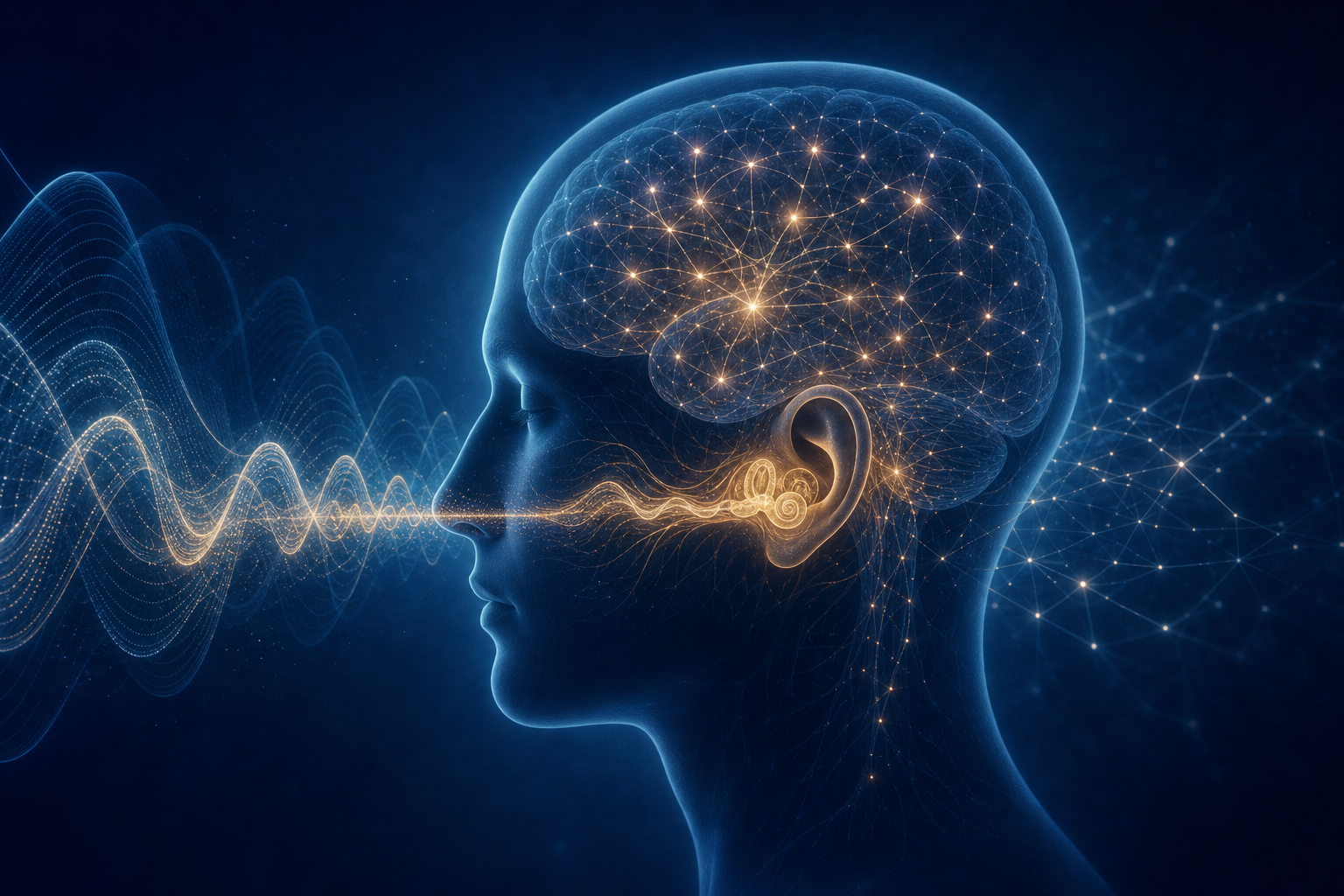
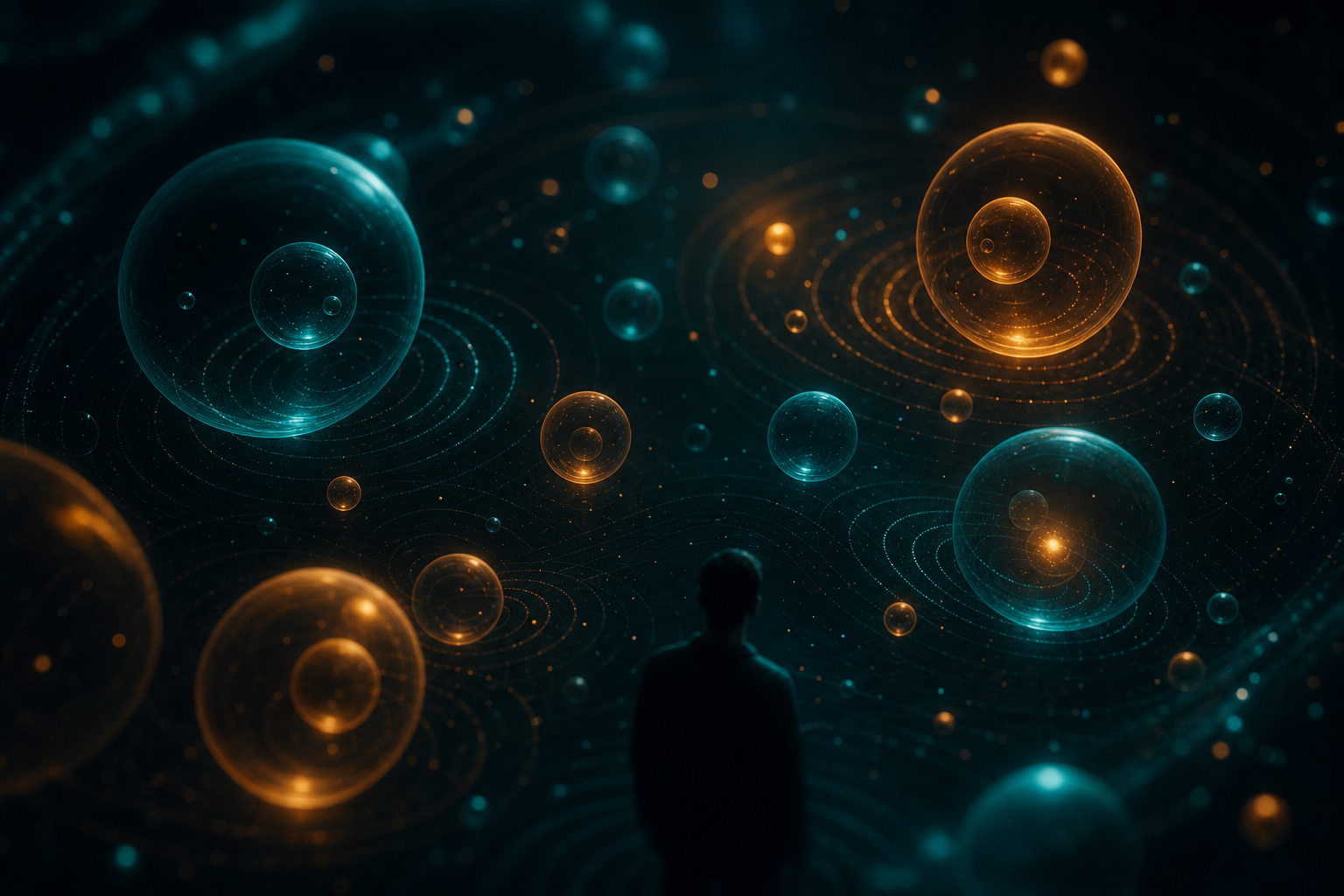
Bregman's foundational work described how the auditory system groups energy using gestalt-like principles adapted for time and frequency: common onset, harmonicity, continuity, and proximity in pitch or space.[1] A rapid sequence of high-low-high notes can stream into two separate melodic lines (Deutsch's streaming illusions demonstrate the effect in music).[5]
Streaming is not decoration; it is prerequisite for following speech in noise, locating alarms, and enjoying polyphonic music. McDermott's review ties ASA to neural population codes that represent acoustic scenes as discrete sources rather than raw spectra.[2] Griffiths and Warren emphasised planum temporale and hierarchical pathways that integrate spatial and spectral cues into stable auditory objects.[3]
Innate machinery — newborns already group
Scene analysis is not a skill learned in adolescence. Winkler et al. showed newborn infants organise tone sequences into streams using the same proximity principles adults use — suggesting powerful innate grouping biases tuned by experience later.[4] Norman-Haignere et al. found neural populations sensitive to harmonic structure in both music and speech, hinting that scene analysis piggybacks on resonant periodicity detectors early in the pathway.[11]
Competition and resolution — when scenes collide
When grouping cues conflict, the brain must choose interpretations. Cherry's dichotic listening showed attention selects one stream among competing messages.[6] Darwin reviewed speech-in-noise literature: talkers with similar timbre and rate fuse into one informational masker even when spatial cues exist.[7] Moore's psychoacoustics texts quantify masking interactions that make some scenes irreversible without movement or level change.[8]
Litovsky's binaural work shows two ears provide spatial tags that help segregate otherwise similar talkers — ASA is inherently binaural in real rooms.[9] Fritz et al. described top-down attention as a movable filter across grouped streams, not a replacement for grouping.[10]
Naturalistic scenes versus artificial mashups
Gould van Praag et al. compared fMRI connectivity when listeners heard naturalistic versus artificial soundscapes. Natural scenes engaged default-mode networks differently — outward, place-like listening — compared with more inward patterns for artificial noise.[12] The brain expects scenes with separable, slowly evolving sources; mono loops violate those statistics.
Rankin's habituation research explains secondary failure: once a loop is fully parsed, cortical gain drops — you hear the seam, not the place.[13] ASA therefore needs ongoing micro-novelty within stable structure — exactly how rain in a real garden never repeats its micro-rhythm.

Streaming in music and everyday life
Try this: alternate high and low notes rapidly. At fast tempos you hear one galloping line; at slow tempos, two interleaved melodies — the classic streaming illusion Deutsch popularised.[5] Pop mixes exploit the same grouping: bass, drums, vocals, and synth occupy separable streams until compression and mono collapse destroy them.
Podcast mashups fail because speech streams fuse — the brain cannot assign separate semantic channels without spatial or timbral cues. Darwin's speech-in-noise review shows even partial phoneme overlap between maskers increases error rates nonlinearly.[7]
McDermott's review ties ASA to neural population codes — the brain represents scenes as discrete sources rather than raw spectra.[2] When engineers mono-sum a rain-and-café mix, they destroy common onset cues that help the system bind distant chatter to spatial location.[1] The listener hears mush; attention spends energy disentangling instead of resting.
Norman-Haignere et al. showed harmonic structure tuning in auditory cortex — periodic complex tones get privileged processing, explaining why steady brown beds feel "natural" while harsh digital spikes feel alien without conscious story.[11] ASA and harmonicity interact: streams group by spectrum and by location together.[9]
ASA in design — why Sound Bubbles uses bubbles
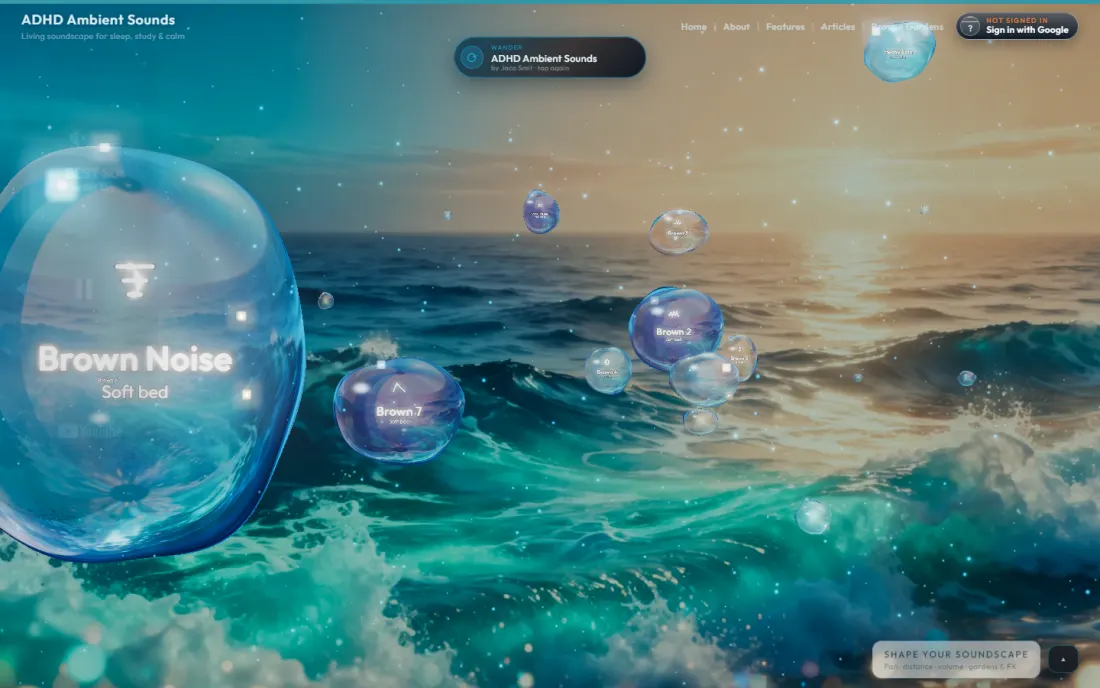
Most ambient apps deliver one flattened bus. Sound Bubbles instead gives each source its own bubble with distance-linked level (Falloff) and optional TimeLine motion:
- Harmonic layers (birds, bells) stay spectrally distinct from broadband brown beds — encouraging separate streams.[1][11]
- Spatial depth mimics interaural cues headphones can approximate — reducing informational masking during focus.[9]
- Slow drift prevents static grouping fatigue without startling onsets.[13]
Banbury et al. documented cognitive costs when irrelevant speech invades working memory — ASA cannot help if maskers are intelligible and near.[14] Keep talk-like layers distant or off during deep work; use soft noise floors to manage external intrusions.[19]
Wellbeing without medical claims
Alvarsson et al. showed faster autonomic recovery after stress with nature sounds versus urban noise — plausible partly because natural scenes parse as non-threatening places.[15] That supports companion listening during relaxation, not ASA therapy as a clinical protocol.
How to listen with ASA in mind
- Start with one broadband floor (brown noise organism) then add character layers at different depths.[1]
- Avoid stacking multiple speech-like sources — they fuse into one masker.[7]
- Enable TimeLine Drift or Tide so streams stay alive without new transients.[13]
- Use headphones when you need maximal binaural segregation.[9]
- Keep volume comfortable; cochlear damage destroys the cues ASA needs.[16][17][18]
Virtual reality and games increasingly rely on ASA cues for presence — separated diegetic sources feel embodied; mono UI beeps feel cheap. Gould van Praag et al.'s naturalistic versus artificial fMRI contrast supports designing wellbeing audio with ecological statistics.[12]
Audiophile "soundstage" language often rediscovers Bregman without citing him — width, depth, and separation are scene-analysis outcomes, not magic cables.[1]
Common mistakes in ambient design
Mono summing everything, looping under four minutes, stacking multiple speech samples, and using sharp notification-like transients in "relaxation" tracks all violate ASA principles.[1][13] The brain parses statistics; fight them and listeners fatigue.
Conversely, overly dense polyphony without spatial cues creates informational masking even at moderate levels — Mozart string quartets are art; four podcasts are torture.[7]
Winkler et al.'s newborn streaming data remind designers: listeners arrive with grouping biases — honour them instead of fighting with mono chaos.[4]
Summary
Auditory scene analysis is how one waveform becomes many objects — streaming, harmonicity, common onset, and spatial tags per Bregman and McDermott.[1][2] Mashups and short loops fail because they destroy the statistics brains evolved to parse.
Sound Bubbles keeps streams alive and separable: brown floors, nature character at depth, TimeLine drift. That is ASA-aware design for long listening, not a medical claim.[13]
Gould van Praag et al. support naturalistic statistics for restoration — ASA and stress recovery pull in the same design direction.[12]
Litovsky's binaural advantage work is the quantitative backbone for "headphone spatial matters" claims — not marketing adjectives.[9]
Fritz et al.'s searchlight framing pairs with scene analysis: you cannot aim attention at streams you never grouped.[10]
Deutsch grouping principles in music foreshadow every spatial mix decision — separation is compositional ethics.[5]
Cherry's shadowing task remains the classroom demo that makes ASA visceral for new listeners.[6]
Limits
ASA explains perception, not cure. Hearing loss, APD, and migraine phonophobia need clinical pathways. If grouped scenes always feel overwhelming or flat, seek audiology — not louder loops.[20]
How this article was researched
We combine first-hand experience placing and tuning Sound Bubbles gardens with citations from peer-reviewed journals, reviews, and institutional pages (including NIH/NCBI, sleep and hearing literature, acoustics, and attention research). Where evidence is mixed or early, we say so. On wellbeing topics we stay cautious: these are companion soundscapes, not cures.
References
Sources cited in this article. Prefer primary literature and institutional guidance; Sound Bubbles is not a medical device and these citations do not imply clinical endorsement.
- (1990). Auditory Scene Analysis. MIT Press.
- (2013). Auditory scene analysis. Neuron (review context). doi:10.1016/j.neuron.2013.07.018
- (2004). The planum temporale as a computational hub. Trends in Neurosciences. doi:10.1016/j.tins.2004.10.011
- (2003). Newborn infants can organize auditory streams. Proceedings of the National Academy of Sciences. doi:10.1073/pnas.2434696100
- (1999). Grouping mechanisms in music. The Psychology of Music.
- (1953). Some experiments on the recognition of speech, with one and with two ears. Journal of the Acoustical Society of America. doi:10.1121/1.1901869
- (2008). Listening to speech in the presence of other sounds. Philosophical Transactions of the Royal Society B. doi:10.1098/rstb.2007.2159
- (2012). An Introduction to the Psychology of Hearing. Brill.
- (2012). The binaural advantage in reverberation and noise. Journal of the Acoustical Society of America. doi:10.1121/1.4754420
- (2007). Auditory attention — focusing the searchlight on sound. Current Opinion in Neurobiology. doi:10.1016/j.conb.2007.07.011
- (2022). Neural population tuning reveals harmonic structure in music and speech. Nature Neuroscience. doi:10.1038/s41593-022-01114-5
- (2017). Mind-wandering and alterations to default mode network connectivity when listening to naturalistic versus artificial sounds. Scientific Reports. doi:10.1038/s41598-017-07890-8
- (2009). Habituation revisited. Neurobiology of Learning and Memory. doi:10.1016/j.nlm.2008.09.015
- (2001). Auditory distraction and short-term memory. Human Factors. doi:10.1518/001872001775992390
- (2010). Stress recovery during exposure to nature sound and environmental noise. IJERPH. doi:10.3390/ijerph7031036
- (2021). World report on hearing. WHO.
- (2023). Noise and hearing loss prevention. CDC.
- (2014). Auditory and non-auditory effects of noise on health. The Lancet. doi:10.1016/S0140-6736(13)61613-X
- (2005). The influence of white noise on sleep in subjects exposed to ICU noise. Sleep Medicine. doi:10.1016/j.sleep.2004.12.004
- (2024). Hearing and communication. NIH.