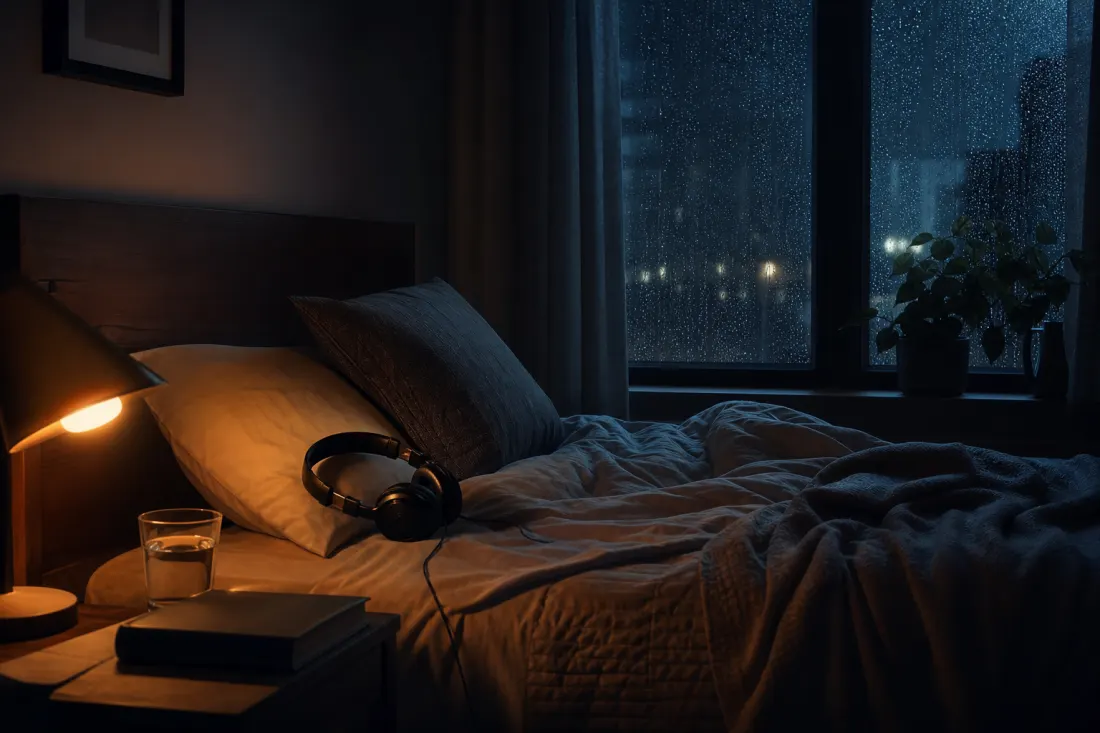

The shift-worker sleep problem
Drake defined shift work sleep disorder as insomnia or excessive sleepiness temporally linked to work schedules.[3] Wright's laboratory and field studies show partial entrainment: many workers never fully align internal phase with external demands, leaving REM and slow-wave sleep compressed into noisy daytime bedrooms.[1] Boivin's reviews emphasise light as primary intervention — yet blackout curtains create silent-isolation paradoxes where every hallway footstep becomes salient.[2]
Daytime sleep: masking beats silence
Stanchina's ICU masking trial is directly transferable: continuous noise beds raise threshold against unpredictable spikes.[4] Daytime urban spikes — delivery trucks, neighbours, phones — resemble ICU events in unpredictability if not intensity. Riedy's review supports broadband noise for onset and continuity in noisy settings.[5]
Recommended stack for day sleep:
- Brown or pink floor for stable masking.[15][16]
- Optional distant rain — irregularity delays habituation.[9]
- High Falloff, low master volume — protect ears across 8-hour sleeps.[20][21]
- No speech content — semantic processing persists during NREM.[23]
Basner warns cumulative noise dose affects cardiovascular and metabolic markers even when sleep feels "fine."[6] Masking level must stay moderate — you are trading external spikes for controlled internal floor, not doubling dose.

Pre-shift wake and alertness
Sleep inertia after daytime sleep can impair driving to night shifts.[8] Bright light exposure remains gold standard for alertness.[7] Auditory dawn ramps — rising nature or brightening noise spectra — provide secondary arousal when light control is limited (winter, shared dark flat). Pair gentle sound rise with caffeine timing per occupational health guidance, not instead of it.
On-shift focus and recovery micro-breaks
Night-shift cognitive lapses peak in circadian nadir hours. Hongisto's speech-intelligibility work predicts nearby conversation destroys serial attention — relevant for charting and monitoring tasks.[25] Low-level masking during documentation blocks may help; during handoff conversation, drop masking so communication stays clear.
Micro-break gardens with nature layers show stress-recovery patterns in Alvarsson's lab paradigm — useful for 10-minute break rooms if hospital policy allows personal audio.[24]
Rotating schedules: change the garden with the shift
Static playlists habituate across weeks.[9] Rotate between brown-dominant day-sleep gardens and lighter nature wake gardens when switching from nights to days. TimeLine motion supplies within-session variability. Document what survives a full pay cycle — not what feels good night one.
What sound will not fix
Shift work disorder may need timed melatonin, light boxes, or schedule modification per sleep medicine.[2][3][7] Sound is adjunct for acoustic environment, not replacement for occupational health limits on consecutive nights or commute safety planning.
Hospital, warehouse, and transport workers
Hospital day-sleepers face pager spikes unlike steady traffic — continuous beds help baseline but cannot mask intentional alerts; negotiate off-duty pager policies separately.[4] Warehouse and factory night workers often arrive home as construction starts; combine brown masking with earplugs only if occupational safety allows — never double-isolate from emergency alarms.[6][21] Drivers finishing night shifts should complete garden-assisted nap before merging onto motorways; inertia plus circadian nadir elevates crash risk beyond any sound fix.[3][8]
Family coordination on rotating rosters
Rotating parents need household quiet contracts: children understand when Dad's "night" means daytime silence in one wing of the house. Visual door signs plus consistent rain garden signal "sleep in progress" better than ad hoc shushing.[2] When both partners rotate, swap saved gardens rather than sharing one habituated loop — different roles tolerate different spectra.[9]
Companion listening in Sound Bubbles
Research above concerns clinical and laboratory sound — not a playlist guarantee. Sound Bubbles offers adjustable living gardens: spatial layers, coloured noise beds, Medical & Wellbeing rooms, and easy mute. Use recommended gardens as environmental support alongside medical care when appropriate.[20]
Not treatment. See clinicians for diagnosis, medication, CBT, neurologic music therapy, or tinnitus programmes. Keep volume comfortable; stop if symptoms worsen.
Why this supports Sound Bubbles — not just "any ambient app"
Most ambient apps deliver one file. The studies above rarely study "a loop." They study continuous floors against irregular noise, unintelligible speech against memory tasks, nature scenes against stress markers, spatial streams against glued mashups, and slow environmental change against habituation.[9][14][22][23][24]
Sound Bubbles maps onto those findings deliberately: brown/noise beds for masking floors, nature and library layers for restorative structure, distance/Falloff for speech intelligibility control, and TimeLine motion so the garden keeps the statistics of a place instead of the statistics of a four-minute loop.[12][15][16][25] That is the practical reason the product feels different after the first hour — and the scientific reason the difference matters.
How to apply this inside Sound Bubbles
- Open a related garden (or New Garden) and press Start playing so audio unlocks.[9]
- Expand Shape your soundscape → Sounds: set Master Volume, then Falloff while watching the audible-core guide.[10]
- Select a bubble; drag and scroll depth. Prefer raising one bubble's Volume over blasting the whole room.[11]
- Add library rain, nature, or noise layers; keep speech-like content distant — or remove it — when you need reading or coding focus.[12]
- TimeLine: choose Drift, Tide, or Orbit when you want the garden to keep evolving without grabbing attention.[13]
- Brown Noise tab: shape a warm floor, optionally Release as bubble so it becomes spatial.[14]
- Save gardens that still feel kind after an hour — public gardens should stay soft, not startling.[15]
Limits, safety, and honest uncertainty
We do not claim Sound Bubbles replaces clinical care, sleep medicine, occupational health programmes, or psychiatric treatment.[1][7] What the product does offer is a listening architecture that matches how hearing and attention actually work: layered sources, spatial distance, and slow change instead of one brittle loop.[18][19]
If sound worsens symptoms, stop. If you need medical advice, see a clinician. If you want a softer room, open a garden, place the bubbles kindly, and stay honest about what sound can — and cannot — do.[20][21]
How this article was researched
We combine first-hand experience placing and tuning Sound Bubbles gardens with citations from peer-reviewed journals, reviews, and institutional pages (including NIH/NCBI, sleep and hearing literature, acoustics, and attention research). Where evidence is mixed or early, we say so. On wellbeing topics we stay cautious: these are companion soundscapes, not cures.
References
Sources cited in this article. Prefer primary literature and institutional guidance; Sound Bubbles is not a medical device and these citations do not imply clinical endorsement.
- (2013). Circadian misalignment in shift work. Current Biology. doi:10.1016/j.cub.2013.08.011
- (2014). Circadian rhythm in shift work. Sleep Medicine Reviews.
- (2004). Shift work sleep disorder. Sleep.
- (2005). White noise masking ICU noise. Sleep Medicine. doi:10.1016/j.sleep.2004.12.004
- (2021). Noise as sleep aid review. Sleep Medicine Reviews. doi:10.1016/j.smrv.2020.101385
- (2014). Noise and health. The Lancet. doi:10.1016/S0140-6736(13)61613-X
- (2016). Light interventions for shift workers. Journal of Biological Rhythms.
- (1995). Sleep inertia. Sleep.
- (2009). Habituation revisited. Neurobiology of Learning and Memory. doi:10.1016/j.nlm.2008.09.015
- (2009). Habituation: a history. Neurobiology of Learning and Memory.
- (1963). Perception and the conditioned reflex. Pergamon Press.
- (2010). The free-energy principle. Nature Reviews Neuroscience. doi:10.1038/nrn2787
- (2013). Whatever next? Predictive brains. Behavioral and Brain Sciences. doi:10.1017/S0140525X12000477
- (1990). Auditory Scene Analysis. MIT Press.
- (2012). An Introduction to the Psychology of Hearing. Brill.
- (2024). Colors of noise. Encyclopedic.
- (2013). Acoustical terminology (masking). ANSI.
- (2014). Auditory and non-auditory effects of noise on health. The Lancet. doi:10.1016/S0140-6736(13)61613-X
- (2021). World report on hearing. WHO.
- (2023). Noise and hearing loss prevention. CDC.
- (2005). White noise on sleep with ICU noise exposure. Sleep Medicine. doi:10.1016/j.sleep.2004.12.004
- (2001). Auditory distraction and short-term memory. Human Factors. doi:10.1518/001872001775992390
- (2010). Stress recovery with nature sound. IJERPH. doi:10.3390/ijerph7031036
- (2005). Speech intelligibility and work performance. Indoor Air. doi:10.1111/j.1600-0668.2005.00391.x