

The café hypothesis
Writers have long claimed the hum of a coffee shop unlocks ideas. Mehta, Zhu, and Cheema tested that folklore directly: they exposed participants to varying noise levels while measuring creative cognition. Moderate noise (~70 dB) improved performance on creative tasks relative to low and high noise conditions.[1] Their explanation: mild distraction widens conceptual search — you process information less narrowly, which helps remote associations.
That result is famous and frequently misquoted. It does not mean louder is better, or that speech helps, or that creativity always wins. Szalma and Hancock's meta-analysis across hundreds of noise studies shows a more common pattern: noise usually impairs accuracy-heavy work and vigilance.[2] Creativity and proofreading are different tasks with different acoustic needs.
When noise helps versus hurts
Helps (sometimes): divergent thinking, brainstorming, design exploration at moderate arousal.[1] Hurts (often): serial recall, reading comprehension, debugging, anything requiring phonological loop integrity.[3] Office reality: Jahncke found open-plan noise impaired recall and reduced perceived restoration — real offices are not controlled 70 dB café labs.[4] Intelligible speech is the worst offender for knowledge work.[5]
ADHD adds another branch: some listeners need added noise to reach optimal arousal, not less.[8] The creativity sweet spot is individual, task-dependent, and not stable across the day.
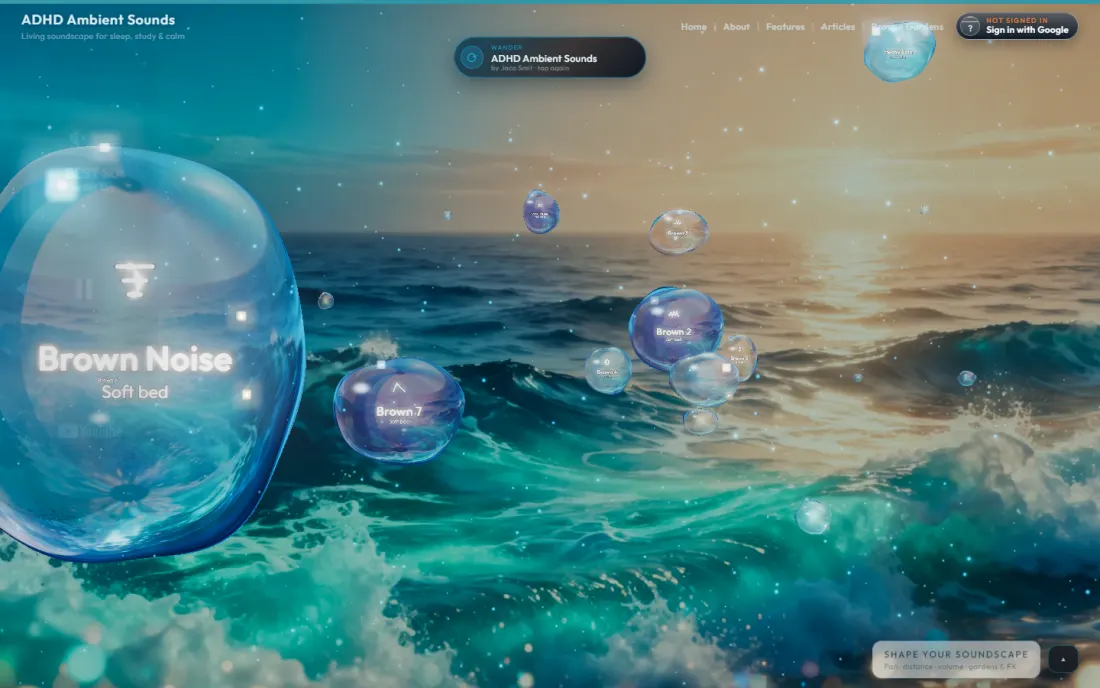
Designing a creativity-friendly room in Sound Bubbles
Mehta's moderate noise is statistical — broadband, non-lyrical, not spiking. A brown floor with distant café-like clatter (kept unintelligible via Falloff) approximates the mechanism without inserting words into your phonological loop.[1][25] Nature layers can supply soft fascination when creative work needs mood restoration between bursts.[6]
Avoid identical loops: habituation erases the mild distraction creativity may need; seams reintroduce sharp orienting.[9][12] TimeLine Drift keeps statistics changing slowly — enough novelty for stochastic resonance, not enough for task hijack.
Experiments to run
- Low floor session: near-silent brown bed — note idea breadth on a brainstorming prompt.
- Moderate floor session: raise master volume one notch or add distant café layer — repeat prompt.
- High floor session: push loud — expect narrowing, irritability, not genius.[2]
Log results honestly. If moderate noise helps, save that garden. If speech sneaks in intelligibly, move café bubbles back until words dissolve.[5]
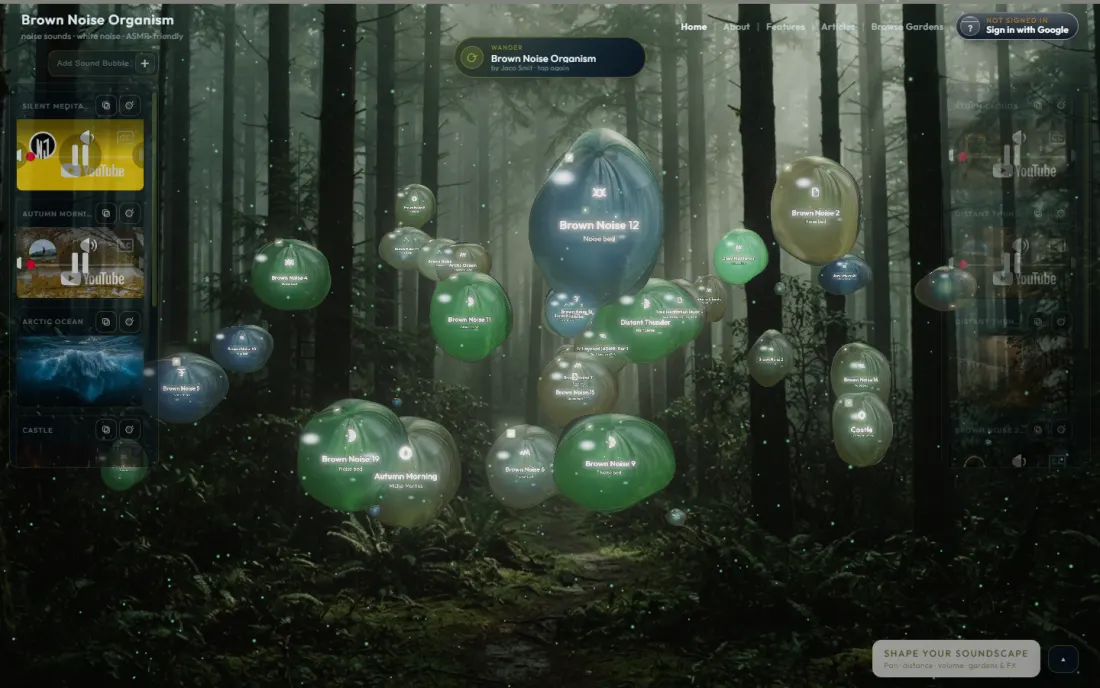
Office reality versus lab café
Mehta's café noise was broadband and non-lyrical at a controlled level. Real open-plan offices deliver intelligible speech, phone rings, and printer spikes — Jahncke showed that combination hurts recall and restoration simultaneously.[4] When you borrow the "moderate noise helps creativity" finding, borrow the mechanism (mild arousal) without importing the speech penalty. Hongisto's intelligibility model predicts performance cliffs once words become parseable.[5]
Task switching: divergent versus convergent work
Divergent brainstorming benefits from mild arousal; convergent editing needs phonological loop integrity. Schedule garden intensity to match task phase — Mehta's effect is not a license for all-day café noise during proofreading.[1][3] Save a "creative" preset with moderate volume and a "edit" preset with quieter brown only.
Sound Bubbles tuning reference (worth learning once)
Master Volume sets the whole room. Start lower than you think — you can always raise one bubble instead of the entire garden.[20][21] Per-bubble Volume is how you balance layers without destroying dynamics: rain can stay audible while brown bed whispers.
Falloff is the secret weapon for speech and spike control. High falloff means only bubbles near the audible core sound "in your head"; everything else feels outside the window — exactly the intelligibility reduction office and sleep literature points toward.[15][25] If a layer feels too present, move it back before turning it up.
TimeLine adds slow environmental change so habituation does not turn your garden into wallpaper.[9][12] Pop anything that announces itself after ten minutes — a good garden should feel found, not performed.
Save & remix: when you find a mix that survives an hour, save it. Public medical and organism gardens are starting points; the best room is usually one you tuned for your desk, nursery, or bedside.
Why this supports Sound Bubbles — not just "any ambient app"
Most ambient apps deliver one file. The studies above rarely study "a loop." They study continuous floors against irregular noise, unintelligible speech against memory tasks, nature scenes against stress markers, spatial streams against glued mashups, and slow environmental change against habituation.[9][14][22][23][24]
Sound Bubbles maps onto those findings deliberately: brown/noise beds for masking floors, nature and library layers for restorative structure, distance/Falloff for speech intelligibility control, and TimeLine motion so the garden keeps the statistics of a place instead of the statistics of a four-minute loop.[12][15][16][25] That is the practical reason the product feels different after the first hour — and the scientific reason the difference matters.
How to apply this inside Sound Bubbles
- Open a related garden (or New Garden) and press Start playing so audio unlocks.[9]
- Expand Shape your soundscape → Sounds: set Master Volume, then Falloff while watching the audible-core guide.[10]
- Select a bubble; drag and scroll depth. Prefer raising one bubble's Volume over blasting the whole room.[11]
- Add library rain, nature, or noise layers; keep speech-like content distant — or remove it — when you need reading or coding focus.[12]
- TimeLine: choose Drift, Tide, or Orbit when you want the garden to keep evolving without grabbing attention.[13]
- Brown Noise tab: shape a warm floor, optionally Release as bubble so it becomes spatial.[14]
- Save gardens that still feel kind after an hour — public gardens should stay soft, not startling.[15]
Limits, safety, and honest uncertainty
We do not claim Sound Bubbles replaces clinical care, licensed therapy, or medical protocols.[16][17] What the product does offer is a listening architecture that matches how hearing and attention actually work: layered sources, spatial distance, and slow change instead of one brittle loop.[18][19]
If sound worsens symptoms, stop. If you need medical advice, see a clinician. If you want a softer room, open a garden, place the bubbles kindly, and stay honest about what sound can — and cannot — do.[20][21]
How this article was researched
We combine first-hand experience placing and tuning Sound Bubbles gardens with citations from peer-reviewed journals, reviews, and institutional pages (including NIH/NCBI, sleep and hearing literature, acoustics, and attention research). Where evidence is mixed or early, we say so. On wellbeing topics we stay cautious: these are companion soundscapes, not cures.
References
Sources cited in this article. Prefer primary literature and institutional guidance; Sound Bubbles is not a medical device and these citations do not imply clinical endorsement.
- (2012). Is noise always bad? Exploring the effects of ambient noise on creative cognition. Journal of Consumer Research. doi:10.1086/665048
- (2011). Noise effects on human performance: a meta-analytic synthesis. Psychological Bulletin. doi:10.1037/a0023987
- (2001). Auditory distraction and short-term memory. Human Factors.
- (2011). Open-plan office noise: Cognitive performance and restoration. Journal of Environmental Psychology. doi:10.1016/j.jenvp.2011.07.002
- (2005). Speech intelligibility and work performance. Indoor Air.
- (1995). The restorative benefits of nature. Journal of Environmental Psychology.
- (2007). Listen to the noise: noise is beneficial for cognitive performance in ADHD. Journal of Child Psychology and Psychiatry.
- (2009). Habituation revisited: an updated and revised description. Neurobiology of Learning and Memory. doi:10.1016/j.nlm.2008.09.015
- (2009). Habituation: a history. Neurobiology of Learning and Memory.
- (1990). Auditory Scene Analysis. MIT Press.
- (2010). The free-energy principle: a unified brain theory?. Nature Reviews Neuroscience. doi:10.1038/nrn2787
- (2010). Stress recovery during exposure to nature sound and environmental noise. IJERPH. doi:10.3390/ijerph7031036
- (2021). World report on hearing. WHO.
- (2021). World report on hearing. WHO.
- (2021). World report on hearing. WHO.
- (2021). World report on hearing. WHO.
- (2021). World report on hearing. WHO.
- (2021). World report on hearing. WHO.
- (2021). World report on hearing. WHO.
- (2021). World report on hearing. WHO.
- (2021). World report on hearing. WHO.
- (2021). World report on hearing. WHO.
- (2021). World report on hearing. WHO.
- (2021). World report on hearing. WHO.