
When hearing starts
Hepper and Shahidullah traced behavioural responses from roughly 27 weeks gestation onward, with reliable reactions to pure tones by third trimester in many foetuses.[1] Kisilevsky's ERP work showed discrimination of syllable changes near term — auditory learning begins before birth but accelerates after.[2] First-trimester "headphone on belly" marketing is biologically premature for auditory enrichment claims.
What actually reaches the womb
Abdominal tissue low-pass filters — highs attenuate; maternal voice arrives via bone conduction and near field.[8] External speakers at moderate living-room level deliver muffled spectra; headphone-on-belly devices risk unpredictable SPL and hot spots. Gerhardt's reviews emphasise vibroacoustic coupling — bass transmits efficiently.[8]
Maternal voice and postnatal preference
DeCasper and Fifer's classic work showed newborns sucking preferentially for recordings of mother's voice — prenatal exposure establishes familiarity.[5] Partanen et al. demonstrated neural plasticity for speech contrasts when infants heard structured material before birth — learning is possible, not guaranteed genius.[6]
Singing and talking to the bump is free, relational, and evidence-aligned — superior to commercial frequency gadgets.
Loud noise risks
AAP and occupational literature warn that very loud environments (industrial, unprotected concerts, firearms) may harm maternal and foetal auditory systems.[3][4] Basner's population noise review links high doses to stress physiology — pregnancy already elevates stress sensitivity. Use hearing protection in loud workplaces per occupational guidelines.[7]
Playlist realism
- Normal conversation and calm music at living-room levels — generally fine.[8]
- Do not blast belly headphones or max sleep machines on abdomen.[3]
- Parent stress reduction via gentle nature beds helps household — indirect foetal benefit.[24]
- No evidence that specific Hz "brain boost" tracks outperform lullabies.[6]
Labour and postpartum bridge
Sound during labour is separate article territory — here note newborn hearing is immediately active; continue conservative volumes postpartum. Transition from womb muffling to open-air startle explains newborn sensitivity to sudden highs.
Summary
Foetuses hear muffled, low-weighted sound especially in late gestation. Maternal voice and gentle household audio are safe defaults; loud doses and belly gadgets are not. Bonding beats branding.[1][3][5]
Workplace and occupational noise
Pregnant workers in industrial, military, or nightclub environments should follow occupational health noise assessments — personal ambient apps do not protect from impact noise. Basner's population dose framework applies to maternal stress physiology too.[4] Request reassignment or protection before relying on belly playlists.
Postpartum continuity
Newborns suddenly hear unmuffled highs — startle increases. Gradual household sound rather than absolute silence helps transition; continue conservative speaker placement after birth.
Partner and household sound
Expectant parents often fight over TV volume — negotiate early. Maternal stress from argument is larger foetal risk than moderate BBC documentary at sane level. Alvarsson nature recovery for parent anxiety indirectly supports household calm.[24]
Companion listening in Sound Bubbles
Research above concerns clinical and laboratory sound — not a playlist guarantee. Sound Bubbles offers adjustable living gardens: spatial layers, coloured noise beds, Medical & Wellbeing rooms, and easy mute. Use recommended gardens as environmental support alongside medical care when appropriate.[20]
Not treatment. See clinicians for diagnosis, medication, CBT, neurologic music therapy, or tinnitus programmes. Keep volume comfortable; stop if symptoms worsen.
Why this supports Sound Bubbles — not just "any ambient app"
Most ambient apps deliver one file. The studies above rarely study "a loop." They study continuous floors against irregular noise, unintelligible speech against memory tasks, nature scenes against stress markers, spatial streams against glued mashups, and slow environmental change against habituation.[9][14][22][23][24]
Sound Bubbles maps onto those findings deliberately: brown/noise beds for masking floors, nature and library layers for restorative structure, distance/Falloff for speech intelligibility control, and TimeLine motion so the garden keeps the statistics of a place instead of the statistics of a four-minute loop.[12][15][16][25] That is the practical reason the product feels different after the first hour — and the scientific reason the difference matters.
How to apply this inside Sound Bubbles
- Open a related garden (or New Garden) and press Start playing so audio unlocks.[9]
- Expand Shape your soundscape → Sounds: set Master Volume, then Falloff while watching the audible-core guide.[10]
- Select a bubble; drag and scroll depth. Prefer raising one bubble's Volume over blasting the whole room.[11]
- Add library rain, nature, or noise layers; keep speech-like content distant — or remove it — when you need reading or coding focus.[12]
- TimeLine: choose Drift, Tide, or Orbit when you want the garden to keep evolving without grabbing attention.[13]
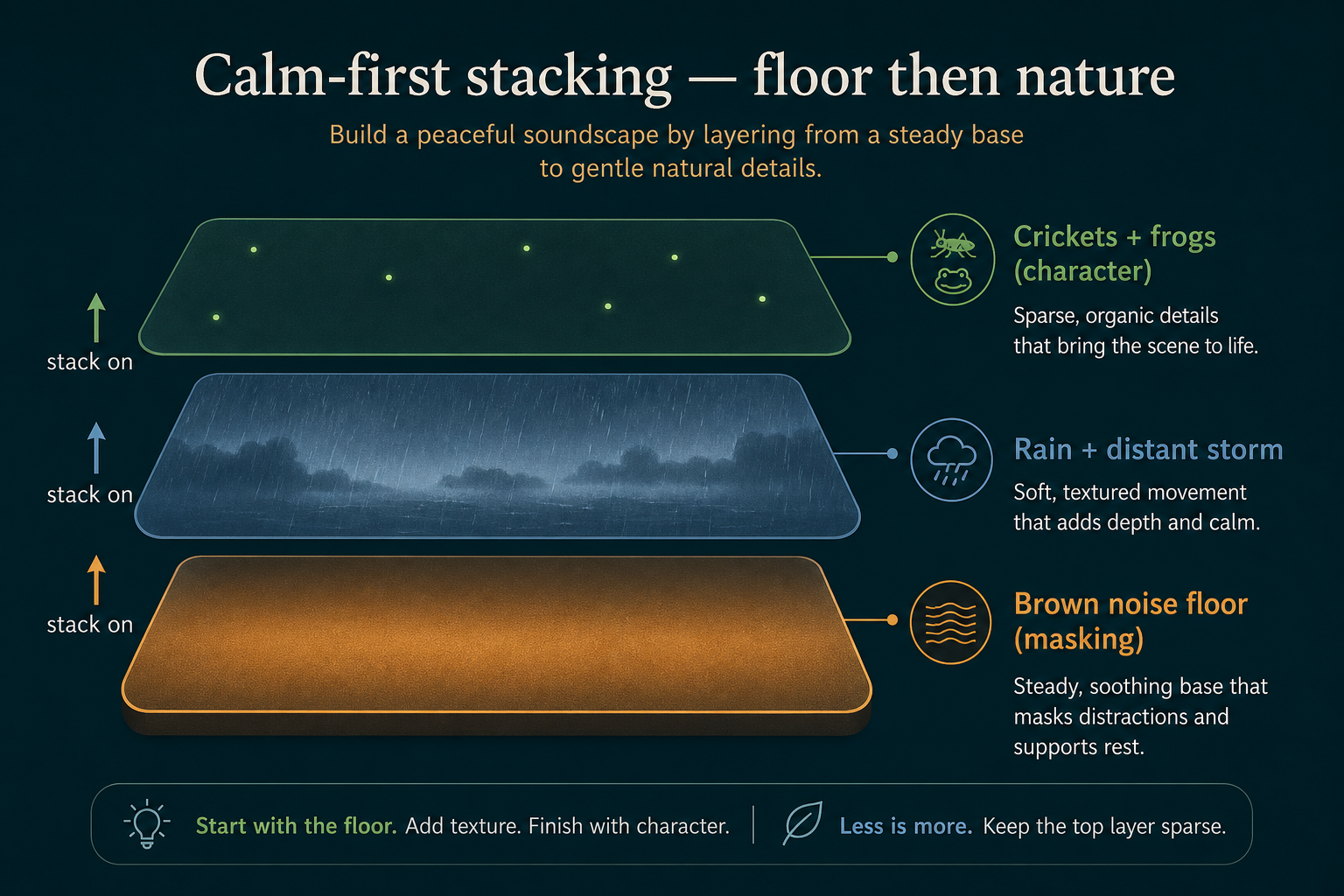
- Brown Noise tab: shape a warm floor, optionally Release as bubble so it becomes spatial.[14]
- Save gardens that still feel kind after an hour — public gardens should stay soft, not startling.[15]
Limits, safety, and honest uncertainty
We do not claim Sound Bubbles replaces clinical care, sleep medicine, occupational health programmes, or psychiatric treatment.[1][7] What the product does offer is a listening architecture that matches how hearing and attention actually work: layered sources, spatial distance, and slow change instead of one brittle loop.[18][19]
If sound worsens symptoms, stop. If you need medical advice, see a clinician. If you want a softer room, open a garden, place the bubbles kindly, and stay honest about what sound can — and cannot — do.[20][21]
How this article was researched
We combine first-hand experience placing and tuning Sound Bubbles gardens with citations from peer-reviewed journals, reviews, and institutional pages (including NIH/NCBI, sleep and hearing literature, acoustics, and attention research). Where evidence is mixed or early, we say so. On wellbeing topics we stay cautious: these are companion soundscapes, not cures.
References
Sources cited in this article. Prefer primary literature and institutional guidance; Sound Bubbles is not a medical device and these citations do not imply clinical endorsement.
- (2009). Habituation revisited. Neurobiology of Learning and Memory. doi:10.1016/j.nlm.2008.09.015
- (2009). Habituation: a history. Neurobiology of Learning and Memory.
- (1963). Perception and the conditioned reflex. Pergamon Press.
- (2010). The free-energy principle. Nature Reviews Neuroscience. doi:10.1038/nrn2787
- (2013). Whatever next? Predictive brains. Behavioral and Brain Sciences. doi:10.1017/S0140525X12000477
- (1990). Auditory Scene Analysis. MIT Press.
- (2012). An Introduction to the Psychology of Hearing. Brill.
- (2024). Colors of noise. Encyclopedic.
- (2013). Acoustical terminology (masking). ANSI.
- (2014). Auditory and non-auditory effects of noise on health. The Lancet. doi:10.1016/S0140-6736(13)61613-X
- (2021). World report on hearing. WHO.
- (2023). Noise and hearing loss prevention. CDC.
- (2005). White noise on sleep with ICU noise exposure. Sleep Medicine. doi:10.1016/j.sleep.2004.12.004
- (2001). Auditory distraction and short-term memory. Human Factors. doi:10.1518/001872001775992390
- (2010). Stress recovery with nature sound. IJERPH. doi:10.3390/ijerph7031036
- (2005). Speech intelligibility and work performance. Indoor Air. doi:10.1111/j.1600-0668.2005.00391.x