

Why sound matters in PTSD
Post-traumatic stress disorder involves hypervigilance — the threat-detection systems stay calibrated for danger long after the danger passed. LeDoux's emotional-brain framework showed how auditory cues can reach amygdala circuits fast, before conscious appraisal.[3] For some survivors, specific sounds (explosions, sirens, helicopters, shouting) reactivate trauma memories and autonomic surges.
Combat and blast exposure also correlate with auditory symptoms — tinnitus, hyperacusis, sound sensitivity — that overlap with PTSD in epidemiological work.[1][2] Rauschecker and colleagues discussed shared circuitry between tinnitus distress and trauma-related hypervigilance.[1] Sound is never "just background" when the nervous system has learned that background can kill.
When ambient sound might help — cautiously
Polyvagal-influenced frameworks describe how continuous low-threat signals can support parasympathetic leaning — not as cure, but as context.[4] Thoma's music-and-stress study measured lower cortisol and faster autonomic recovery with preferred calming music after stressors — individual preference mattered enormously.[5] Bradt's Cochrane work on music for PTSD shows mixed but promising evidence for anxiety reduction in structured interventions — not random playlists.[8]
Masking unpredictable environmental spikes (street bangs, hallway doors) with a gentle floor can shrink orienting frequency for some listeners.[7][15] The mechanism is contrast reduction, not trauma processing. Trauma processing requires clinical care.[6]
When ambient sound can harm
- Trigger overlap: thunder, fireworks-like crackle, military-adjacent rotors — pop immediately.
- Startle layers: sharp birds, loop seams, sudden volume jumps recruit orienting.[3][9]
- Loss of control: if you cannot mute instantly, the soundscape becomes another threat.
- Hyperacusis comorbidity: comfortable for others may be painful — see a audiologist.[7]
PTSD-aware garden principles
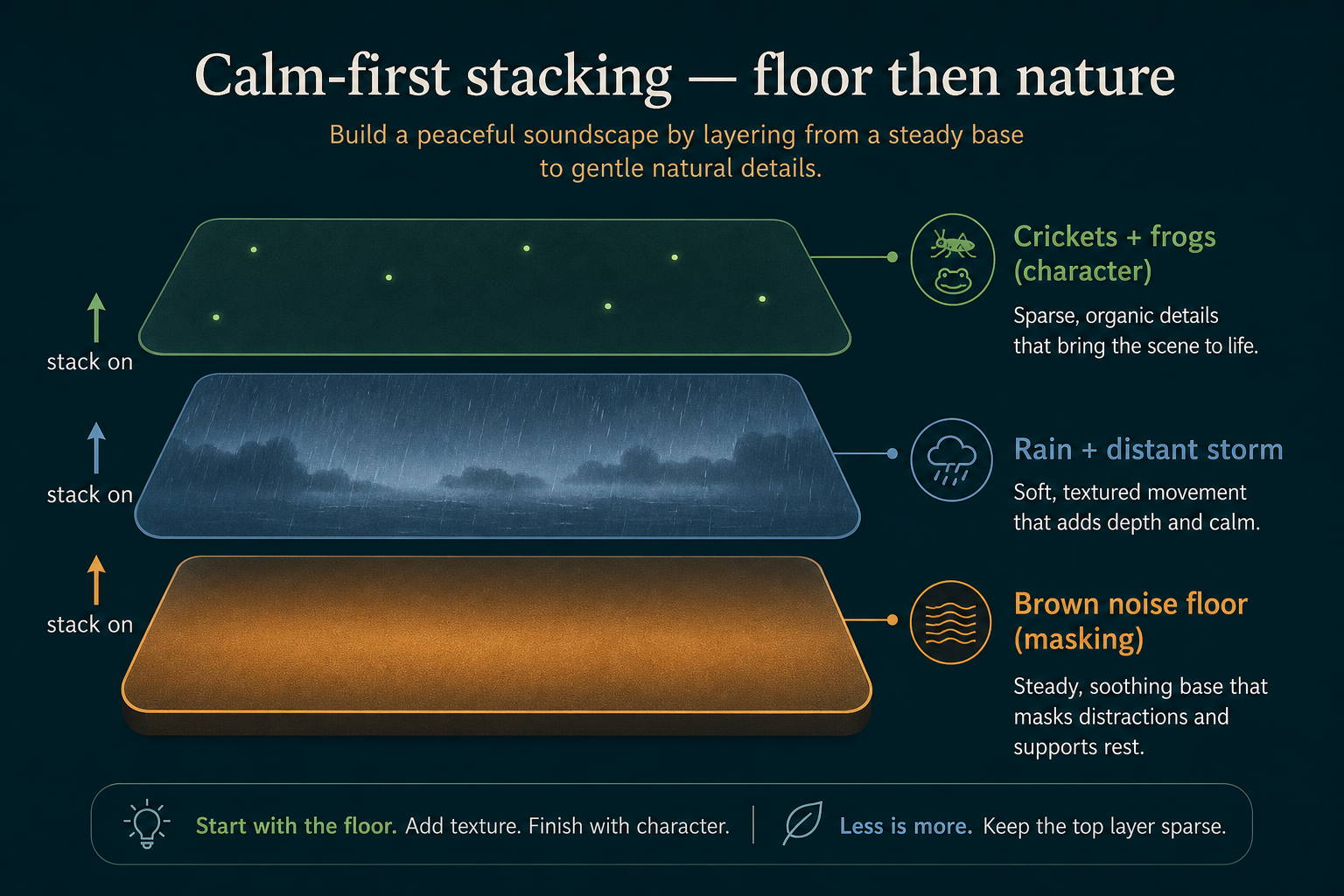
Start with ultra-soft brown floors, no wildlife surprises, TimeLine Chaos near zero. Build your own garden so every layer is accountable. Save multiple presets: "bare minimum," "slightly more mask." Never use sound to dissociate from symptoms that need clinician support.[6]
If a garden helped yesterday and hurts today, that is normal in PTSD — nervous systems shift. Mute without guilt. The VA and national PTSD centres emphasise evidence-based therapies (PE, CPT, EMDR); companion audio sits beside them, not instead.[6]
Working with clinicians and triggers lists
Many trauma therapists help patients build trigger inventories — sounds, smells, postures — before exposure work. If you use Sound Bubbles, share your garden recipe with your therapist: which layers helped waiting rooms, which caused startle. VA PTSD resources emphasise evidence-based trauma therapies first; environmental tweaks are scaffolding.[6] Never use headphones in situations requiring situational awareness unless your safety plan allows it.
Sleep and nightmare nights
Nightmares and startle awakenings complicate sleep sound — a bed that masked traffic at 10pm may feel trapping at 3am. Keep mute on nightstand; prefer presets without low-frequency rumble if rumble triggers blast memories. Stanchina-style masking logic still applies when spikes are the enemy, not the floor itself.[24]
Community and veteran resources
Veteran centres and trauma clinics increasingly acknowledge sensory triggers in daily life — acoustic environments are part of safety planning alongside exposure hierarchies. Share what spikes you (sirens, rotors, bangs) when building gardens; pop those layers permanently from PTSD presets. Recovery is nonlinear: a garden that worked in spring may fail in winter when windows stay closed and bass traps resonate. Mute is always valid.
Sound Bubbles tuning reference (worth learning once)
Master Volume sets the whole room. Start lower than you think — you can always raise one bubble instead of the entire garden.[20][21] Per-bubble Volume is how you balance layers without destroying dynamics: rain can stay audible while brown bed whispers.
Falloff is the secret weapon for speech and spike control. High falloff means only bubbles near the audible core sound "in your head"; everything else feels outside the window — exactly the intelligibility reduction office and sleep literature points toward.[15][25] If a layer feels too present, move it back before turning it up.
TimeLine adds slow environmental change so habituation does not turn your garden into wallpaper.[9][12] Pop anything that announces itself after ten minutes — a good garden should feel found, not performed.
Save & remix: when you find a mix that survives an hour, save it. Public medical and organism gardens are starting points; the best room is usually one you tuned for your desk, nursery, or bedside.
Why this supports Sound Bubbles — not just "any ambient app"
Most ambient apps deliver one file. The studies above rarely study "a loop." They study continuous floors against irregular noise, unintelligible speech against memory tasks, nature scenes against stress markers, spatial streams against glued mashups, and slow environmental change against habituation.[9][14][22][23][24]
Sound Bubbles maps onto those findings deliberately: brown/noise beds for masking floors, nature and library layers for restorative structure, distance/Falloff for speech intelligibility control, and TimeLine motion so the garden keeps the statistics of a place instead of the statistics of a four-minute loop.[12][15][16][25] That is the practical reason the product feels different after the first hour — and the scientific reason the difference matters.
How to apply this inside Sound Bubbles
- Open a related garden (or New Garden) and press Start playing so audio unlocks.[9]
- Expand Shape your soundscape → Sounds: set Master Volume, then Falloff while watching the audible-core guide.[10]
- Select a bubble; drag and scroll depth. Prefer raising one bubble's Volume over blasting the whole room.[11]
- Add library rain, nature, or noise layers; keep speech-like content distant — or remove it — when you need reading or coding focus.[12]
- TimeLine: choose Drift, Tide, or Orbit when you want the garden to keep evolving without grabbing attention.[13]
- Brown Noise tab: shape a warm floor, optionally Release as bubble so it becomes spatial.[14]
- Save gardens that still feel kind after an hour — public gardens should stay soft, not startling.[15]
Limits, safety, and honest uncertainty
We do not claim Sound Bubbles replaces clinical care, licensed therapy, or medical protocols.[16][17] What the product does offer is a listening architecture that matches how hearing and attention actually work: layered sources, spatial distance, and slow change instead of one brittle loop.[18][19]
If sound worsens symptoms, stop. If you need medical advice, see a clinician. If you want a softer room, open a garden, place the bubbles kindly, and stay honest about what sound can — and cannot — do.[20][21]
How this article was researched
We combine first-hand experience placing and tuning Sound Bubbles gardens with citations from peer-reviewed journals, reviews, and institutional pages (including NIH/NCBI, sleep and hearing literature, acoustics, and attention research). Where evidence is mixed or early, we say so. On wellbeing topics we stay cautious: these are companion soundscapes, not cures.
References
Sources cited in this article. Prefer primary literature and institutional guidance; Sound Bubbles is not a medical device and these citations do not imply clinical endorsement.
- (2010). Tinnitus and PTSD. Hearing Research.
- (2019). A prospective study of PTSD and hearing symptoms. Psychological Medicine.
- (1996). The Emotional Brain. Simon & Schuster.
- (2007). The polyvagal perspective. Biological Psychology.
- (2013). The effect of music on the human stress response. PLOS ONE. doi:10.1371/journal.pone.0070141
- (2024). PTSD and trauma resources. U.S. Department of Veterans Affairs.
- (2014). Auditory and non-auditory effects of noise on health. The Lancet.
- (2018). Music interventions for PTSD. Cochrane Database.
- (2009). Habituation revisited: an updated and revised description. Neurobiology of Learning and Memory. doi:10.1016/j.nlm.2008.09.015
- (2009). Habituation: a history. Neurobiology of Learning and Memory.
- (1990). Auditory Scene Analysis. MIT Press.
- (2010). The free-energy principle: a unified brain theory?. Nature Reviews Neuroscience. doi:10.1038/nrn2787
- (2010). Stress recovery during exposure to nature sound and environmental noise. IJERPH. doi:10.3390/ijerph7031036
- (2021). World report on hearing. WHO.
- (2021). World report on hearing. WHO.
- (2021). World report on hearing. WHO.
- (2021). World report on hearing. WHO.
- (2021). World report on hearing. WHO.
- (2021). World report on hearing. WHO.
- (2021). World report on hearing. WHO.
- (2021). World report on hearing. WHO.
- (2021). World report on hearing. WHO.
- (2021). World report on hearing. WHO.
- (2021). World report on hearing. WHO.
- (2021). World report on hearing. WHO.