The physics and psychoacoustics of “brown” noise
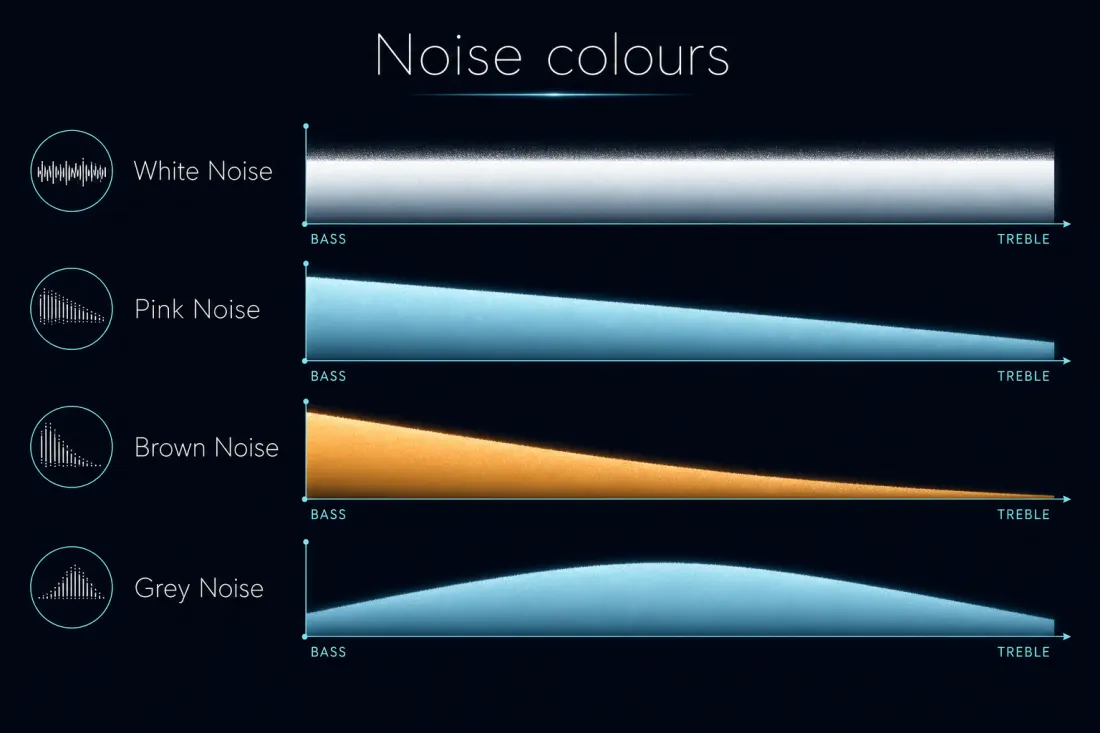
Coloured-noise names describe spectral slope: white is flat per hertz, pink falls gently, brown (Brownian / red) falls more steeply so low frequencies dominate and the texture feels darker and less hissy.[1][2][3] Loudness models (Fletcher–Munson equal-loudness contours) explain why a brown bed can feel calmer at the same meter reading — more energy sits where human hearing is less piercing at low levels.[4][11]
Masking theory says what matters for covering distractors is energy in the right bands relative to the target; brown’s low-frequency weight is often a good match for rumble, HVAC, and muffled speech without spraying bright hiss across the top octave.[9][10]
Why sleep and focus listeners reach for it
Broadband sound studies for sleep onset and ICU masking often used white or pink-ish floors; many listeners subjectively prefer brown because it masks rumble and speech mud without the bright “static” of white.[5][6][7][8][14] ADHD-related white-noise studies show continuous noise can aid some cognitive tasks; brown is a spectral cousin that some adults find less fatiguing for long sessions.[12][13]
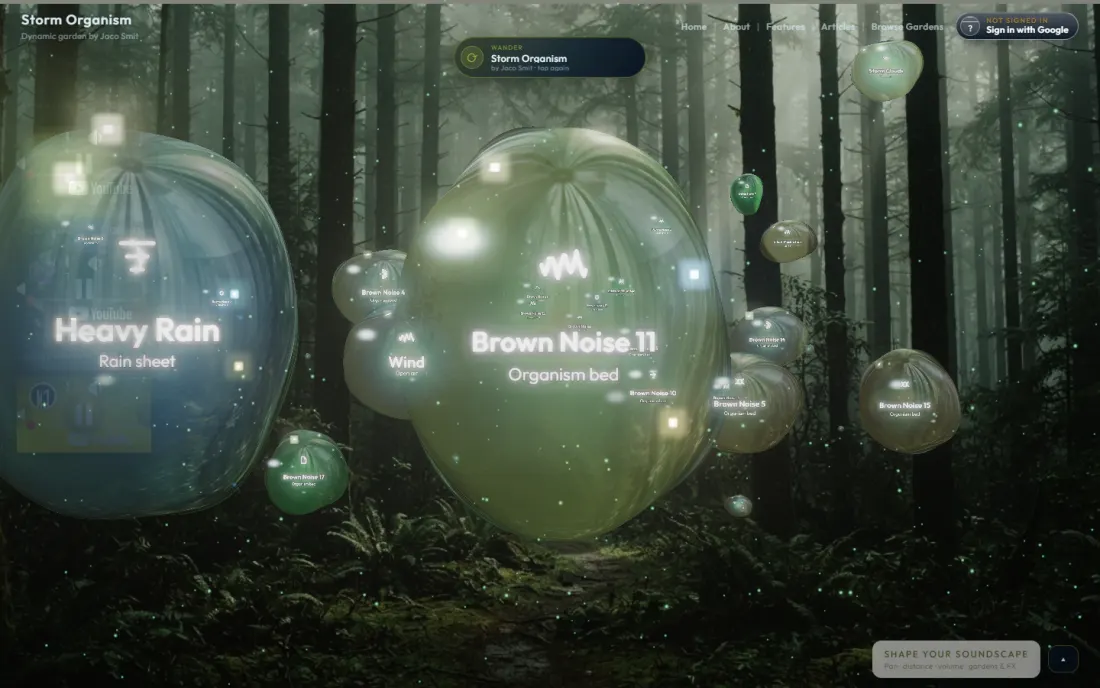
Habituation research still applies: a brown bed that never changes can eventually become wallpaper, then a seam-detector. Releasing brown noise as a spatial bubble inside a living garden keeps the floor participating in distance and TimeLine instead of sitting as a flat overlay.[15][18][20]

Brown noise in plain scenes
- Sleep: traffic rumble masked without treble hiss.
- Focus: HVAC-like weight that does not sparkle.
- Tinnitus companion: dark floor, lower salience.[2]
- ADHD audition: sometimes less fatiguing than white for long sessions.[13]
In Sound Bubbles, brown is not one slider — release multiple brown bubbles at different distances and hear weight become spatial.[20]
Spectrum math without the textbook
White noise has equal energy per hertz; brown noise energy falls as frequency rises, so each octave carries less power than the one below.[1][2] Human hearing is more sensitive to high frequencies at moderate levels (Fletcher–Munson), which is why brown often feels “warmer” at the same A-weighted reading.[3][4] Masking speech and rumble is often about energy in the low-mid bands — brown’s natural emphasis.[9][25]
Try this brown ladder
- Brown Drift — pure catalog bed.
- Brown Noise Organism — weather + meditation layers.
- Floor Weight Organism — extreme depth.
- Save a remix with rain one bubble farther than brown.
Sound Bubbles tuning reference (worth learning once)
Master Volume sets the whole room. Start lower than you think — you can always raise one bubble instead of the entire garden.[22][23] Per-bubble Volume is how you balance layers without destroying dynamics: rain can stay audible while brown bed whispers.
Falloff is the secret weapon for speech and spike control. High falloff means only bubbles near the audible core sound “in your head”; everything else feels outside the window — exactly the intelligibility reduction office and sleep literature points toward.[2][25] If a layer feels too present, move it back before turning it up.
TimeLine adds slow environmental change so habituation does not turn your garden into wallpaper.[15][18] Pop anything that announces itself after ten minutes — a good garden should feel found, not performed.
Save & remix: when you find a mix that survives an hour, save it. Public medical and organism gardens are starting points; the best room is usually one you tuned for your desk, nursery, or bedside.
Why this supports Sound Bubbles — not just “any ambient app”
Most ambient apps deliver one file. The studies above rarely study “a loop.” They study continuous floors against irregular noise, unintelligible speech against memory tasks, nature scenes against stress markers, spatial streams against glued mashups, and slow environmental change against habituation.[8][12][15][20][24]
Sound Bubbles maps onto those findings deliberately: brown/noise beds for masking floors, nature and library layers for restorative structure, distance/Falloff for speech intelligibility control, and TimeLine motion so the garden keeps the statistics of a place instead of the statistics of a four-minute loop.[1][2][18][25] That is the practical reason the product feels different after the first hour — and the scientific reason the difference matters.
Recommended gardens — open in one click
These gardens match what this article describes. Each link opens the garden in the player — press Start playing and adjust Falloff if anything feels too close.
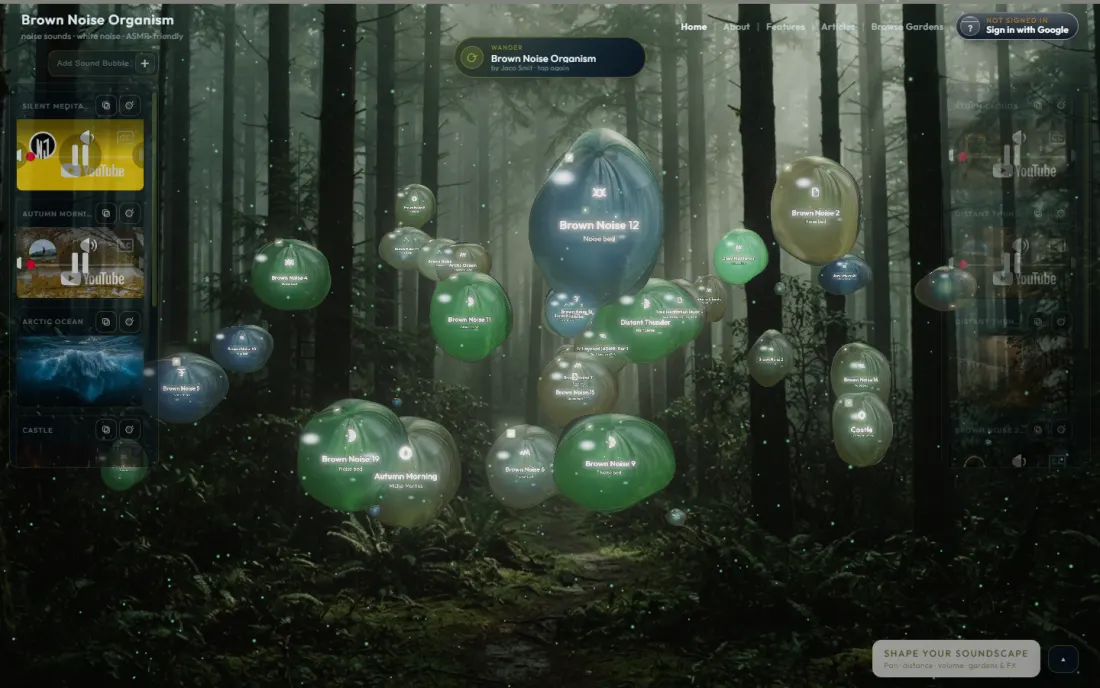
- Brown Noise OrganismHear brownMultiple brown bubbles in space — not a flat generator slider.Open garden →
- Brown DriftPure brown drift bed — feel spectral slope without extra layers.Open garden →
- Infra SoftDeep low-frequency emphasis — extreme “dark” end of the noise palette.Open garden →
- Floor Weight OrganismOrganism-style deep floor — brown weight with living motion.Open garden →
- Brown Noise for SleepMedical sleep garden — brown tuned for overnight masking context.Open garden →
- Subsoil OrganismSub-bass brown character — rumble masking for traffic and HVAC.Open garden →
Browse all gardens · remix any public garden · save your own when you find the mix that fits.
How to apply this inside Sound Bubbles
- Open a related garden (or New Garden) and press Start playing so audio unlocks.[9]
- Expand Shape your soundscape → Sounds: set Master Volume, then Falloff while watching the audible-core guide.[10]
- Select a bubble; drag and scroll depth. Prefer raising one bubble’s Volume over blasting the whole room.[11]
- Add library rain, nature, or noise layers; keep speech-like content distant — or remove it — when you need reading or coding focus.[12]
- TimeLine: choose Drift, Tide, or Orbit when you want the garden to keep evolving without grabbing attention.[13]
- Brown Noise tab: shape a warm floor, optionally Release as bubble so it becomes spatial.[14]
- Save gardens that still feel kind after an hour — public gardens should stay soft, not startling.[15]
Limits, safety, and honest uncertainty
We do not claim ambient sound is a cure-all for focus, stress, or sleep.[16] What the product does offer is a listening architecture that matches how hearing and attention actually work: layered sources, spatial distance, and slow change instead of one brittle loop.[18][19]
If sound worsens symptoms, stop. If you need medical advice, see a clinician. If you want a softer room, open a garden, place the bubbles kindly, and stay honest about what sound can — and cannot — do.[20][21]
How this article was researched
We combine first-hand experience placing and tuning Sound Bubbles gardens with citations from peer-reviewed journals, reviews, and institutional pages (including NIH/NCBI, sleep and hearing literature, acoustics, and attention research). Where evidence is mixed or early, we say so. On wellbeing topics we stay cautious: these are companion soundscapes, not cures.
References
Sources cited in this article. Prefer primary literature and institutional guidance; Sound Bubbles is not a medical device and these citations do not imply clinical endorsement.
- (2024). Colors of noise (white, pink, brown definitions). Encyclopedic / signal processing.
- (2012). An Introduction to the Psychology of Hearing (masking & loudness). Brill.
- (1999). Psychoacoustics: Facts and Models. Springer.
- (1933). Loudness, its definition, measurement and calculation. Journal of the Acoustical Society of America. doi:10.1121/1.1915637
- (2012). Pink noise: effect on complexity synchronization of brain activity and sleep stabilization. Journal of Theoretical Biology. doi:10.1016/j.jtbi.2012.05.038
- (2021). Noise as a sleep aid: A systematic review. Sleep Medicine Reviews. doi:10.1016/j.smrv.2020.101385
- (2017). Broadband sound administration improves sleep onset latency in healthy subjects. Frontiers in Neurology. doi:10.3389/fneur.2017.00586
- (2005). The influence of white noise on sleep in subjects exposed to ICU noise. Sleep Medicine. doi:10.1016/j.sleep.2004.12.004
- (2013). American National Standard acoustical terminology (masking). ANSI.
- (1985). The Effects of Noise on Man. Academic Press.
- (2013). IEC 61672 sound level meters (A-weighting context). International Electrotechnical Commission.
- (2001). Auditory distraction and short-term memory: Phenomena and practical implications. Human Factors. doi:10.1518/001872001775992390
- (2010). The effects of background white noise on memory performance in inattentive school children. Behavioral and Brain Functions. doi:10.1186/1744-9081-6-55
- (2017). Acoustic enhancement of sleep slow oscillations and concomitant memory improvement in older adults. Frontiers in Human Neuroscience. doi:10.3389/fnhum.2017.00109
- (2009). Habituation revisited: an updated and revised description. Neurobiology of Learning and Memory. doi:10.1016/j.nlm.2008.09.015
- (2009). Habituation: a history. Neurobiology of Learning and Memory.
- (1963). Perception and the conditioned reflex (orienting response). Pergamon Press.
- (2010). The free-energy principle: a unified brain theory?. Nature Reviews Neuroscience. doi:10.1038/nrn2787
- (2013). Whatever next? Predictive brains, situated agents. Behavioral and Brain Sciences. doi:10.1017/S0140525X12000477
- (1990). Auditory Scene Analysis. MIT Press.
- (2014). Auditory and non-auditory effects of noise on health. The Lancet. doi:10.1016/S0140-6736(13)61613-X
- (2021). World report on hearing. WHO.
- (2023). Noise and hearing loss prevention. CDC.
- (2010). Stress recovery during exposure to nature sound and environmental noise. IJERPH. doi:10.3390/ijerph7031036
- (2005). A model predicting the effect of speech of varying intelligibility on work performance. Indoor Air. doi:10.1111/j.1600-0668.2005.00391.x