
Why podcasts destroy drafting
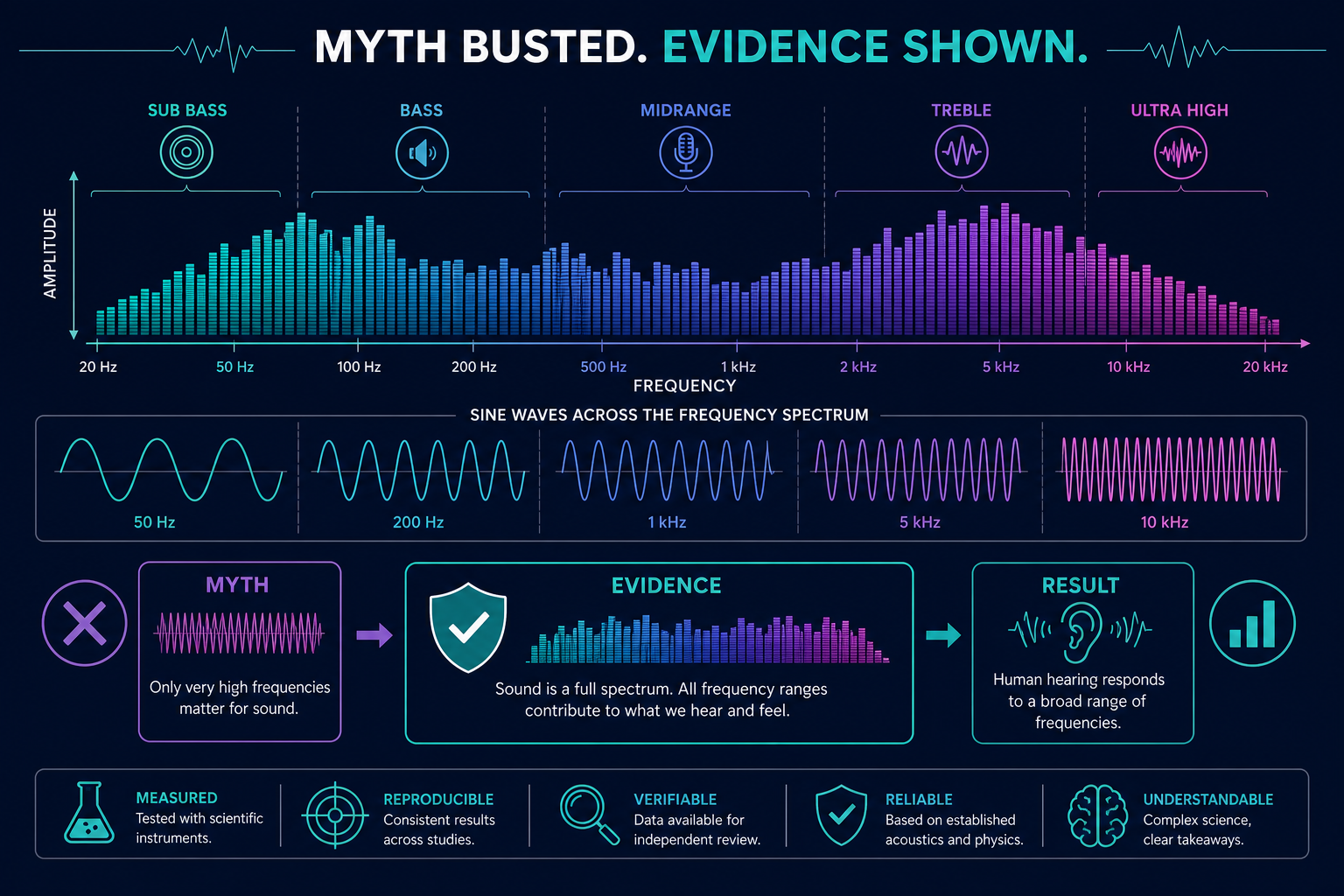
Serial recall tasks degrade with intelligible speech even when participants ignore it — the effect is automatic, not effortful.[1][2] Fiction and argumentative prose both require subvocal rehearsal: you "hear" the line before committing. Competing real voices or lyric music colonise the same loop. Hongisto's office models predict steep performance loss when speech is clear.[5] Marsh shows deviant sounds in a stream capture attention — plot-twist podcast moments are worst-case.[7]
When moderate noise helps first drafts
Mehta found moderate ambient noise aided creative association — useful for brainstorming chapter arcs, generating metaphors, or breaking perfectionism on zero drafts.[3] Switch gardens when transitioning from generative to revising: analytical editing needs quieter beds. Szalma's meta-analysis confirms task dependency — creativity tolerates noise editing does not.[6]
Nature sound and stress before sessions
Bradt's music meta-analysis shows stress reduction with chosen calming audio — relevant for writers carrying deadline cortisol.[8] Alvarsson measured faster autonomic recovery after stress with nature sounds versus city noise — five-minute pre-writing garden may lower avoidance without touching the manuscript loop.[4]
Phase-based sound recipe
Zero draft / freewrite: moderate café or rain + brown bed; no lyrics.[3][15]
Structural edit: lower volume; remove all speech; prefer brown or library HVAC.[1][5]
Line edit / poetry: near-silence or very distant rain — phonological precision maximised.[2]
Submission anxiety: brief nature garden, then off during final proof — error detection needs full loop capacity.[4]
Spatial audio for long sessions
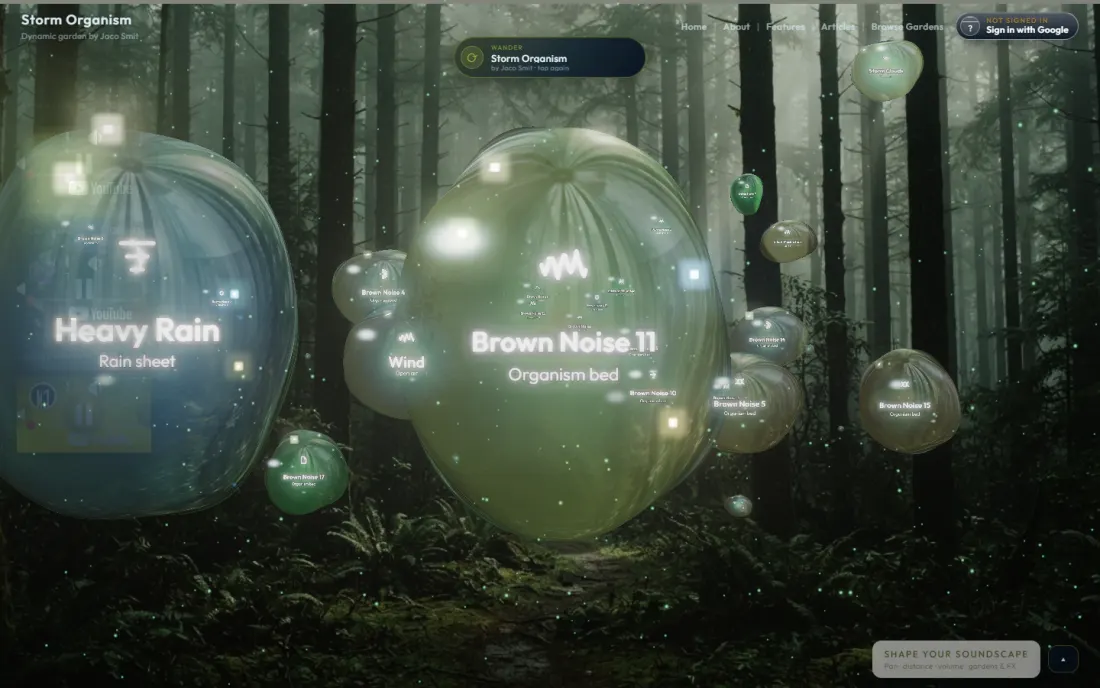
Bregman's scene analysis: separate bubbles for rain "outside" and typewriter "desk" maintain place illusion without glued stereo mush.[14] TimeLine drift prevents seam detection that pulls you out of narrative trance.[9][13] Habituation to static loops makes writers crank volume — bad for ears and worse for distraction.[21]
Common writer mistakes
- Audiobooks while drafting dialogue — doubles speech load.[2]
- Same playlist for ten years — habituation then volume creep.[9]
- Instrumental music with unpredictable vocals — deviance captures.[7]
Genre and medium differences
Poetry and literary fiction lean harder on phonological loop fidelity than technical documentation — line-level sound sensitivity rises with prosodic demands.[2] Screenwriters juggling dialogue may tolerate distant café murmur when drafting scene description but need silence for punch-up passes where every syllable counts. Non-fiction researchers synthesising sources face serial memory load similar to coding — treat citations like variables: no podcasts.[1][4] Translation work doubles linguistic competition; target-language speech in background is catastrophic even when source drafting tolerated moderate noise.[2]
Deadlines, RSI breaks, and session pacing
Longform projects benefit from Pomodoro-aligned garden changes: creative blocks with moderate noise, editing blocks quiet.[6] Hand and wrist breaks in silence reset both proprioception and phonological loop — avoid filling every break with new audio input.[9]
Voice dictation and accessibility tools
Writers using speech-to-text must silence all other speech layers — the recognition engine competes with café murmur and podcast leakage.[2][5] Screen-reader users face triple load when ambient apps add unrelated verbal content; prefer non-speech beds exclusively.[23]
Editing passes and read-aloud workflows
Reading work aloud during line edits occupies the phonological loop entirely — any background speech causes missed repeated words and homophone slips. Schedule read-aloud passes in silence; return to generative gardens only after structural lock.[1][2] Beta readers and critique partners provide human speech input sufficient without additive podcasts.[4]
Companion listening in Sound Bubbles
Research above concerns clinical and laboratory sound — not a playlist guarantee. Sound Bubbles offers adjustable living gardens: spatial layers, coloured noise beds, Medical & Wellbeing rooms, and easy mute. Use recommended gardens as environmental support alongside medical care when appropriate.[20]
Not treatment. See clinicians for diagnosis, medication, CBT, neurologic music therapy, or tinnitus programmes. Keep volume comfortable; stop if symptoms worsen.
Why this supports Sound Bubbles — not just "any ambient app"
Most ambient apps deliver one file. The studies above rarely study "a loop." They study continuous floors against irregular noise, unintelligible speech against memory tasks, nature scenes against stress markers, spatial streams against glued mashups, and slow environmental change against habituation.[9][14][22][23][24]
Sound Bubbles maps onto those findings deliberately: brown/noise beds for masking floors, nature and library layers for restorative structure, distance/Falloff for speech intelligibility control, and TimeLine motion so the garden keeps the statistics of a place instead of the statistics of a four-minute loop.[12][15][16][25] That is the practical reason the product feels different after the first hour — and the scientific reason the difference matters.
How to apply this inside Sound Bubbles
- Open a related garden (or New Garden) and press Start playing so audio unlocks.[9]
- Expand Shape your soundscape → Sounds: set Master Volume, then Falloff while watching the audible-core guide.[10]
- Select a bubble; drag and scroll depth. Prefer raising one bubble's Volume over blasting the whole room.[11]
- Add library rain, nature, or noise layers; keep speech-like content distant — or remove it — when you need reading or coding focus.[12]
- TimeLine: choose Drift, Tide, or Orbit when you want the garden to keep evolving without grabbing attention.[13]
- Brown Noise tab: shape a warm floor, optionally Release as bubble so it becomes spatial.[14]
- Save gardens that still feel kind after an hour — public gardens should stay soft, not startling.[15]
Limits, safety, and honest uncertainty
We do not claim Sound Bubbles replaces clinical care, sleep medicine, occupational health programmes, or psychiatric treatment.[1][7] What the product does offer is a listening architecture that matches how hearing and attention actually work: layered sources, spatial distance, and slow change instead of one brittle loop.[18][19]
If sound worsens symptoms, stop. If you need medical advice, see a clinician. If you want a softer room, open a garden, place the bubbles kindly, and stay honest about what sound can — and cannot — do.[20][21]
How this article was researched
We combine first-hand experience placing and tuning Sound Bubbles gardens with citations from peer-reviewed journals, reviews, and institutional pages (including NIH/NCBI, sleep and hearing literature, acoustics, and attention research). Where evidence is mixed or early, we say so. On wellbeing topics we stay cautious: these are companion soundscapes, not cures.
References
Sources cited in this article. Prefer primary literature and institutional guidance; Sound Bubbles is not a medical device and these citations do not imply clinical endorsement.
- (2001). Auditory distraction and short-term memory. Human Factors. doi:10.1518/001872001775992390
- (1993). Irrelevant speech effect. J Exp Psychol LMC. doi:10.1037/0278-7393.19.2.369
- (2012). Ambient noise and creative cognition. Journal of Consumer Research. doi:10.1086/665048
- (2010). Nature sound stress recovery. IJERPH. doi:10.3390/ijerph7031036
- (2005). Speech and work performance. Indoor Air. doi:10.1111/j.1600-0668.2005.00391.x
- (2011). Noise and performance meta-analysis. Psychological Bulletin. doi:10.1037/a0023987
- (2009). Auditory distraction by deviance. J Exp Psychol.
- (2013). Music for stress reduction meta-analysis. Health Psychology Review. doi:10.1080/17437199.2013.802137
- (2009). Habituation revisited. Neurobiology of Learning and Memory. doi:10.1016/j.nlm.2008.09.015
- (2009). Habituation: a history. Neurobiology of Learning and Memory.
- (1963). Perception and the conditioned reflex. Pergamon Press.
- (2010). The free-energy principle. Nature Reviews Neuroscience. doi:10.1038/nrn2787
- (2013). Whatever next? Predictive brains. Behavioral and Brain Sciences. doi:10.1017/S0140525X12000477
- (1990). Auditory Scene Analysis. MIT Press.
- (2012). An Introduction to the Psychology of Hearing. Brill.
- (2024). Colors of noise. Encyclopedic.
- (2013). Acoustical terminology (masking). ANSI.
- (2014). Auditory and non-auditory effects of noise on health. The Lancet. doi:10.1016/S0140-6736(13)61613-X
- (2021). World report on hearing. WHO.
- (2023). Noise and hearing loss prevention. CDC.
- (2005). White noise on sleep with ICU noise exposure. Sleep Medicine. doi:10.1016/j.sleep.2004.12.004
- (2001). Auditory distraction and short-term memory. Human Factors. doi:10.1518/001872001775992390
- (2010). Stress recovery with nature sound. IJERPH. doi:10.3390/ijerph7031036
- (2005). Speech intelligibility and work performance. Indoor Air. doi:10.1111/j.1600-0668.2005.00391.x