
Campus noise is not neutral
Klatte synthesised field and lab evidence: aircraft and classroom babble delay language processing and raise stress markers in children — effects plausibly extend to university readers under similar SPL.[1] Banbury's irrelevant speech effect explains why roommate FaceTime destroys textbook retention.[4] Masking is damage control, not permission for 24/7 noise exposure — Basner's dose concept still applies in dorms.[19]
ADHD and the optimal arousal band
Söderlund's stochastic resonance hypothesis: moderate white noise adds neural noise that helps inattentive profiles reach functional alertness.[3][5] Helps replicated differential effects across attention tiers.[6] Baijot found neurophysiological benefits in ADHD children with white noise — not a licence for max volume; effect sizes modest.[7] Neurotypical high performers may study best quieter — experiment honestly.
Subject-specific listening
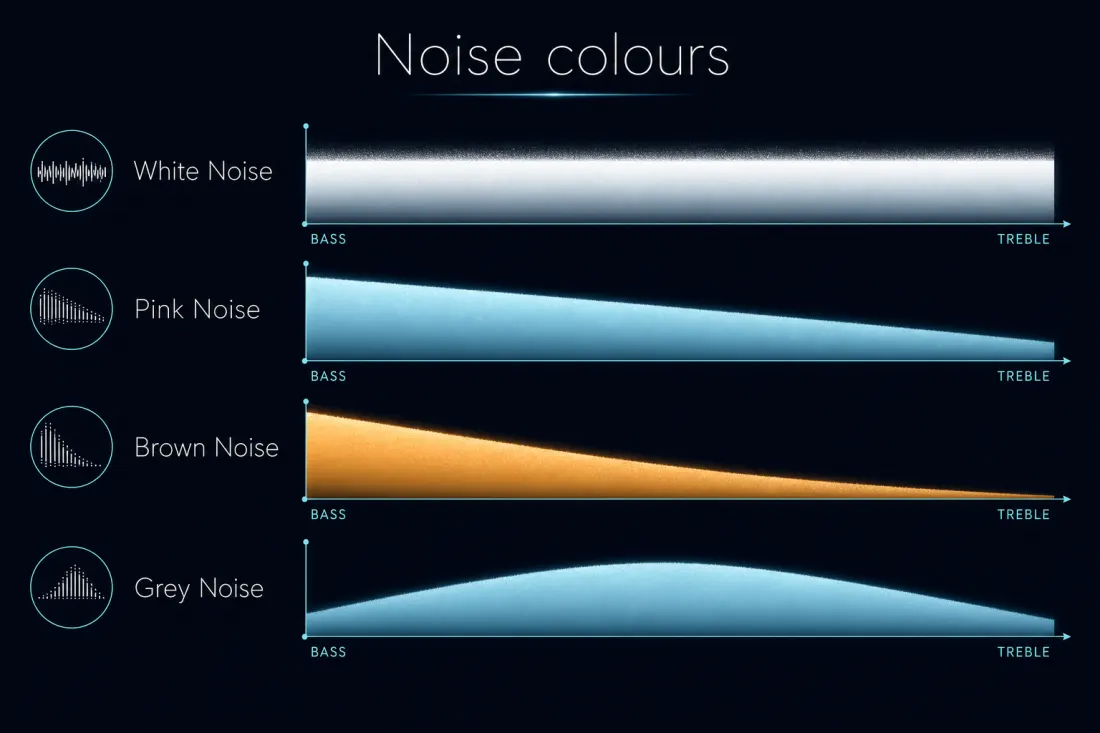
STEM problem sets: low speech, brown or library bed; music with lyrics fails serial math.[4]
Humanities reading: same — phonological loop conflict.[2]
Brainstorming essays: moderate café per Mehta — see sound-for-writers.[3]
Language vocabulary: target language audio is study material, not mask — do not double with café speech.
Sleep before 8am seminars
Riedy's review supports masking for noisy dorms at night — separate sleep garden from study garden to avoid CBT-I-style bed-work association.[8] Use rain or pink at lower volume overnight; different scene for desk work builds context cue.
Dorm etiquette and headphones
Open speakers bleed to roommates — headphones with spatial gardens reduce social friction. WHO hearing report reminds young adults that recreational noise contributes to lifelong threshold shift.[20] Keep comfortable level; if tinnitus appears, stop and audiology referral.
Study session structure
- 25-minute focused block with appropriate garden.[5]
- 5-minute silent or nature break — Alvarsson recovery logic.[24]
- Log what worked; attention profile changes with sleep debt.[2]
- Exam week: prioritise sleep garden over heroic all-nighter noise.[8]
Library versus dorm: context switching
Libraries provide social quiet norms; dorms lack them. Headphones signal do-not-disturb better than posters alone.[1] When relocating from library to dorm, rebuild garden rather than copying identical SPL — room acoustics differ. Klatte's classroom findings imply reverberant dorm cinderblock exaggerates masking needs versus carpeted study hall.[1]
Group projects and accountability
Shared study sessions need speech intelligibility — mute personal gardens during verbal problem-solving.[4] Solo review immediately after group work may need five-minute silence to flush phonological loop before flashcards.[2]
Attention profiles across the semester
End-of-term fatigue lowers working-memory capacity — gardens that worked in week three may feel overwhelming in week twelve. Re-tune downward rather than pushing through.[5][6] Summer break resets habituation; re-test Söderlund-style noise benefit each term rather than assuming last year's preset still fits.[3]
Online versus in-person courses
Remote lectures introduce home distraction — gardens mask dishwasher cycles but not professor speech when live; mute during instruction, restore during problem sets.[1][4] Recorded async courses blur boundaries; use separate garden presets for watch versus practice phases to preserve stimulus control.[8]
Research labs and STEM bench work
Lab students splitting time between bench protocols and literature review need zero garden during calculation steps — serial memory again. Return to low brown noise only during repetitive data entry where arousal support helps without semantic load.[4][5] Thesis writers approaching defence should mirror sound-for-writers phase rules — committee questions punish sloppy phonological loop management.[4] Language learners drilling conjugation tables need the same quiet as STEM — grammar is serial verbal memory.[2]
Commute and mobile studying
Transit noise varies by route — download offline garden presets for underground segments where streaming fails. Keep volume below WHO recreational guidance when using open-back headphones in public.[20] Never study critical material during stops and announcements — deviance capture peaks when conductor speech interrupts.[11] Flashcards on noisy buses work only with silent visual review, not verbal rehearsal.[2]
Companion listening in Sound Bubbles
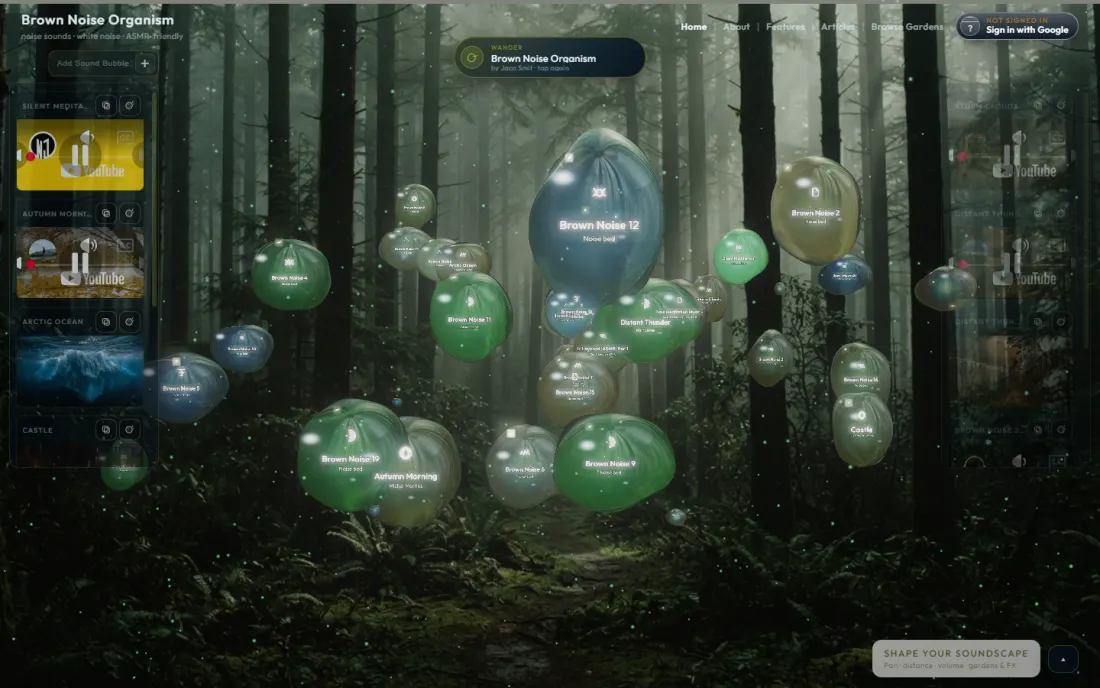
Research above concerns clinical and laboratory sound — not a playlist guarantee. Sound Bubbles offers adjustable living gardens: spatial layers, coloured noise beds, Medical & Wellbeing rooms, and easy mute. Use recommended gardens as environmental support alongside medical care when appropriate.[20]
Not treatment. See clinicians for diagnosis, medication, CBT, neurologic music therapy, or tinnitus programmes. Keep volume comfortable; stop if symptoms worsen.
Why this supports Sound Bubbles — not just "any ambient app"
Most ambient apps deliver one file. The studies above rarely study "a loop." They study continuous floors against irregular noise, unintelligible speech against memory tasks, nature scenes against stress markers, spatial streams against glued mashups, and slow environmental change against habituation.[9][14][22][23][24]
Sound Bubbles maps onto those findings deliberately: brown/noise beds for masking floors, nature and library layers for restorative structure, distance/Falloff for speech intelligibility control, and TimeLine motion so the garden keeps the statistics of a place instead of the statistics of a four-minute loop.[12][15][16][25] That is the practical reason the product feels different after the first hour — and the scientific reason the difference matters.
How to apply this inside Sound Bubbles
- Open a related garden (or New Garden) and press Start playing so audio unlocks.[9]
- Expand Shape your soundscape → Sounds: set Master Volume, then Falloff while watching the audible-core guide.[10]
- Select a bubble; drag and scroll depth. Prefer raising one bubble's Volume over blasting the whole room.[11]
- Add library rain, nature, or noise layers; keep speech-like content distant — or remove it — when you need reading or coding focus.[12]
- TimeLine: choose Drift, Tide, or Orbit when you want the garden to keep evolving without grabbing attention.[13]
- Brown Noise tab: shape a warm floor, optionally Release as bubble so it becomes spatial.[14]
- Save gardens that still feel kind after an hour — public gardens should stay soft, not startling.[15]
Limits, safety, and honest uncertainty
We do not claim Sound Bubbles replaces clinical care, sleep medicine, occupational health programmes, or psychiatric treatment.[1][7] What the product does offer is a listening architecture that matches how hearing and attention actually work: layered sources, spatial distance, and slow change instead of one brittle loop.[18][19]
If sound worsens symptoms, stop. If you need medical advice, see a clinician. If you want a softer room, open a garden, place the bubbles kindly, and stay honest about what sound can — and cannot — do.[20][21]
How this article was researched
We combine first-hand experience placing and tuning Sound Bubbles gardens with citations from peer-reviewed journals, reviews, and institutional pages (including NIH/NCBI, sleep and hearing literature, acoustics, and attention research). Where evidence is mixed or early, we say so. On wellbeing topics we stay cautious: these are companion soundscapes, not cures.
References
Sources cited in this article. Prefer primary literature and institutional guidance; Sound Bubbles is not a medical device and these citations do not imply clinical endorsement.
- (2013). Effects of classroom noise on children. Frontiers in Psychology. doi:10.3389/fpsyg.2013.00578
- (2010). White noise and inattentive children memory. Behavioral and Brain Functions. doi:10.1186/1744-9081-6-55
- (2007). Noise beneficial for ADHD cognition. J Child Psychol Psychiatry. doi:10.1111/j.1469-7610.2007.01749.x
- (2001). Auditory distraction and memory. Human Factors. doi:10.1518/001872001775992390
- (2011). Noise meta-analysis. Psychological Bulletin. doi:10.1037/a0023987
- (2014). White noise across attention profiles. PLOS ONE. doi:10.1371/journal.pone.0112768
- (2016). White noise in children with ADHD. Behavioral and Brain Functions. doi:10.1186/s12993-016-0095-y
- (2021). Noise as sleep aid. Sleep Medicine Reviews. doi:10.1016/j.smrv.2020.101385
- (2009). Habituation revisited. Neurobiology of Learning and Memory. doi:10.1016/j.nlm.2008.09.015
- (2009). Habituation: a history. Neurobiology of Learning and Memory.
- (1963). Perception and the conditioned reflex. Pergamon Press.
- (2010). The free-energy principle. Nature Reviews Neuroscience. doi:10.1038/nrn2787
- (2013). Whatever next? Predictive brains. Behavioral and Brain Sciences. doi:10.1017/S0140525X12000477
- (1990). Auditory Scene Analysis. MIT Press.
- (2012). An Introduction to the Psychology of Hearing. Brill.
- (2024). Colors of noise. Encyclopedic.
- (2013). Acoustical terminology (masking). ANSI.
- (2014). Auditory and non-auditory effects of noise on health. The Lancet. doi:10.1016/S0140-6736(13)61613-X
- (2021). World report on hearing. WHO.
- (2023). Noise and hearing loss prevention. CDC.
- (2005). White noise on sleep with ICU noise exposure. Sleep Medicine. doi:10.1016/j.sleep.2004.12.004
- (2001). Auditory distraction and short-term memory. Human Factors. doi:10.1518/001872001775992390
- (2010). Stress recovery with nature sound. IJERPH. doi:10.3390/ijerph7031036
- (2005). Speech intelligibility and work performance. Indoor Air. doi:10.1111/j.1600-0668.2005.00391.x