
Divergent vs convergent design phases
Mehta showed ~70 dB ambient noise improved creative association — relevant when brainstorming brand directions or rough compositing.[1] Convergent tasks — grid snapping, token naming in Figma, writing microcopy — rely on verbal working memory; Hongisto predicts intelligible speech hurts.[5] Szalma confirms task-noise fit matters more than universal rules.[8] Switch gardens when switching modes, not once per project.
Visual fatigue and auditory restoration
Ulrich's restorative environments research began with visual nature; Alvarsson extended recovery to nature sound — skin conductance and heart rate improved after stressor exposure.[2][7] Designers staring at screens accumulate sympathetic load; five-minute green or water garden between crits may reset autonomic baseline faster than scrolling Twitter.
Jahncke measured slower psychological restoration after open-plan noise exposure — studio chatter without masking extends recovery time between intense visual tasks.[3]
Music, rhythm, and flow
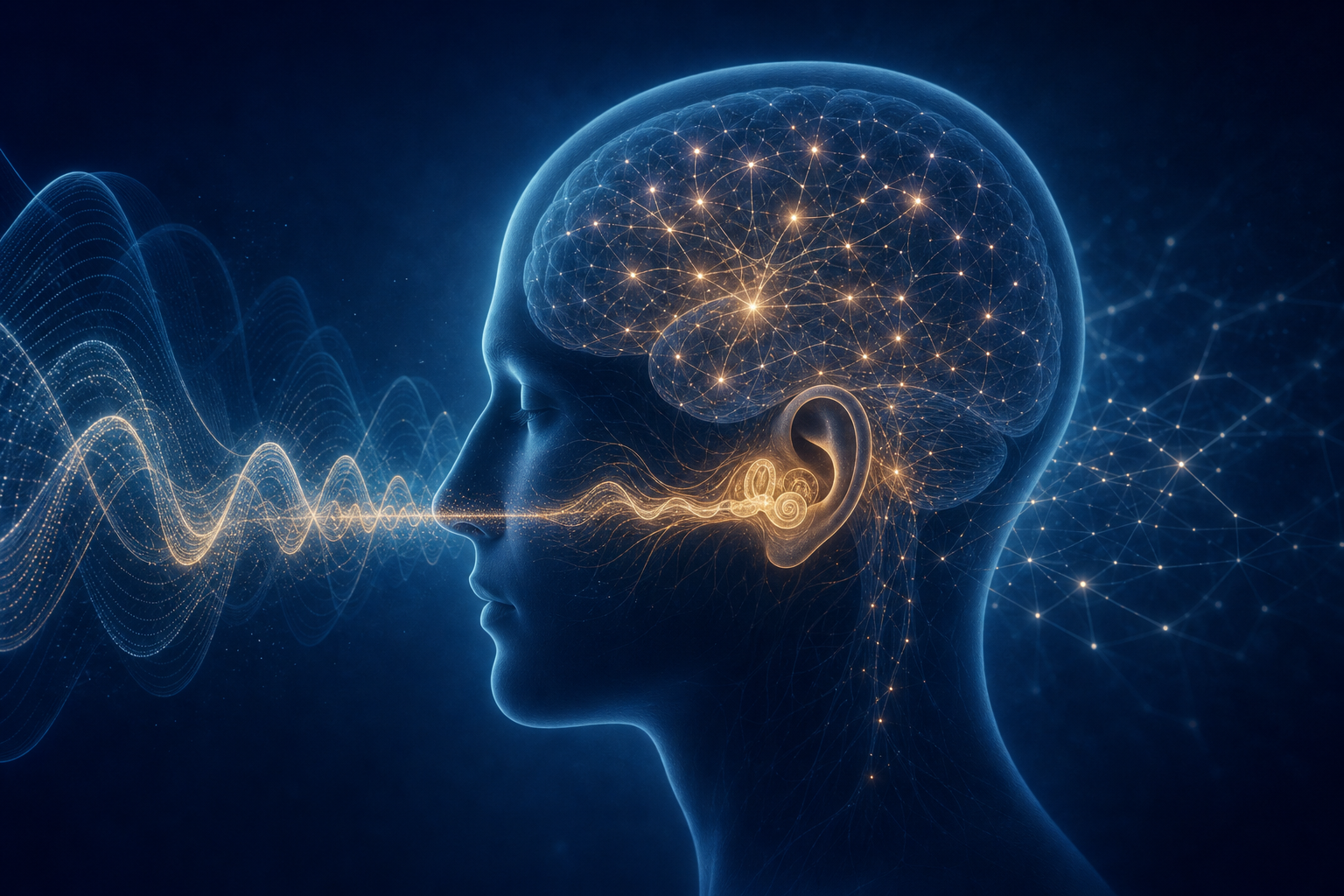
Bradt's meta-analysis supports chosen music for anxiety reduction — useful before presentations.[6] Instrumental music with sudden vocals triggers deviance capture per Marsh-style findings applied to design trance. Prefer stable spectra or spatial nature over dramatic dynamic range during layout work.
Client calls and hybrid days
During video critique, mute gardens — mic bleed destroys professionalism. After calls, rebuild mask quickly for maker time. Pair programming with developers? Same rule as engineers: speech intelligibility beats masking.[5]
Spatial design parallels
Designers intuit Falloff: foreground hero, background blur. Sound Bubbles applies same hierarchy — character bubbles forward, floor beds back.[14] Scene coherence reduces cognitive dissonance when visual and auditory spaces match.
Accessibility, migraine, and motion sensitivity
Visual designers with migraine or photosensitivity often report parallel auditory sensitivity — sharp transients trigger episodes alongside screen glare. Keep Chaos low on TimeLine; favour brown beds over clinking café layers during post-aura return-to-work.[9][19] Motion-heavy UI animation plus drifting audio may overload vestibular-sensitive individuals — simplify one channel when both compete.
Handoff to development and stakeholder review
Design tokens and spec writing resemble technical writing — switch to writer-quiet gardens when producing redlines developers will parse literally.[4] Stakeholder presentation prep benefits from Bradt-style calming audio; execution polish benefits from silence.[6]
Colour calibration and sensory load
Monitor calibration sessions need minimal auditory deviance — a sudden clink pulling attention during white-point adjustment corrupts judgment as much as screen glare.[7] Schedule calibration in silence; return to exploratory gardens only after hardware pass completes.
Motion design and audio sync
Designers prototyping motion with audio cues should mute unrelated garden layers — beat detection competes with café clatter. After export, restore ambient beds for non-sync tasks. TimeLine Orbit motion pairs well with iterative visual drift without adding semantic load.[9][13]
Freelance client calls and portfolio work
Freelancers context-switch between client pitches and deep craft hourly — save separate gardens in Sound Bubbles presets labelled pitch versus production. Pitch mode may use moderate café per Mehta; production mode drops speech entirely.[1][4] Invoice accuracy improves when context switches are deliberate, not accidental playlist shuffle.[8] Brand guideline work referencing precise hex values needs the same silence as calibration — colour naming is verbal memory.[4] Design systems documentation with dense token tables mirrors programming serial load — quiet gardens only.[4]
Agency sprint cycles
Two-week sprints alternate critique-heavy days with maker days — swap gardens at standup when the sprint goal shifts from exploration to delivery. Jahncke-style recovery applies after loud critique rooms even when you were not presenting.[3] Document which preset matched which sprint phase for future retrospectives.
Companion listening in Sound Bubbles
Research above concerns clinical and laboratory sound — not a playlist guarantee. Sound Bubbles offers adjustable living gardens: spatial layers, coloured noise beds, Medical & Wellbeing rooms, and easy mute. Use recommended gardens as environmental support alongside medical care when appropriate.[20]
Not treatment. See clinicians for diagnosis, medication, CBT, neurologic music therapy, or tinnitus programmes. Keep volume comfortable; stop if symptoms worsen.
Why this supports Sound Bubbles — not just "any ambient app"
Most ambient apps deliver one file. The studies above rarely study "a loop." They study continuous floors against irregular noise, unintelligible speech against memory tasks, nature scenes against stress markers, spatial streams against glued mashups, and slow environmental change against habituation.[9][14][22][23][24]
Sound Bubbles maps onto those findings deliberately: brown/noise beds for masking floors, nature and library layers for restorative structure, distance/Falloff for speech intelligibility control, and TimeLine motion so the garden keeps the statistics of a place instead of the statistics of a four-minute loop.[12][15][16][25] That is the practical reason the product feels different after the first hour — and the scientific reason the difference matters.
How to apply this inside Sound Bubbles
- Open a related garden (or New Garden) and press Start playing so audio unlocks.[9]
- Expand Shape your soundscape → Sounds: set Master Volume, then Falloff while watching the audible-core guide.[10]
- Select a bubble; drag and scroll depth. Prefer raising one bubble's Volume over blasting the whole room.[11]
- Add library rain, nature, or noise layers; keep speech-like content distant — or remove it — when you need reading or coding focus.[12]
- TimeLine: choose Drift, Tide, or Orbit when you want the garden to keep evolving without grabbing attention.[13]
- Brown Noise tab: shape a warm floor, optionally Release as bubble so it becomes spatial.[14]
- Save gardens that still feel kind after an hour — public gardens should stay soft, not startling.[15]
Limits, safety, and honest uncertainty
We do not claim Sound Bubbles replaces clinical care, sleep medicine, occupational health programmes, or psychiatric treatment.[1][7] What the product does offer is a listening architecture that matches how hearing and attention actually work: layered sources, spatial distance, and slow change instead of one brittle loop.[18][19]
If sound worsens symptoms, stop. If you need medical advice, see a clinician. If you want a softer room, open a garden, place the bubbles kindly, and stay honest about what sound can — and cannot — do.[20][21]
How this article was researched
We combine first-hand experience placing and tuning Sound Bubbles gardens with citations from peer-reviewed journals, reviews, and institutional pages (including NIH/NCBI, sleep and hearing literature, acoustics, and attention research). Where evidence is mixed or early, we say so. On wellbeing topics we stay cautious: these are companion soundscapes, not cures.
References
Sources cited in this article. Prefer primary literature and institutional guidance; Sound Bubbles is not a medical device and these citations do not imply clinical endorsement.
- (2012). Ambient noise and creative cognition. Journal of Consumer Research. doi:10.1086/665048
- (2010). Nature sound stress recovery. IJERPH. doi:10.3390/ijerph7031036
- (2011). Open-plan noise and restoration. Journal of Environmental Psychology. doi:10.1016/j.jenvp.2011.07.002
- (2001). Auditory distraction. Human Factors. doi:10.1518/001872001775992390
- (2005). Speech intelligibility model. Indoor Air. doi:10.1111/j.1600-0668.2005.00391.x
- (2013). Music for anxiety reduction. Health Psychology Review. doi:10.1080/17437199.2013.802137
- (1984). View through a window. Science. doi:10.1126/science.6143402
- (2011). Noise performance meta-analysis. Psychological Bulletin. doi:10.1037/a0023987
- (2009). Habituation revisited. Neurobiology of Learning and Memory. doi:10.1016/j.nlm.2008.09.015
- (2009). Habituation: a history. Neurobiology of Learning and Memory.
- (1963). Perception and the conditioned reflex. Pergamon Press.
- (2010). The free-energy principle. Nature Reviews Neuroscience. doi:10.1038/nrn2787
- (2013). Whatever next? Predictive brains. Behavioral and Brain Sciences. doi:10.1017/S0140525X12000477
- (1990). Auditory Scene Analysis. MIT Press.
- (2012). An Introduction to the Psychology of Hearing. Brill.
- (2024). Colors of noise. Encyclopedic.
- (2013). Acoustical terminology (masking). ANSI.
- (2014). Auditory and non-auditory effects of noise on health. The Lancet. doi:10.1016/S0140-6736(13)61613-X
- (2021). World report on hearing. WHO.
- (2023). Noise and hearing loss prevention. CDC.
- (2005). White noise on sleep with ICU noise exposure. Sleep Medicine. doi:10.1016/j.sleep.2004.12.004
- (2001). Auditory distraction and short-term memory. Human Factors. doi:10.1518/001872001775992390
- (2010). Stress recovery with nature sound. IJERPH. doi:10.3390/ijerph7031036
- (2005). Speech intelligibility and work performance. Indoor Air. doi:10.1111/j.1600-0668.2005.00391.x