Why alarms feel brutal
Sleep inertia is not laziness. Bonnet and Arand documented measurable cognitive deficits immediately after forced awakening, especially when sleep is curtailed or REM-heavy.[1] Tassi's review linked inertia severity to sleep stage at termination, prior sleep debt, and circadian phase — meaning a 6:30am alarm after a short night hits harder than the same tone at 8am on a rested weekend.[2]
Auditory alarms exploit startle circuitry: sudden high-frequency energy triggers orienting responses, sympathetic arousal, and cortisol spikes that evolutionary biology associates with threat.[7][8] Basner's aircraft-noise sleep work shows even sub-arousal noise events fragment sleep architecture; an alarm is deliberately supra-threshold.[8] The design goal of consumer alarms is reliable waking, not comfortable waking — and reliability often wins at the cost of the first hour of your day.
Light, cortisol, and the natural awakening curve
Healthy morning physiology includes a cortisol awakening response (CAR): cortisol rises in the 30–45 minutes after waking, partially driven by light hitting melanopsin-containing retinal ganglion cells.[3] Thapan and colleagues showed bright light can amplify CAR magnitude when timed near habitual wake — linking photic input to endocrine wake signalling independent of alarm clocks.[3]
Dawn simulators extend that logic: lamps that ramp from red to full-spectrum white over 20–30 minutes mimic outdoor twilight. Leppämäki et al. found dawn simulation combined with bright-light therapy improved mood and energy in seasonal affective patterns — not identical to healthy sleepers, but demonstrating that gradual photic ramps change subjective wake quality.[4] Figueiro's circadian-light reviews emphasise that timing and spectrum matter: late-night bright light delays phase; early-morning light advances it.[5]
Sound cannot replace melanopsin pathways, but auditory dawn can parallel the gradualism light provides: rising volume, increasing spectral brightness (more birds, less rumble), and spatial spread that mimics an environment waking around you rather than a siren inside your skull.

Auditory ramps versus single-tone alarms
Few peer-reviewed trials isolate "nature alarm" apps, but principles transfer from masking and habituation literature. A flat 85 dB tone maximises orienting response on first presentation; a 20-minute ramp from near-threshold brown noise to moderate dawn chorus spreads arousal across time, reducing the single spike Bonnet associated with inertia severity.[1][9]
Schomer's EEG work on auditory stimuli during sleep showed complex sounds can produce different cortical activation patterns than pure tones — relevant when choosing layered nature beds over sine-wave beeps.[7] Czeisler's circadian clinic emphasises consistent wake timing; gentle ramps fail if they are so soft you oversleep. The practical compromise is a two-stage wake: soft ramp ending in a backup alarm you actually trust.[6]
Designing a research-aligned gentle wake
If you control lighting: pair a dawn lamp (or east-facing window time) with auditory layers that start 15–25 minutes before target wake.[4][5] If you only control headphones or a bedside speaker:
- Begin with brown or pink bed at whisper level — continuous floor, not silence.[15][16]
- Add distant dawn chorus or soft rain; increase bubble volume slowly via manual ramp or timed playlist segments.[24]
- Keep backup alarm distinct (different timbre) so habituation to the pleasant layer does not cause oversleep.[9]
- After waking, avoid immediately checking stressful content — inertia window is real.[2]
Shift workers and parents with fragmented sleep should treat gentle wake as optimisation, not cure: sleep debt dominates inertia regardless of alarm aesthetics.[1][2]
When sharp alarms remain appropriate
Fire drills, medication timing, single-parent school runs, and on-call medicine still need fail-safe signals. Occupational sleep medicine prioritises adequate duration over alarm gentleness.[6] Do not trade reliability for ambience when consequences of oversleeping exceed grogginess costs.
Companion listening in Sound Bubbles
Research above concerns clinical and laboratory sound — not a playlist guarantee. Sound Bubbles offers adjustable living gardens: spatial layers, coloured noise beds, Medical & Wellbeing rooms, and easy mute. Use recommended gardens as environmental support alongside medical care when appropriate.[20]
Not treatment. See clinicians for diagnosis, medication, CBT, neurologic music therapy, or tinnitus programmes. Keep volume comfortable; stop if symptoms worsen.
Why this supports Sound Bubbles — not just "any ambient app"
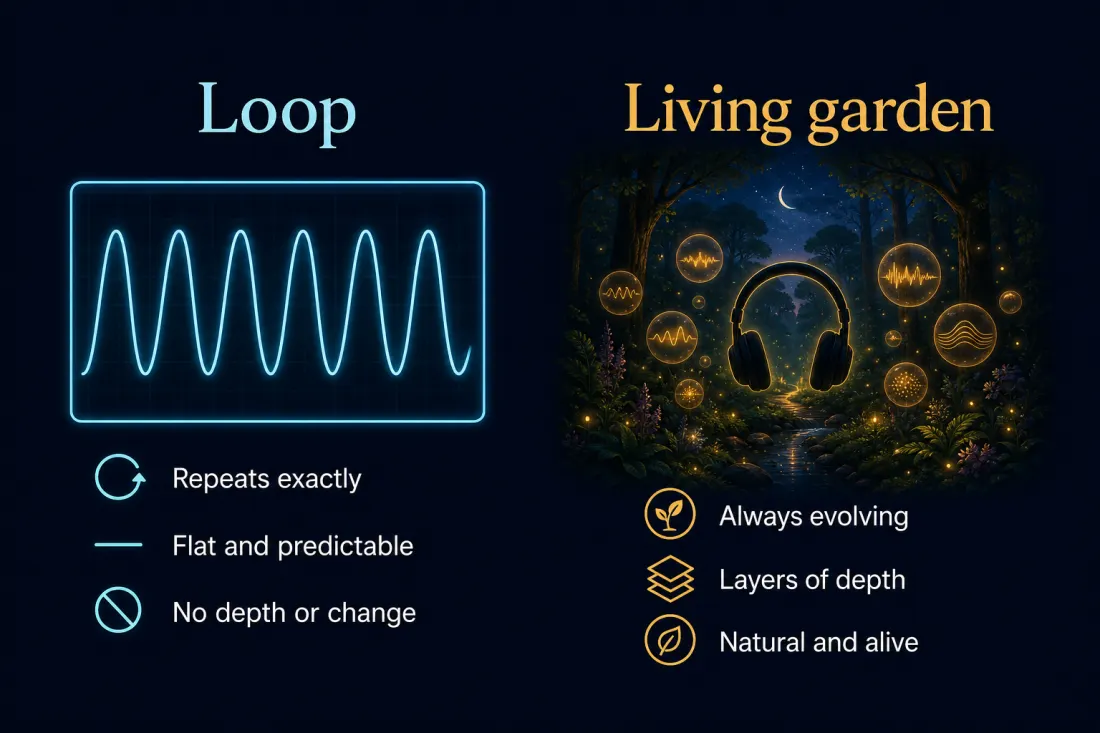
Most ambient apps deliver one file. The studies above rarely study "a loop." They study continuous floors against irregular noise, unintelligible speech against memory tasks, nature scenes against stress markers, spatial streams against glued mashups, and slow environmental change against habituation.[9][14][22][23][24]
Sound Bubbles maps onto those findings deliberately: brown/noise beds for masking floors, nature and library layers for restorative structure, distance/Falloff for speech intelligibility control, and TimeLine motion so the garden keeps the statistics of a place instead of the statistics of a four-minute loop.[12][15][16][25] That is the practical reason the product feels different after the first hour — and the scientific reason the difference matters.
How to apply this inside Sound Bubbles
- Open a related garden (or New Garden) and press Start playing so audio unlocks.[9]
- Expand Shape your soundscape → Sounds: set Master Volume, then Falloff while watching the audible-core guide.[10]
- Select a bubble; drag and scroll depth. Prefer raising one bubble's Volume over blasting the whole room.[11]
- Add library rain, nature, or noise layers; keep speech-like content distant — or remove it — when you need reading or coding focus.[12]
- TimeLine: choose Drift, Tide, or Orbit when you want the garden to keep evolving without grabbing attention.[13]
- Brown Noise tab: shape a warm floor, optionally Release as bubble so it becomes spatial.[14]
- Save gardens that still feel kind after an hour — public gardens should stay soft, not startling.[15]
Limits, safety, and honest uncertainty
We do not claim Sound Bubbles replaces clinical care, sleep medicine, occupational health programmes, or psychiatric treatment.[1][7] What the product does offer is a listening architecture that matches how hearing and attention actually work: layered sources, spatial distance, and slow change instead of one brittle loop.[18][19]
If sound worsens symptoms, stop. If you need medical advice, see a clinician. If you want a softer room, open a garden, place the bubbles kindly, and stay honest about what sound can — and cannot — do.[20][21]
How this article was researched
We combine first-hand experience placing and tuning Sound Bubbles gardens with citations from peer-reviewed journals, reviews, and institutional pages (including NIH/NCBI, sleep and hearing literature, acoustics, and attention research). Where evidence is mixed or early, we say so. On wellbeing topics we stay cautious: these are companion soundscapes, not cures.
References
Sources cited in this article. Prefer primary literature and institutional guidance; Sound Bubbles is not a medical device and these citations do not imply clinical endorsement.
- (1995). Sleep inertia. Sleep.
- (2000). Sleep inertia: a review. Sleep Medicine Reviews.
- (2001). Light and cortisol awakening response. Journal of Clinical Endocrinology & Metabolism. doi:10.1210/jcem.86.1.7116
- (2003). Dawn simulation and bright light therapy in winter depression. Journal of Affective Disorders.
- (2016). Light at night and circadian disruption. Journal of Biological Rhythms.
- (2016). Bright light induction of strong circadian resetting. Journal of Clinical Sleep Medicine.
- (2011). EEG and behavioral responses to auditory alarms. Sleep Medicine.
- (2017). ICAO aircraft noise and sleep. Sleep Medicine Reviews.
- (2009). Habituation revisited. Neurobiology of Learning and Memory. doi:10.1016/j.nlm.2008.09.015
- (2009). Habituation: a history. Neurobiology of Learning and Memory.
- (1963). Perception and the conditioned reflex. Pergamon Press.
- (2010). The free-energy principle. Nature Reviews Neuroscience. doi:10.1038/nrn2787
- (2013). Whatever next? Predictive brains. Behavioral and Brain Sciences. doi:10.1017/S0140525X12000477
- (1990). Auditory Scene Analysis. MIT Press.
- (2012). An Introduction to the Psychology of Hearing. Brill.
- (2024). Colors of noise. Encyclopedic.
- (2013). Acoustical terminology (masking). ANSI.
- (2014). Auditory and non-auditory effects of noise on health. The Lancet. doi:10.1016/S0140-6736(13)61613-X
- (2021). World report on hearing. WHO.
- (2023). Noise and hearing loss prevention. CDC.
- (2005). White noise on sleep with ICU noise exposure. Sleep Medicine. doi:10.1016/j.sleep.2004.12.004
- (2001). Auditory distraction and short-term memory. Human Factors. doi:10.1518/001872001775992390
- (2010). Stress recovery with nature sound. IJERPH. doi:10.3390/ijerph7031036
- (2005). Speech intelligibility and work performance. Indoor Air. doi:10.1111/j.1600-0668.2005.00391.x