Phonophobia and interictal sound sensitivity
Phonophobia — fear or intolerance of sound during migraine — appears in IHS diagnostic criteria as a common accompanying symptom.[8] Schwedt and colleagues documented high prevalence of sound sensitivity both during and between migraine attacks, with interictal hyperacusis correlating with attack frequency and allodynia severity.[1] Wilcox's review synthesised sensory sensitivity in migraine, noting amplified cortical responses to auditory stimuli and overlap with photophobia and osmophobia as part of a broader sensory threshold shift.[2]
Ashina's work on phonophobia pathophysiology implicates brainstem and thalamocortical gating dysfunction — the same pathways that make sudden sounds feel like assaults during an attack.[5] This is qualitatively different from ordinary annoyance: phonophobia reflects altered nociceptive and sensory integration, not weak coping.
Sound as trigger versus sound as shelter
Loud, irregular, or high-frequency noise can precipitate migraine in susceptible individuals — Basner's health noise review links environmental noise to stress, sleep loss, and autonomic activation, all migraine risk amplifiers.[6][19] Yet between attacks, some patients use continuous low-level sound to sleep in urban bedrooms where unpredictable spikes would otherwise fragment rest. The distinction is spectral content, contrast, and timing:
- Triggers: sudden transients, bright hiss, intelligible speech, repetitive alarms.[23][25]
- Potential shelter: soft brown or pink floors, distant rain, spatial separation so no source feels "in-head."[15][16][24]
During active migraine attacks, most clinical guidance prioritises dark quiet rooms — adding any sound, even masking, may worsen symptoms. Respect attack-phase silence unless your neurologist suggests otherwise.
Sleep, night noise, and migraine chronification
Lipton's epidemiologic work links poor sleep, frequent attacks, and migraine chronification — a cycle where sleep fragmentation lowers attack thresholds.[4] Night traffic noise provokes autonomic arousals during sleep in polysomnography studies, reducing slow-wave recovery.[19] For interictal nights in noisy environments, masking that reduces event contrast — without adding bright energy — aligns with Stanchina's ICU noise findings adapted to home bedrooms.[22]
Bregman's scene analysis framework explains why spatially separated rain and brown beds feel less intrusive than monolithic white noise: the brain parses them as environmental context rather than a single foreground object demanding vigilance.[14]
Designing migraine-aware listening
- Never use sound during acute attacks unless you know from experience it helps — default to silence and medical therapy.[8]
- Between attacks, start brown or pink floors at minimal volume; increase only if spikes still wake you.[15][16]
- Remove crickets, bells, and speech-like layers entirely during sensitivity weeks.[25]
- Use high Falloff so only distant bubbles contribute — nothing close to the ears.[14]
- Log attacks against sleep noise exposure to identify personal trigger patterns.[2]

Phonophobia during attacks versus between attacks
Migraine phonophobia peaks during headache phases when even footsteps feel violent. Between attacks, many migraineurs tolerate — and benefit from — soft masking that prevents sleep disruption from unpredictable noise.[1][4] The same person may need silence on Tuesday and brown noise on Thursday; carry no guilt about inconsistency — migraine biology is state-dependent.
Trigger diaries help separate phonophobia from prodrome anxiety: if sound sensitivity arrives hours before head pain, environmental reduction may abort progression for some patients, though evidence is individual.[3] Avoid high-frequency content during any aura or visual symptom window; low brown beds only, or complete silence.
Workplace accommodations for migraine often include reduced open-plan exposure and permission to use ear protection — sound gardens at home extend that logic: control contrast, eliminate intelligible speech during recovery, and treat environmental design as preventive care rather than luxury.[2][25]
Companion listening in Sound Bubbles
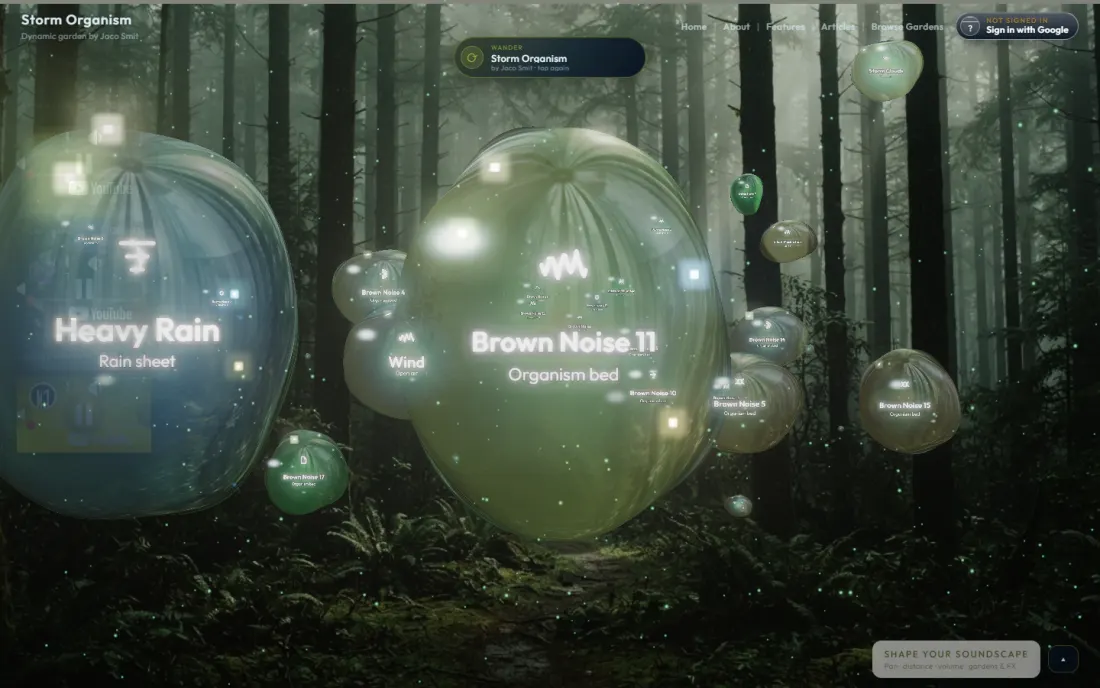
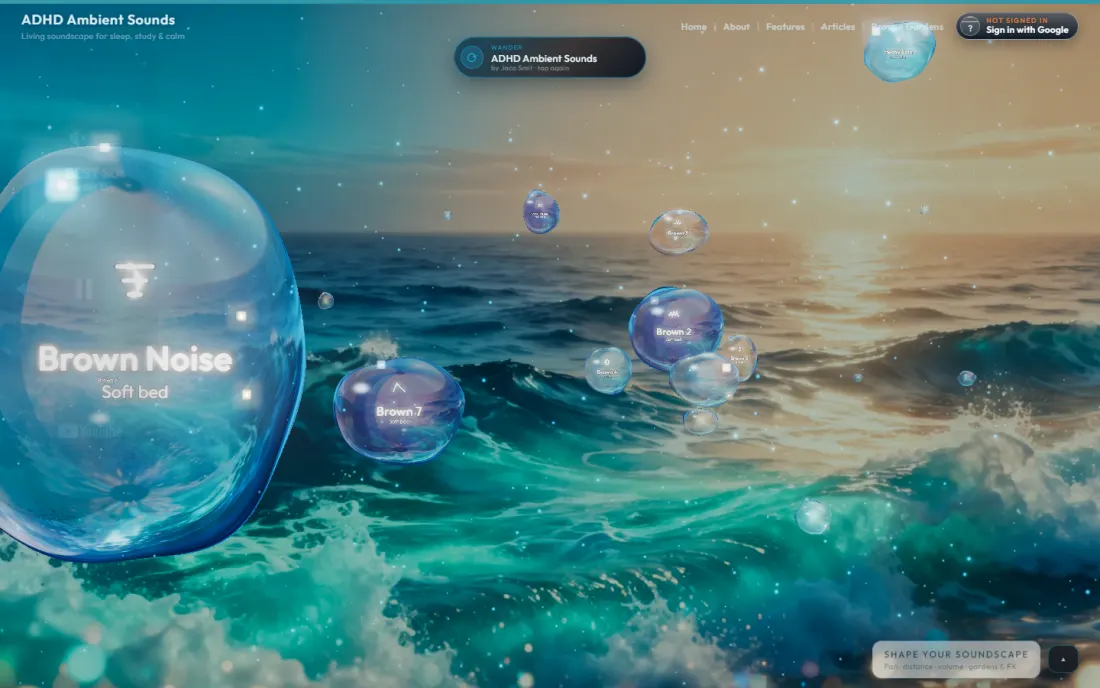
Research above concerns clinical and laboratory sound — not a playlist guarantee. Sound Bubbles offers adjustable living gardens: spatial layers, coloured noise beds, Medical & Wellbeing rooms, and easy mute. Use the recommended gardens below as environmental support alongside medical care when appropriate.[20]
Not treatment. See clinicians for diagnosis, medication, CBT, neurologic music therapy, or tinnitus programmes. Keep volume comfortable; stop if symptoms worsen.
Why this supports Sound Bubbles — not just "any ambient app"
Most ambient apps deliver one file. The studies above rarely study "a loop." They study continuous floors against irregular noise, unintelligible speech against memory tasks, nature scenes against stress markers, spatial streams against glued mashups, and slow environmental change against habituation.[9][14][22][23][24]
Sound Bubbles maps onto those findings deliberately: brown/noise beds for masking floors, nature and library layers for restorative structure, distance/Falloff for speech intelligibility control, and TimeLine motion so the garden keeps the statistics of a place instead of the statistics of a four-minute loop.[12][15][16][25] That is the practical reason the product feels different after the first hour — and the scientific reason the difference matters.
How to apply this inside Sound Bubbles
- Open a related garden (or New Garden) and press Start playing so audio unlocks.[9]
- Expand Shape your soundscape → Sounds: set Master Volume, then Falloff while watching the audible-core guide.[10]
- Select a bubble; drag and scroll depth. Prefer raising one bubble's Volume over blasting the whole room.[11]
- Add library rain, nature, or noise layers; keep speech-like content distant — or remove it — when you need reading or coding focus.[12]
- TimeLine: choose Drift, Tide, or Orbit when you want the garden to keep evolving without grabbing attention.[13]
- Brown Noise tab: shape a warm floor, optionally Release as bubble so it becomes spatial.[14]
- Save gardens that still feel kind after an hour — public gardens should stay soft, not startling.[15]
Limits, safety, and honest uncertainty
We do not claim Sound Bubbles prevents migraine, treats phonophobia, or replaces neurology care.[1][7] What the product does offer is a listening architecture that matches how hearing and attention actually work: layered sources, spatial distance, and slow change instead of one brittle loop.[18][19]
If sound worsens symptoms, stop. If you need medical advice, see a clinician. If you want a softer room, open a garden, place the bubbles kindly, and stay honest about what sound can — and cannot — do.[20][21]
How this article was researched
We combine first-hand experience placing and tuning Sound Bubbles gardens with citations from peer-reviewed journals, reviews, and institutional pages (including NIH/NCBI, sleep and hearing literature, acoustics, and attention research). Where evidence is mixed or early, we say so. On wellbeing topics we stay cautious: these are companion soundscapes, not cures.
References
Sources cited in this article. Prefer primary literature and institutional guidance; Sound Bubbles is not a medical device and these citations do not imply clinical endorsement.
- (2016). Phonophobia and hyperacusis in migraine: epidemiology and clinical correlates. Headache. doi:10.1111/head.12753
- (2016). Sensory sensitivity in migraine: a review. Headache. doi:10.1111/head.12844
- (2018). An update on the pathophysiology of migraine. Current Opinion in Neurology. doi:10.1097/WCO.0000000000000543
- (2017). Migraine: epidemiology, impact, and comorbidity. Neurologic Clinics. doi:10.1016/j.ncl.2017.08.001
- (2017). Phonophobia in migraine: clinical features and pathophysiology. Cephalalgia. doi:10.1177/0333102417702123
- (2014). Auditory and non-auditory effects of noise on health. The Lancet. doi:10.1016/S0140-6736(13)61613-X
- (2024). Understanding migraine and sensory sensitivity. AMF.
- (2018). The International Classification of Headache Disorders, 3rd edition. IHS.
- (2009). Habituation revisited. Neurobiology of Learning and Memory. doi:10.1016/j.nlm.2008.09.015
- (2009). Habituation: a history. Neurobiology of Learning and Memory.
- (1963). Perception and the conditioned reflex. Pergamon Press.
- (2010). The free-energy principle. Nature Reviews Neuroscience. doi:10.1038/nrn2787
- (2013). Whatever next? Predictive brains. Behavioral and Brain Sciences. doi:10.1017/S0140525X12000477
- (1990). Auditory Scene Analysis. MIT Press.
- (2012). An Introduction to the Psychology of Hearing. Brill.
- (2024). Colors of noise. Encyclopedic.
- (2013). Acoustical terminology (masking). ANSI.
- (2014). Auditory and non-auditory effects of noise on health. The Lancet. doi:10.1016/S0140-6736(13)61613-X
- (2021). World report on hearing. WHO.
- (2023). Noise and hearing loss prevention. CDC.
- (2005). White noise on sleep with ICU noise exposure. Sleep Medicine. doi:10.1016/j.sleep.2004.12.004
- (2001). Auditory distraction and short-term memory. Human Factors. doi:10.1518/001872001775992390
- (2010). Stress recovery with nature sound. IJERPH. doi:10.3390/ijerph7031036
- (2005). Speech intelligibility and work performance. Indoor Air. doi:10.1111/j.1600-0668.2005.00391.x