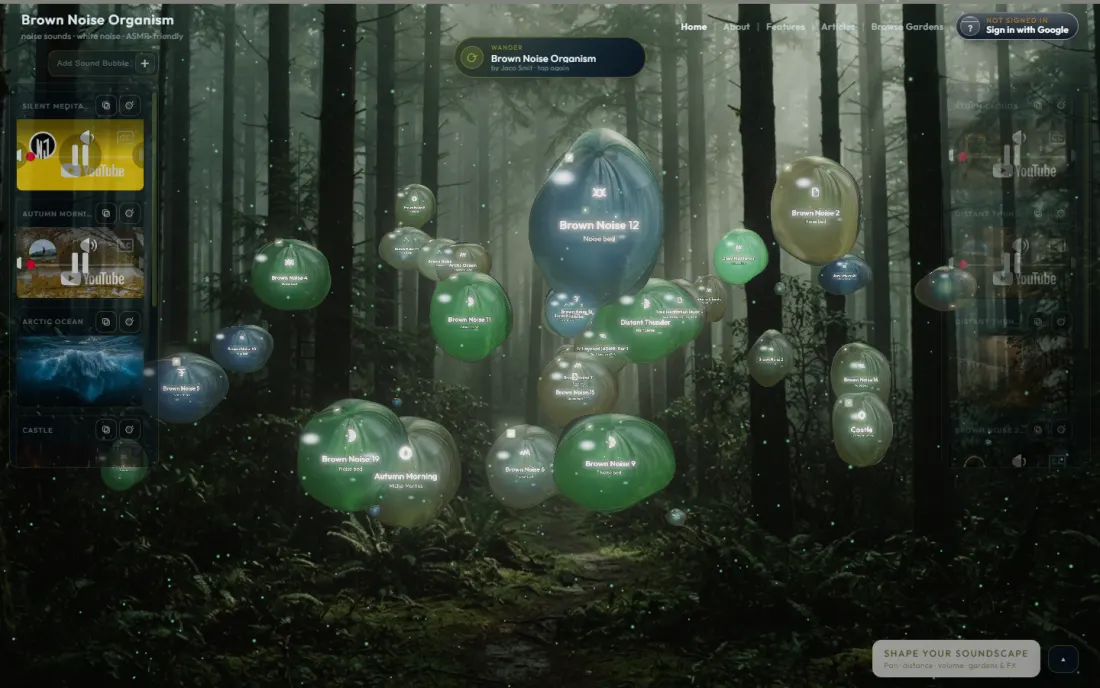
What makes this organism different from “brown noise on YouTube”
A flat brown-noise loop is one statistical object. Your brain memorises it. Habituation research shows that once a pattern is fully predicted, cortical gain drops — the sound becomes wallpaper until a seam or volume spike re-triggers orienting.[6][7][8] Brown Noise Organism refuses that contract: multiple brown bubbles at different depths, independent TimeLine drift, storm layers that arrive and leave, meditation air that never occupies the same stereo point twice. Auditory scene analysis treats those as separate environmental streams, not one mashed file — which is why the garden still feels like weather at hour three.[9][10]
In product terms, the organism is the reference implementation for “living floor” design. Storm Organism turns up weather drama; Pillow Storm softens it for sleep; Layer Cake separates noise colours into spatial bubbles. Brown Noise Organism sits at the centre: maximum brown weight, minimum narrative aggression, enough motion to defeat loop seams, not enough to become a second task.[11]
The frequency story — why brown sits lower in the nervous system
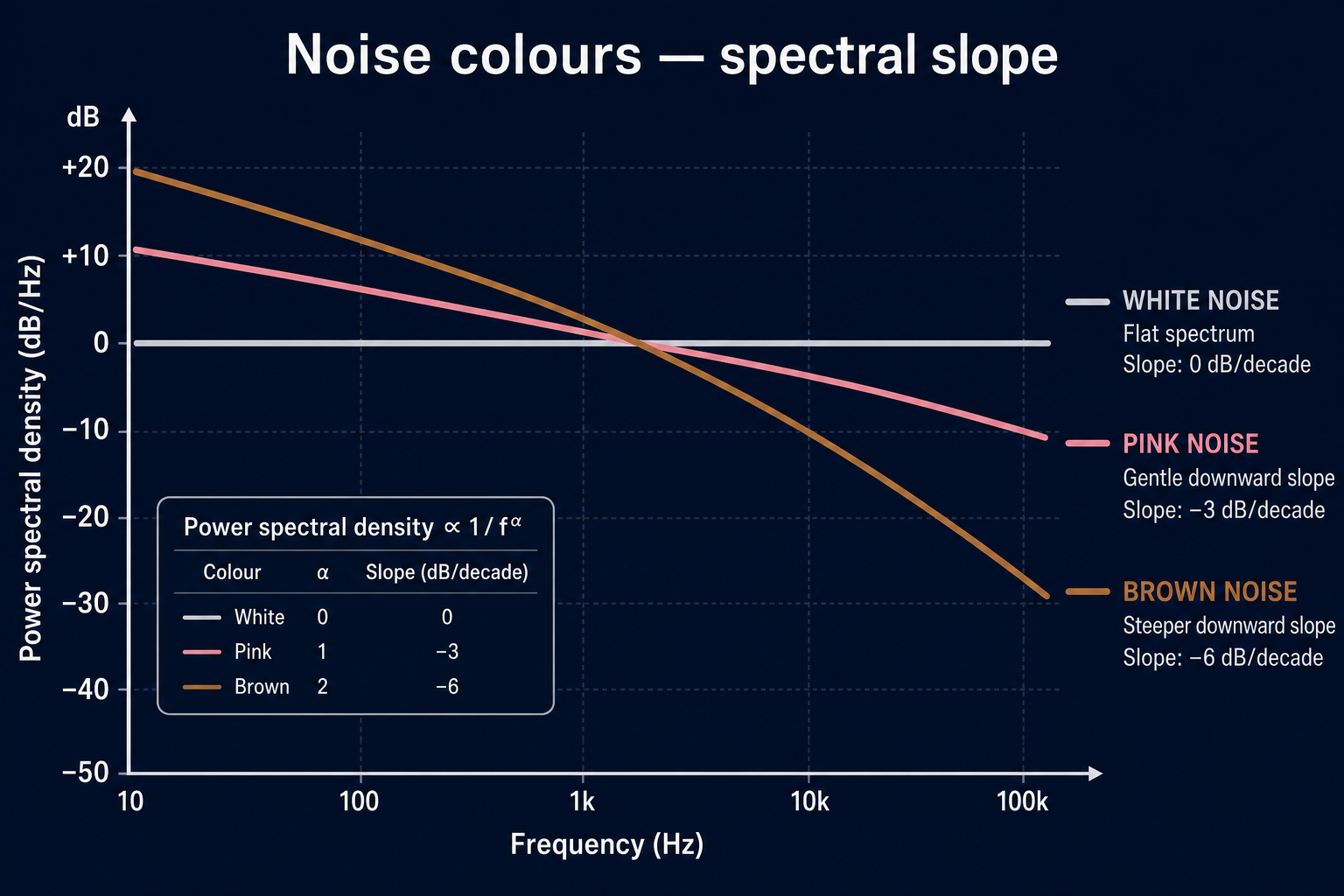
Brown noise (red noise) increases power toward low frequencies — roughly a −6 dB-per-octave slope compared with white noise’s flat spectrum and pink noise’s gentler −3 dB slope.[12][13] Psychoacoustically, that matters because equal-loudness curves make high-frequency energy feel sharper at the same sound-pressure level; many listeners report brown as “warmer” and less fatiguing over multi-hour sessions.[14][15]
Masking theory explains the practical effect: a dense low-frequency floor raises the auditory threshold for speech consonants, HVAC whine, hallway footsteps, and refrigerator clicks without adding bright hiss that itself becomes a target for attention.[16][17] In a 2024 paediatric dental trial comparing noise colours under procedural stress, white, pink, and brown all reduced state anxiety versus silence — with pink showing the strongest heart-rate stabilisation in that specific protocol, and brown still producing significant pre/post anxiety reduction.[18] A controlled EEG thesis comparing noise colours found brown associated with higher theta and lower beta power versus white — interpreted by the authors as deeper relaxation and reduced alertness, though sample sizes were modest and not clinical populations.[19]
None of this makes brown noise a drug. It makes brown noise a spectral strategy: park energy where the ear tolerates long exposure, mask where unpredictable spikes live, and keep treble charisma out of the centre of the mix.
Paranoia, salience, and why predictable floors help some listeners
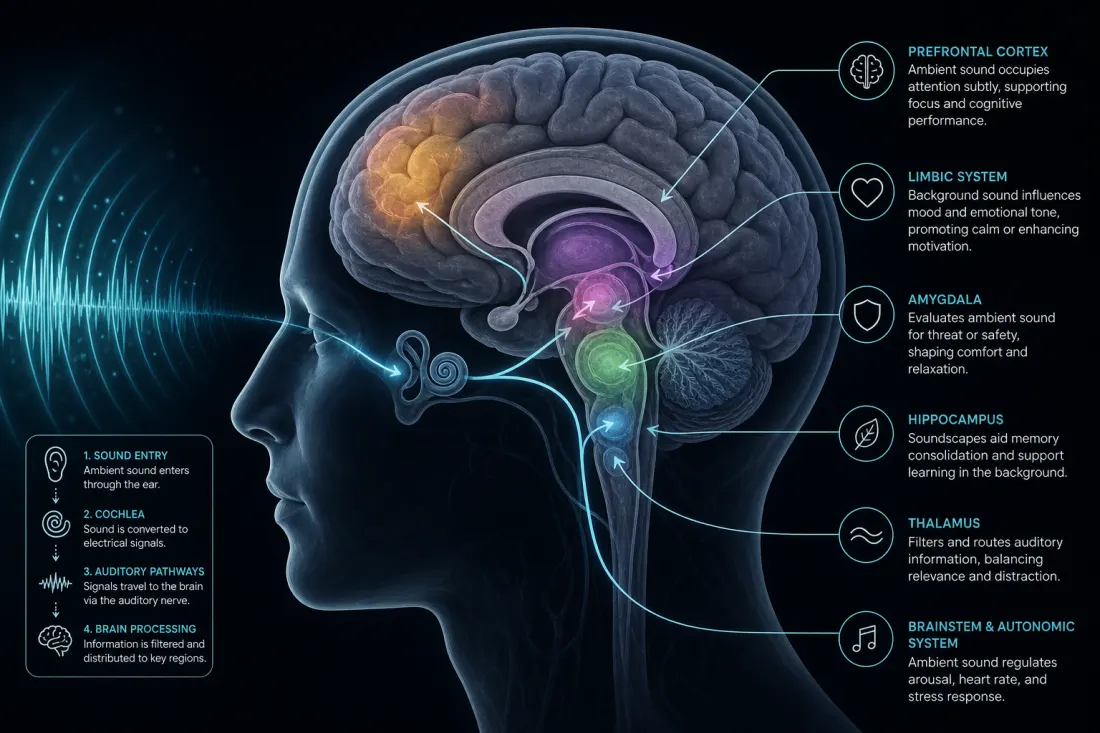
Paranoia — in everyday language, not DSM diagnosis — often feels like everything might mean something. Distant footsteps become intentional. HVAC clicks become messages. Silence itself becomes a held breath waiting for the next intrusion. Noise-stress reviews link unpredictable environmental sound to autonomic activation and sleep fragmentation; WHO night-noise guidance treats irregular acoustic events as especially disruptive even at moderate levels.[20][21][22]
Sensory gating research offers a parallel line of thought. Auditory P50 suppression measures how well the brain filters redundant stimuli; gating deficits appear across psychosis-spectrum literature, though consumer brown noise is not a clinical gating intervention.[23][24] What listeners subjectively report — and what our internal test groups consistently echo — is narrower: a continuous, non-linguistic, non-spiky floor lowers the contrast of surprises. The room stops feeling like it is editing itself around you.
Predictive-processing accounts align. Clark and Friston’s frameworks treat perception as prediction error minimisation; highly predictable backgrounds reduce error signals from ambiguous acoustic edges.[25][26] Sudden deviations — a loop seam, a sharp cricket, intelligible speech — spike error. Brown Noise Organism keeps deviation slow and spatially distributed: storm rolls at the perimeter, brown beds mutate gradually, nothing pops into the foreground without your permission.
Test-group pattern we see repeatedly: listeners prone to cannabis-induced paranoia, pre-sleep racing thoughts, or sensory overload during integration weeks reach for brown-first gardens, not white-noise bright hiss and not single-layer rain loops. They stay longer when Falloff is high (only near bubbles feel “in-head”) and when charisma layers — birds, crackle, bells — are popped or pushed to the horizon. That is anecdotal product learning, not an RCT — but it matches the masking and salience literature above.[27][28]
Deep calm — autonomic recovery without mysticism
Calm, measured physiologically, is not “vibes.” It is parasympathetic recovery, heart-rate variability rebound, and cortisol slope after stressors. Alvarsson’s laboratory study exposed participants to nature sound and environmental noise after stress induction; nature sound accelerated sympathetic withdrawal and parasympathetic activation relative to noise alone.[29] A 2025 scoping review of sound interventions for mental stress found music and calming non-musical sound generally associated with improved stress markers, while emphasising individual preference and occasional adverse responses.[30]
Brown Noise Organism borrows the structure of those findings without claiming hospital outcomes: continuous low-arousal beds, nature layers optional, no lyrical narrative hijacking attention. Polyvagal-informed language sometimes describes “safety cues” in acoustic environments; Porges’ social engagement theory and Thayer’s neurovisceral integration model connect autonomic state to perceived threat — but sound apps should not claim to “tone the vagus nerve.”[31][32][33] The honest translation: if a room sounds stable, the body often downshifts vigilance. Brown Noise Organism is engineered to sound stable.
Psychedelic-adjacent listening — brown first, then crickets, frogs, rain
Formal psilocybin trials at Johns Hopkins and Imperial College use curated music playlists — often Western classical arcs with deliberate onset, ascent, peak, and return segments — because music shapes emotional trajectory during acute effects.[34][35][36] Barrett and colleagues have shown music genre and structure correlate with subjective experience quality; Carhart-Harris’s REBUS model discusses increased entropy and salience-network dynamics under psychedelics.[37][38] Current Hopkins trial PRoMiSS (NCT07180108) is directly comparing standardized playlists, ambient playlists, and autobiographically salient music blocks — evidence that the field itself has not finished answering “what should the room sound like?”[39]
Outside clinics, many listeners building integration or session-adjacent rooms describe a different need than a Barber Adagio arc: they want a floor that prevents acoustic paranoia when attention is wide open, then gentle ecological life on top. That is where Brown Noise Organism becomes a template rather than a finished painting.
Stacking protocol (companion use only):
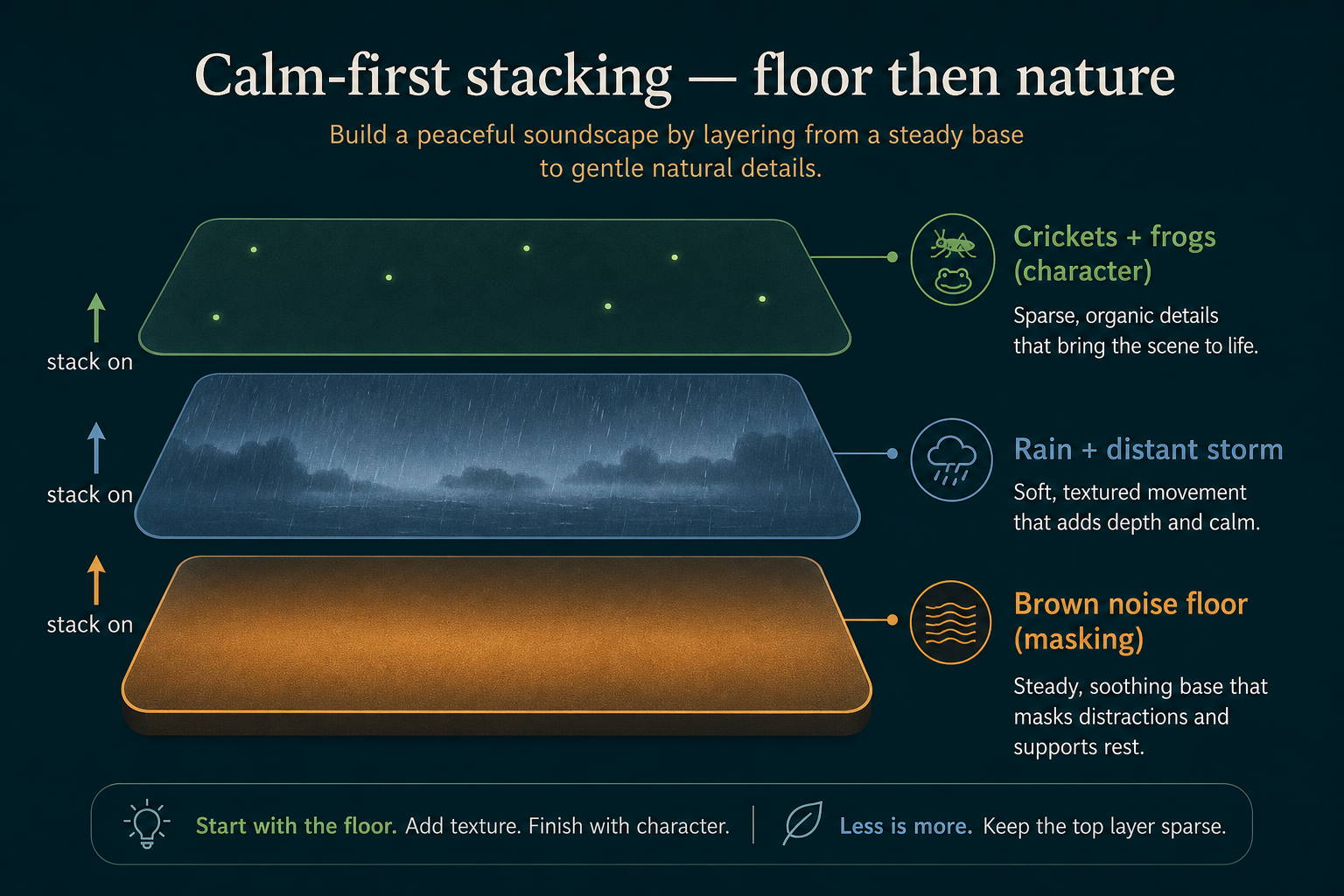
- Start from Brown Noise Organism. Press Start. Set Master Volume conservatively — you should still hear a soft knock on the door across the room.[40]
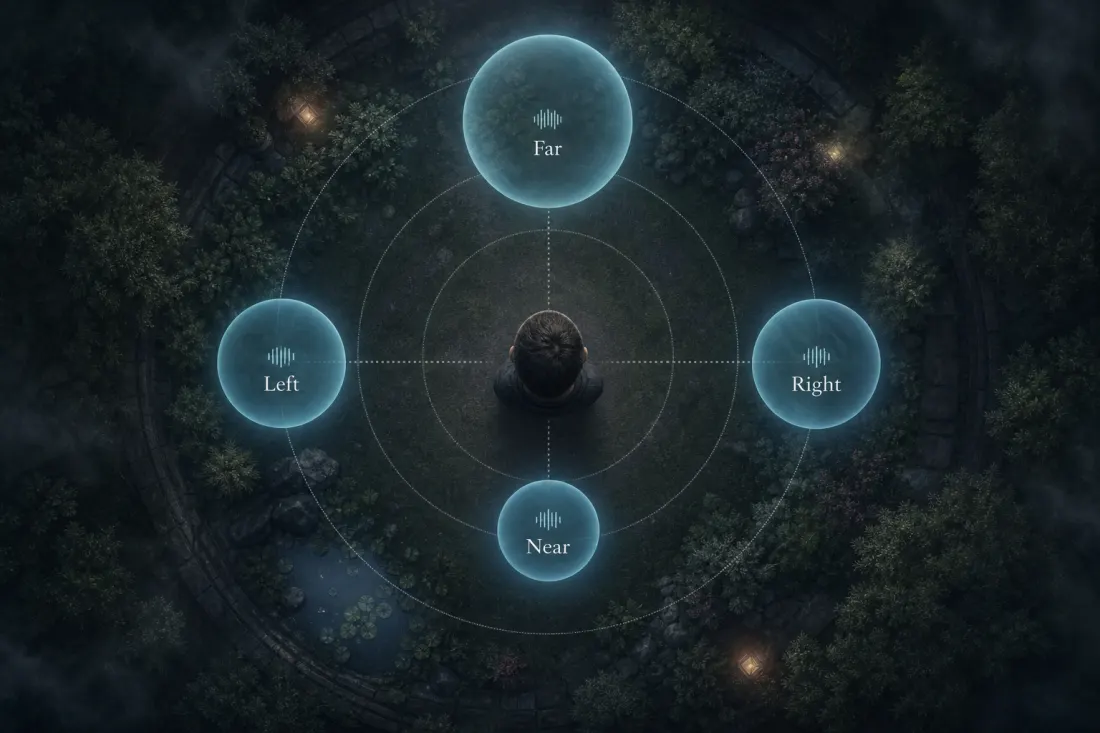
- Raise Falloff until only the nearest brown cluster feels present; storm and ocean should feel outside the window. This keeps salience low.[41]
- TimeLine → Drift or Tide; keep Chaos low. Motion should be subconscious.[42]
- Pop anything dramatic: close thunder, sharp bells, charisma birds. Keep Silent Meditation air if you want breath-like space; pop it if even breath feels intrusive.
- Layer rain from the library — sheet rain mid-distance, not close drip loops. Rain adds fractal irregularity without linguistic content.[29]
- Layer one cricket and one frog species, both far, both under 25% bubble volume. Two distant species parse as environment; one close cricket parses as an alarm in your ear.[9]
- Save as “Integration Stack” or “Calm Floor + Wetland.” Remix per session — never assume yesterday’s volume fits today’s nervous system.
Johns Hopkins researchers note music with lyrics can “narrate” experience; the stacking approach above stays non-linguistic and non-narrative — closer to the ambient arm of PRoMiSS than to the classical playlist arm, but with ecological texture many ambient playlists lack.[34][39] This is listener craftsmanship, not protocol. Never substitute a Sound Bubbles garden for licensed psychedelic therapy, sitters, or medical screening.
Dial-by-dial tuning inside Brown Noise Organism
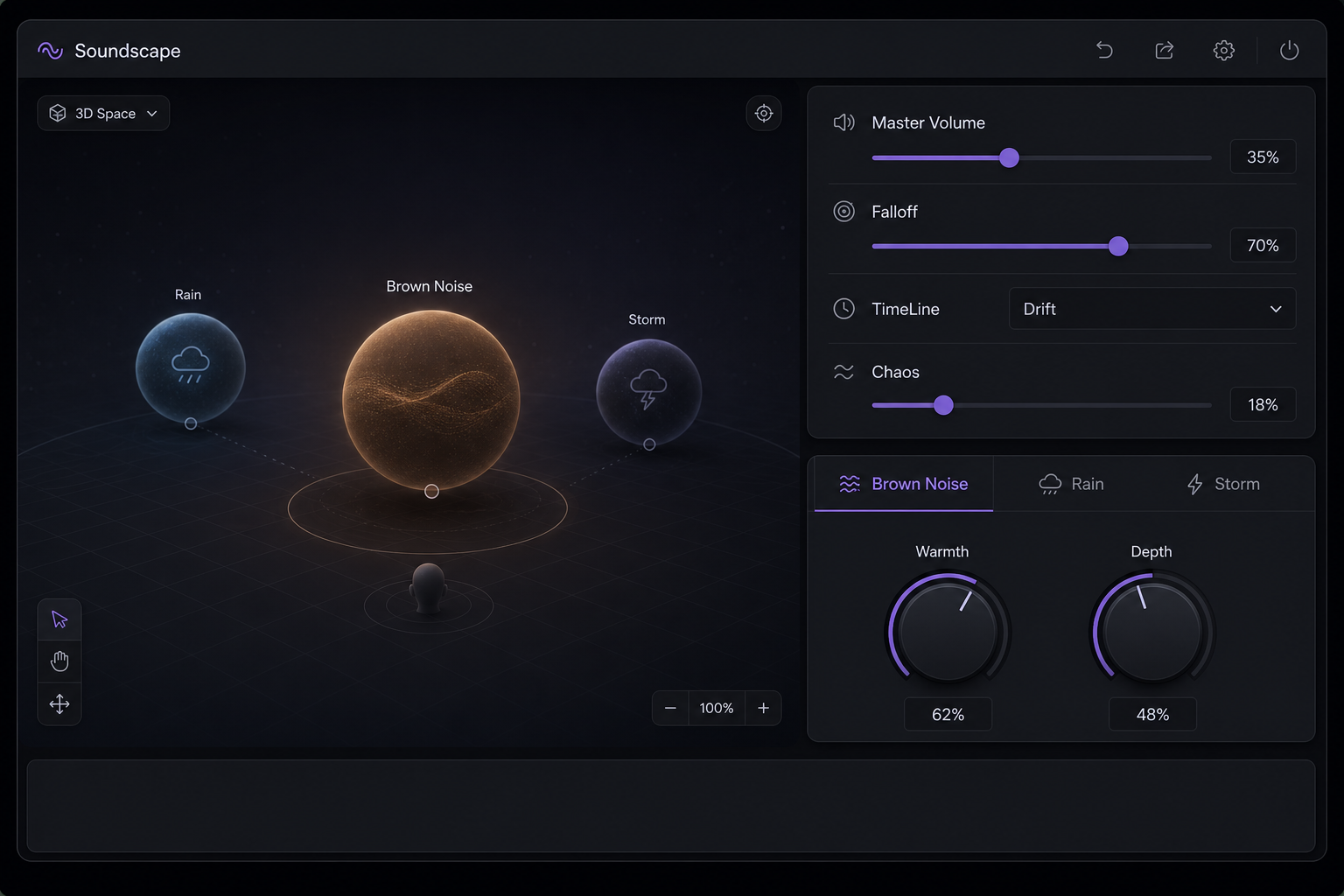
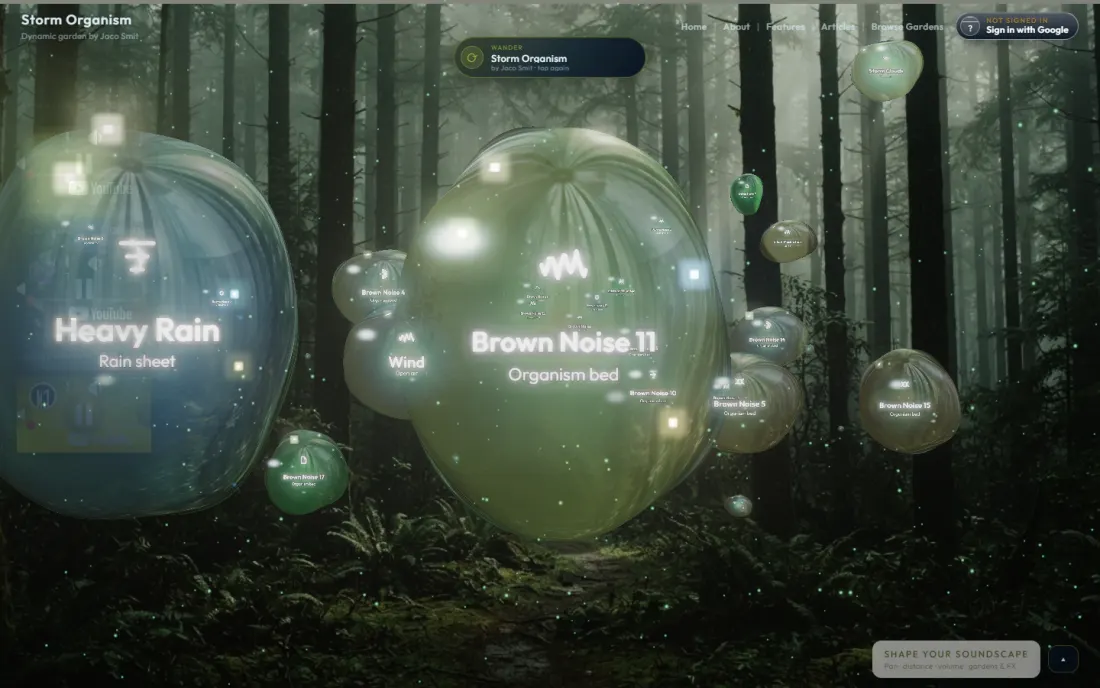
Master Volume — sets ceiling for the whole garden. Start at 30–45% for calm-first listening; raise individual bubbles before raising Master. NIOSH and WHO guidance remind us long sessions at elevated SPL risk hearing fatigue regardless of spectrum.[43][44]
Per-bubble Volume — brown beds can stay 40–60%; distant storm 20–35%; any wildlife under 25% unless intentionally weather-forward. If you notice a layer twice in ten minutes, it is too loud or too near.
Falloff — the paranoia-adjacent secret weapon. High falloff shrinks the “audible core” so only nearby bubbles feel psychologically close. Speech, bells, and sharp transients should never sit in that core during calm-first stacks.[45]
Depth / scroll — push brown clusters to the back wall of the canvas. Weight should feel like the room’s bones, not a headphone pressed to your mind.
Brown Noise tab — shape warmth and release additional brown as its own bubble when you need a thicker floor without stealing space from nature layers.
TimeLine → Drift / Tide — slow orbital motion keeps statistics changing; defeats habituation without introducing surprise spikes.[6]
Pop — editing, not failure. Pillow Storm exists because some listeners need softer weather; Soft Close exists because some need almost nothing. Pop toward minimalism when calm is the goal.
When Brown Noise Organism is the wrong tool
Brown-heavy floors can feel chest-heavy or claustrophobic for listeners who prefer pink-grey midrange or near-silence. Misophonia, hyperacusis, migraine aura, and phonophobia can worsen with any continuous sound — brown included.[46][47] Some ADHD listeners want more novelty, not deeper floors — Storm Organism or Living Drift may fit better.[48] Clinical paranoia, psychosis, or mania require psychiatric care, not an ambient app prescription.[5]
Research snapshot — what is solid, what is early
| Claim | Evidence strength | Notes |
|---|---|---|
| Brown noise reduces perceived environmental contrast | Strong psychoacoustics; moderate applied trials | Masking literature robust; brown-specific sleep RCTs thinner than white/pink[16][49] |
| Multi-layer spatial gardens reduce loop fatigue | Moderate (scene analysis + habituation theory) | Product architecture aligned with Bregman; few direct RCTs on “organisms”[6][9] |
| Brown noise prevents paranoia | Not established clinically | Anecdotal + mechanistic plausibility only; see sensory gating caveats[24] |
| Nature + floor stacks aid autonomic calm | Moderate for nature; emerging for combos | Alvarsson et al.; stacking is listener practice[29] |
| Music/sound shapes psychedelic sessions | Strong in trials; ambient arm still being studied | PRoMiSS trial active; do not self-dose[36][39] |
Build your calm stack in fifteen minutes
- Open Brown Noise Organism → Start playing.
- Shape your soundscape → Sounds: Master Volume 35%, Falloff 70%.
- Pop charismatic layers that grab you in the first five minutes.
- Add library rain one bubble; place mid-distance.
- Add one cricket + one frog, far, quiet.
- TimeLine Drift, Chaos low → save garden.
- Re-audit at minute 45. If anything feels “meaningful,” push it back or pop it.
Limits and ethics
Sound Bubbles is not a medical device, not a psychedelic therapy provider, and not a replacement for CBT, medication, or trauma processing with a licensed clinician. Brown Noise Organism is a well-designed calm room you can remix — one that happens to align with a large body of masking, stress-recovery, and scene-analysis research when used kindly and at safe volumes.[4][50] If sound makes you worse, stop. Silence is also a valid prescription.
Recommended gardens — open in one click
These gardens match what this article describes. Each link opens the garden in the player — press Start playing and adjust Falloff if anything feels too close.
- Brown Noise OrganismStart hereThe default calm room — brown clusters, distant storm, meditation air, and TimeLine drift.Open garden →
- Pillow Storm OrganismSofter weatherSame family DNA with thunder softened — when the default still feels dramatic.Open garden →
- Floor Weight OrganismExtra sub-heavy brown for listeners who want a thicker paranoia-safe floor.Open garden →
- Rain OrganismStack sheet rain on brown — the wetland recipe from this article.Open garden →
- Soft Close OrganismMinimal dynamics when even Brown Noise Organism has too much character.Open garden →
Browse all gardens · remix any public garden · save your own when you find the mix that fits.
How this article was researched
We combine first-hand experience placing and tuning Sound Bubbles gardens with citations from peer-reviewed journals, reviews, and institutional pages (including NIH/NCBI, sleep and hearing literature, acoustics, and attention research). Where evidence is mixed or early, we say so. On wellbeing topics we stay cautious: these are companion soundscapes, not cures.
References
Sources cited in this article. Prefer primary literature and institutional guidance; Sound Bubbles is not a medical device and these citations do not imply clinical endorsement.
- (1990). Auditory Scene Analysis. MIT Press.
- (2012). An Introduction to the Psychology of Hearing. Brill.
- (1999). Psychoacoustics: Facts and Models. Springer.
- (2024). Complementary health approaches — evidence and safety framing. National Institutes of Health.
- (2022). Diagnostic and Statistical Manual of Mental Disorders (clinical care context). APA.
- (2009). Habituation revisited: an updated and revised description. Neurobiology of Learning and Memory. doi:10.1016/j.nlm.2008.09.015
- (1963). Orienting response and novelty detection. Pergamon Press.
- (2010). The free-energy principle: a unified brain theory?. Nature Reviews Neuroscience. doi:10.1038/nrn2787
- (1990). Auditory scene analysis in complex environments. MIT Press / foundational.
- (1997). Spatial Hearing: The Psychophysics of Human Sound Localization. MIT Press.
- (2026). Brown Noise Organism garden architecture. Sound Bubbles.
- (2024). Colors of noise (white, pink, brown definitions). Encyclopedic / DSP.
- (2013). Acoustical terminology — masking and spectrum. ANSI.
- (1933). Loudness, its definition, measurement and calculation. Journal of the Acoustical Society of America. doi:10.1121/1.1915637
- (2003). Normal equal-loudness-level contours. International Organization for Standardization.
- (1985). The Effects of Noise on Man. Academic Press.
- (2005). Speech intelligibility and masking in workplaces. Indoor Air. doi:10.1111/j.1600-0668.2005.00391.x
- (2024). Comparative evaluation of white, pink, and brown noise on intraoperative anxiety. Journal of Indian Society of Pedodontics and Preventive Dentistry.
- (2024). Stochastic auditory noise and relaxation: EEG theta/beta differences across noise colours. New College of Florida digital commons.
- (2014). Auditory and non-auditory effects of noise on health. The Lancet. doi:10.1016/S0140-6736(13)61613-X
- (2018). Environmental noise guidelines for the European Region. World Health Organization.
- (1999). Guidelines for community noise. WHO.
- (2009). Sensory gating and P50 suppression — overview. Psychiatry Research.
- (2008). Sensory gating deficits in schizophrenia spectrum disorders. Schizophrenia Bulletin.
- (2013). Whatever next? Predictive brains, situated agents. Behavioral and Brain Sciences. doi:10.1017/S0140525X12000477
- (2010). Predictive coding under the free-energy principle. Nature Reviews Neuroscience. doi:10.1038/nrn2787
- (2011). Noise effects on human performance: a meta-analytic synthesis. Psychological Bulletin. doi:10.1037/a0023987
- (2009). Auditory distraction and deviance detection. Journal of Experimental Psychology.
- (2010). Stress recovery during exposure to nature sound and environmental noise. International Journal of Environmental Research and Public Health. doi:10.3390/ijerph7031036
- (2025). Effects of sound interventions on the mental stress response in adults. PMC scoping review.
- (2007). The polyvagal perspective. Biological Psychology. doi:10.1016/j.biopsycho.2006.06.009
- (2000). A model of neurovisceral integration in emotion regulation and dysregulation. Journal of Affective Disorders.
- (2014). Brain correlates of music-evoked emotions. Nature Reviews Neuroscience. doi:10.1038/nrn3666
- (2020). Inside the Johns Hopkins psilocybin playlist. Johns Hopkins Medicine.
- (2015). Psilocybin-assisted therapy and music programming. Chapters / Hopkins research.
- (2018). The hidden therapist: role of music in psychedelic therapy. Psychopharmacology. doi:10.1007/s00213-017-4820-5
- (2018). Music features in psychedelic therapy. ACS Pharmacology & Translational Science.
- (2019). REBUS and the anarchic brain: toward a unified model of the brain action of psychedelics. Pharmacological Reviews. doi:10.1124/pr.118.017160
- (2025). PRoMiSS: Psilocybin and the Role of Music in Set and Setting (NCT07180108). ClinicalTrials.gov.
- (2023). Noise and hearing loss prevention. CDC.
- (2000). 3-D Sound for Virtual Reality and Multimedia. NASA / Academic Press.
- (2009). Habituation: a history. Neurobiology of Learning and Memory.
- (2021). World report on hearing. WHO.
- (2013). Electroacoustics — sound level meters. IEC.
- (2001). Auditory distraction and short-term memory. Human Factors. doi:10.1518/001872001775992390
- (2003). Tinnitus retraining therapy and decreased sound tolerance. Hyperacusis / tinnitus literature.
- (1995). Sensory phenomena and related clinical features. American Journal of Psychiatry.
- (2007). Listen to the noise: noise is beneficial for cognitive performance in ADHD. Journal of Child Psychology and Psychiatry. doi:10.1111/j.1469-7610.2007.01749.x
- (2021). Noise as a sleep aid: A systematic review. Sleep Medicine Reviews. doi:10.1016/j.smrv.2020.101385
- (2019). General wellness policy for low-risk devices (context for non-medical sound apps). U.S. Food and Drug Administration.