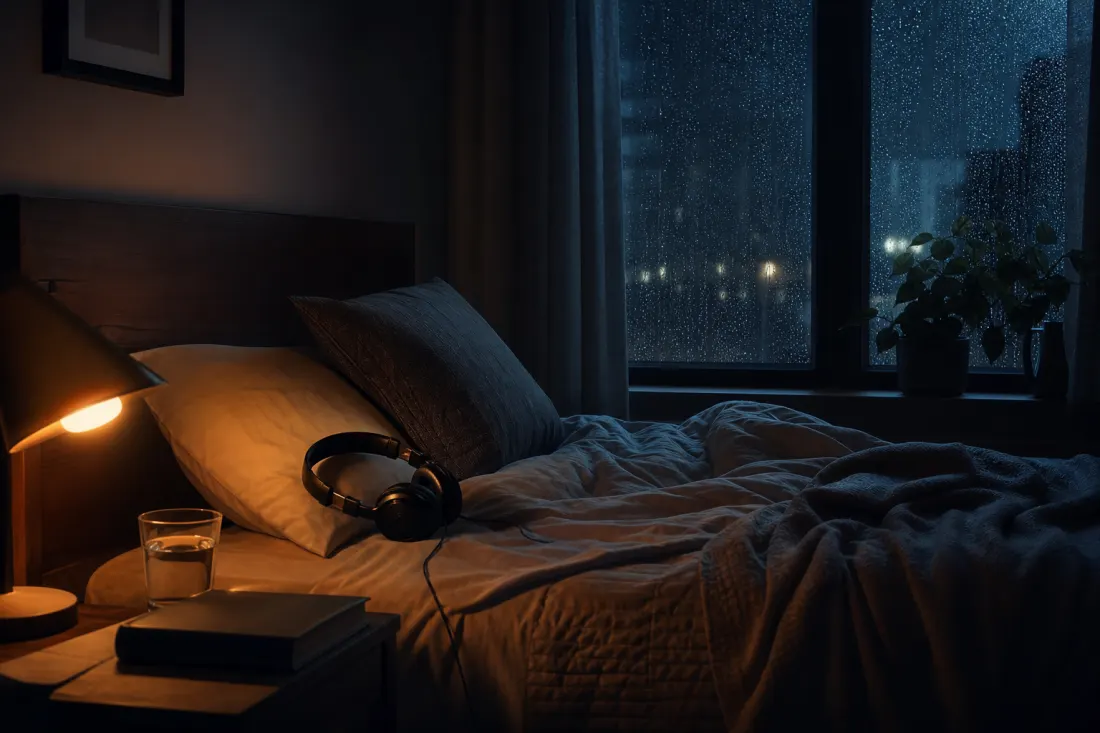

Layers of bedroom acoustics
Effective sleep rooms combine source control (quiet appliances, door seals), transmission reduction (mass, insulation, double glazing), and masking or absorption inside the room. WHO night-noise guidelines emphasise outdoor source limits — traffic, rail, aircraft — because bedroom interventions cannot fully negate loud external Lnight exposures.[1] Basner's Lancet review quantifies health burdens of environmental noise, framing bedroom design as public-health adjacency.[2]
When structural fixes are impossible — rental flats, historic buildings — internal masking and layout changes become the lever. Clark and Paunovic's WHO evidence synthesis on sleep and noise documents that even sub-awakening arousals accumulate across the night.[3]
Speech, intelligibility, and the neighbour problem
Hongisto modelled how speech intelligibility degrades work performance — the same mechanism disrupts sleep when neighbour conversations or TV bleed through walls.[4] Masking helps when it raises the noise floor in the speech band without adding its own intelligible content.[18][25] Banbury's distraction research shows even unattended speech captures working memory resources — during sleep, that capture manifests as micro-arousal.[23]
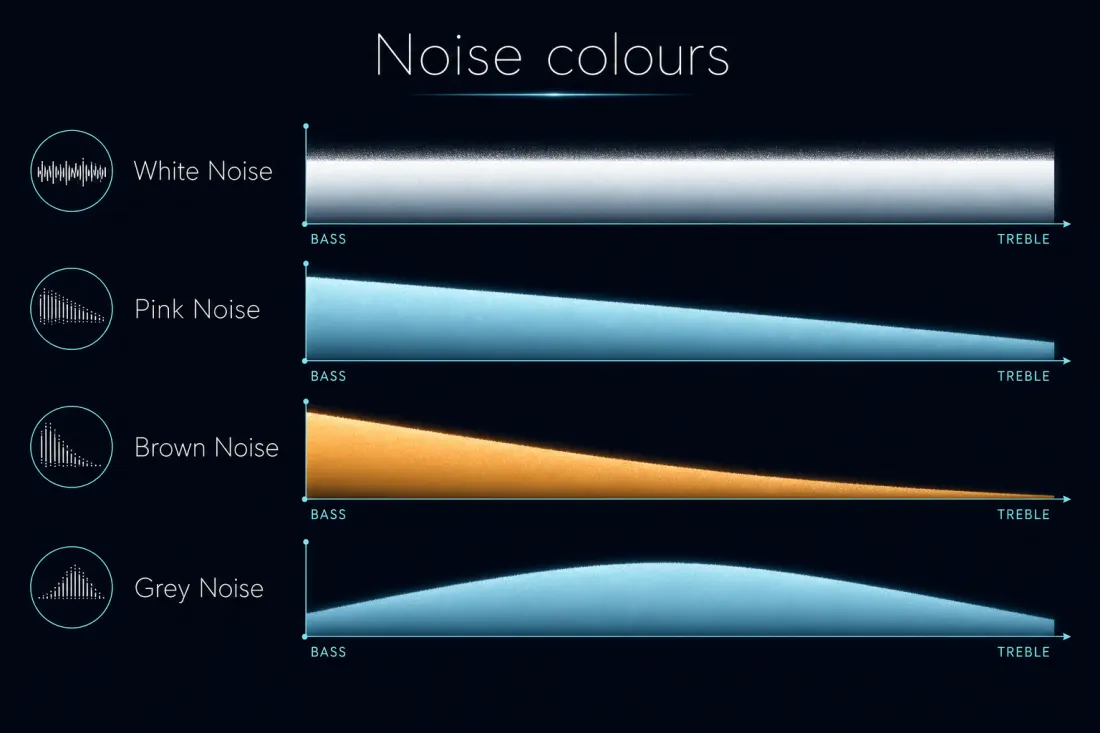
Design rule: if you can follow the words, the masker failed or speech is too loud structurally. Combine brown or pink beds with distant non-linguistic nature layers; never add podcast speech to "cover" neighbour speech.[14]
Traffic, HVAC, and event structure
Griefahn's polysomnography studies linked traffic noise event structure to autonomic arousals — steady rumble often tolerated better than intermittent honks.[6] HVAC cycling produces similar contrast: silence, then fan, then silence. A low brown floor can smooth perceived continuity so compressor starts feel less salient.[15][16]
Stanchina's ICU masking study established proof-of-concept for raising internal floors against uncontrollable hospital noise — analogous to uncontrollable urban bedrooms.[5] Halperin reviewed clinical consequences of environmental sleep disturbance, supporting proactive bedroom acoustics as health behaviour.[8]
Room layout and device placement
Speaker placement changes masking efficacy. Head-level bedside phones beam directly into the audible core; corner-placed speakers or spatial gardens simulate distant environmental sources — aligning with Bregman's segregated streams.[14] Berglund's WHO community noise guidelines recommend considering reverberation and room modes in residential settings — soft furnishings reduce flutter echo that makes maskers feel "in-head."[7]
Partner asymmetry is common: one sleeper needs masking, another needs silence. Headphones, split duvets, and individually tuned low floors at opposite bed sides reduce conflict. Keep partner-facing volume minimal.
Checklist: designing your sleep room
- Measure problem sources — traffic peaks, snoring, HVAC cycles — before choosing colour.[2]
- Seal doors and windows where possible; masking complements, not replaces, insulation.[1]
- Choose pink or brown over bright white for multi-hour tolerance.[15][16]
- Place sound away from head; use spatial gardens or corner speakers.[14]
- Remove intelligible content from the mix entirely.[25]
- Re-test at 2am — habituation and seams show up late.[9]
Couples, children, and shared sleep spaces
Bedroom acoustics are negotiated: one partner may need masking while another needs near-silence. Directional speakers, pillow-adjacent versus foot-of-bed placement, and timed fade-out after sleep onset reduce conflict.[19][22] For co-sleeping parents, infant-safe volume limits apply — never mask a baby monitor's medically relevant alerts.
Rental constraints limit structural fixes; behavioural and electronic solutions dominate: white/brown/pink beds, draft stoppers, curtain upgrades, and moving sleep schedules slightly off peak traffic hours. Document what helps across seasons — HVAC noise often worsens in summer when windows stay closed.[7]
Measure before buying gadgets: a free SPL app at pillow height during typical night hours reveals whether traffic or HVAC dominates. Target masking beds only at the problematic band — brown for rumble, pink for hiss — instead of blasting full-spectrum noise that partners hate.[15][16]
Companion listening in Sound Bubbles
Research above concerns clinical and laboratory sound — not a playlist guarantee. Sound Bubbles offers adjustable living gardens: spatial layers, coloured noise beds, Medical & Wellbeing rooms, and easy mute. Use the recommended gardens below as environmental support alongside medical care when appropriate.[20]
Not treatment. See clinicians for diagnosis, medication, CBT, neurologic music therapy, or tinnitus programmes. Keep volume comfortable; stop if symptoms worsen.
Why this supports Sound Bubbles — not just "any ambient app"
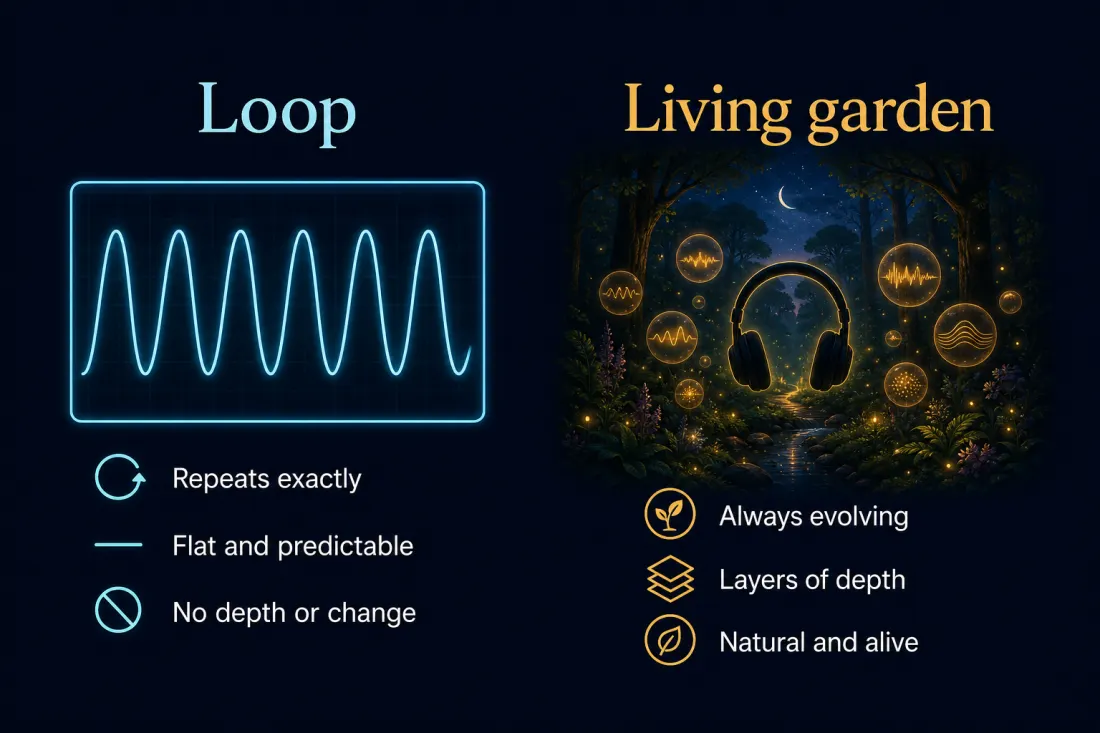
Most ambient apps deliver one file. The studies above rarely study "a loop." They study continuous floors against irregular noise, unintelligible speech against memory tasks, nature scenes against stress markers, spatial streams against glued mashups, and slow environmental change against habituation.[9][14][22][23][24]
Sound Bubbles maps onto those findings deliberately: brown/noise beds for masking floors, nature and library layers for restorative structure, distance/Falloff for speech intelligibility control, and TimeLine motion so the garden keeps the statistics of a place instead of the statistics of a four-minute loop.[12][15][16][25] That is the practical reason the product feels different after the first hour — and the scientific reason the difference matters.
How to apply this inside Sound Bubbles
- Open a related garden (or New Garden) and press Start playing so audio unlocks.[9]
- Expand Shape your soundscape → Sounds: set Master Volume, then Falloff while watching the audible-core guide.[10]
- Select a bubble; drag and scroll depth. Prefer raising one bubble's Volume over blasting the whole room.[11]
- Add library rain, nature, or noise layers; keep speech-like content distant — or remove it — when you need reading or coding focus.[12]
- TimeLine: choose Drift, Tide, or Orbit when you want the garden to keep evolving without grabbing attention.[13]
- Brown Noise tab: shape a warm floor, optionally Release as bubble so it becomes spatial.[14]
- Save gardens that still feel kind after an hour — public gardens should stay soft, not startling.[15]
Limits, safety, and honest uncertainty
We do not claim Sound Bubbles replaces architectural acoustics, white-noise machines in NICU protocols, or sleep disorder treatment.[1][8] What the product does offer is a listening architecture that matches how hearing and attention actually work: layered sources, spatial distance, and slow change instead of one brittle loop.[18][19]
If sound worsens symptoms, stop. If you need medical advice, see a clinician. If you want a softer room, open a garden, place the bubbles kindly, and stay honest about what sound can — and cannot — do.[20][21]
How this article was researched
We combine first-hand experience placing and tuning Sound Bubbles gardens with citations from peer-reviewed journals, reviews, and institutional pages (including NIH/NCBI, sleep and hearing literature, acoustics, and attention research). Where evidence is mixed or early, we say so. On wellbeing topics we stay cautious: these are companion soundscapes, not cures.
References
Sources cited in this article. Prefer primary literature and institutional guidance; Sound Bubbles is not a medical device and these citations do not imply clinical endorsement.
- (2009). Night noise guidelines for Europe. WHO Regional Office for Europe.
- (2014). Auditory and non-auditory effects of noise on health. The Lancet. doi:10.1016/S0140-6736(13)61613-X
- (2018). WHO environmental noise guidelines: evidence on sleep. IJERPH.
- (2005). A model predicting the effect of speech of varying intelligibility on work performance. Indoor Air. doi:10.1111/j.1600-0668.2005.00391.x
- (2005). The influence of white noise on sleep in subjects exposed to ICU noise. Sleep Medicine. doi:10.1016/j.sleep.2004.12.004
- (2008). Autonomic arousals related to traffic noise during sleep. Sleep Medicine.
- (1999). Guidelines for community noise (WHO). WHO.
- (2014). Environmental noise and sleep disturbances: A threat to health?. Sleep Science. doi:10.1016/j.slsci.2014.11.003
- (2009). Habituation revisited. Neurobiology of Learning and Memory. doi:10.1016/j.nlm.2008.09.015
- (2009). Habituation: a history. Neurobiology of Learning and Memory.
- (1963). Perception and the conditioned reflex. Pergamon Press.
- (2010). The free-energy principle. Nature Reviews Neuroscience. doi:10.1038/nrn2787
- (2013). Whatever next? Predictive brains. Behavioral and Brain Sciences. doi:10.1017/S0140525X12000477
- (1990). Auditory Scene Analysis. MIT Press.
- (2012). An Introduction to the Psychology of Hearing. Brill.
- (2024). Colors of noise. Encyclopedic.
- (2013). Acoustical terminology (masking). ANSI.
- (2014). Auditory and non-auditory effects of noise on health. The Lancet. doi:10.1016/S0140-6736(13)61613-X
- (2021). World report on hearing. WHO.
- (2023). Noise and hearing loss prevention. CDC.
- (2005). White noise on sleep with ICU noise exposure. Sleep Medicine. doi:10.1016/j.sleep.2004.12.004
- (2001). Auditory distraction and short-term memory. Human Factors. doi:10.1518/001872001775992390
- (2010). Stress recovery with nature sound. IJERPH. doi:10.3390/ijerph7031036
- (2005). Speech intelligibility and work performance. Indoor Air. doi:10.1111/j.1600-0668.2005.00391.x