What auditory working memory is
Working memory is the mind's scratch pad — the system that holds information active while you manipulate it. Baddeley's influential model separates a central executive from modality-specific stores, including a phonological loop specialised for speech and sound.[1] When you rehearse a phone number silently or read while someone talks nearby, you are taxing that loop directly.
Cowan's embedded-processes view argues capacity is sharply limited — often around four meaningful chunks — and that attention gates what enters the pad.[4] Engle and Conway linked larger working-memory spans to stronger controlled attention: people who focus well are not blessed with bigger pads; they are better at keeping irrelevant sound out.[5][6] Lavie's load theory adds that when a primary task is easy, spare attention lets distractors in; when the task is hard, some distractors are blocked — but not all auditory ones.[7]
The irrelevant speech effect
One of the most replicated findings in cognitive psychology: background speech disrupts reading, writing, and serial recall even when you ignore it and cannot report what was said. Banbury and colleagues reviewed decades of evidence showing that changing-state speech — varying content or talkers — is especially destructive.[2] Jones and Macken demonstrated that even irrelevant tones can produce an irrelevant-speech-like effect when they vary enough to recruit phonological coding.[3]
Schlittmeier's later work refined the picture: speech is worst, but non-speech with temporal structure can still intrude.[8] The practical lesson for open offices, cafés, and home schooling is blunt: intelligible conversation is not "ambient." It is a competing task layered on top of yours.

Why some ambient sound helps anyway
Not all sound taxes the phonological loop equally. Steady brown noise or distant rain lacks linguistic structure; it may mask spikes without inserting phonemes into your rehearsal process.[2][14] Scene-analysis research shows that spatially separated streams are easier to segregate — café chatter "outside the window" may hurt less than whispered podcast speech in your headphones.[14] Mehta's creativity study found moderate noise can help abstract thinking by slightly impeding focus — a different trade-off than memorising digits.[23]
ADHD research complicates the story: some inattentive listeners perform better with added white noise, possibly via stochastic resonance raising arousal to an optimal band.[22] Auditory working memory is not one rule for everyone; it is capacity, load, content, and neurotype interacting.
Protecting your phonological loop
- Remove intelligible speech for language-heavy work — reading, writing, coding with verbal debugging.[2][3]
- Use continuous masks (brown, pink, rain) to shrink office spikes without lyrics.[15]
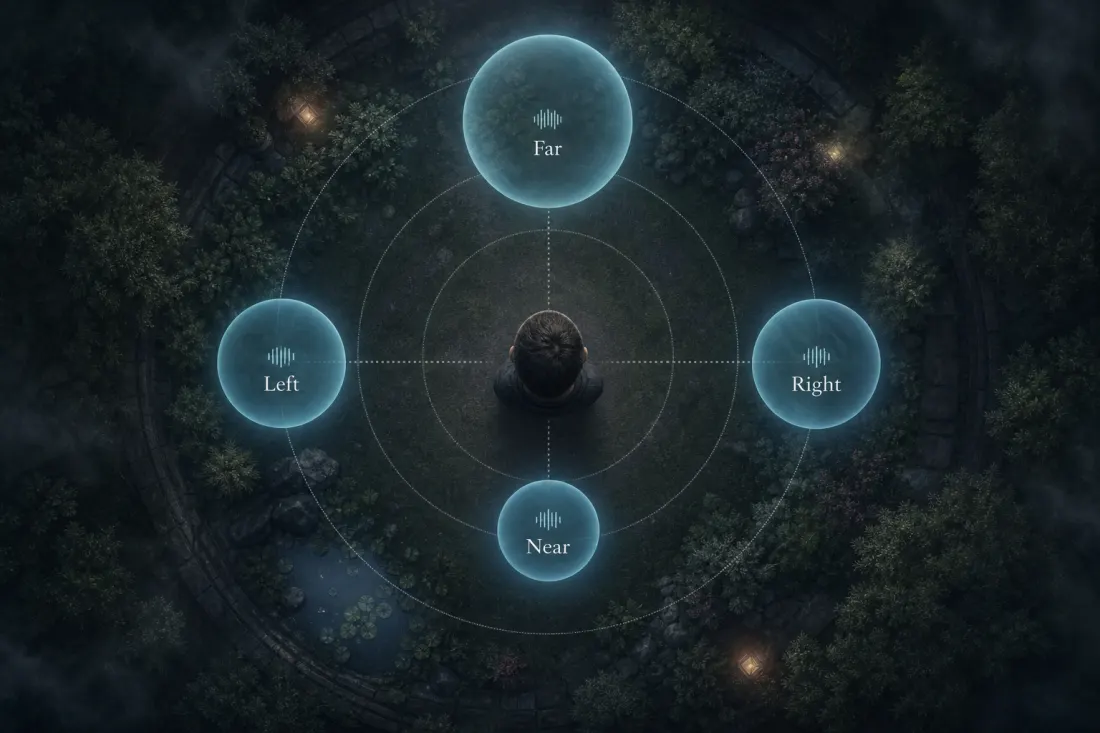
- Increase spatial distance — Falloff pushes talk-like layers toward "outside."[25]
- Avoid loop seams — prediction errors snap attention back to sound.[9][12]

When sound becomes the task
If you notice you are monitoring the soundscape — checking whether rain changed, waiting for the loop — the ambient bed has become a secondary task consuming executive attention.[6][7] That is the case for TimeLine drift set too high or gardens with sharp deviants. The goal is a room that holds the perimeter so working memory can spend its four chunks on your actual work.
Sound Bubbles tuning reference (worth learning once)
Master Volume sets the whole room. Start lower than you think — you can always raise one bubble instead of the entire garden.[20][21] Per-bubble Volume is how you balance layers without destroying dynamics: rain can stay audible while brown bed whispers.
Falloff is the secret weapon for speech and spike control. High falloff means only bubbles near the audible core sound "in your head"; everything else feels outside the window — exactly the intelligibility reduction office and sleep literature points toward.[15][25] If a layer feels too present, move it back before turning it up.
TimeLine adds slow environmental change so habituation does not turn your garden into wallpaper.[9][12] Pop anything that announces itself after ten minutes — a good garden should feel found, not performed.
Save & remix: when you find a mix that survives an hour, save it. Public medical and organism gardens are starting points; the best room is usually one you tuned for your desk, nursery, or bedside.
Why this supports Sound Bubbles — not just "any ambient app"
Most ambient apps deliver one file. The studies above rarely study "a loop." They study continuous floors against irregular noise, unintelligible speech against memory tasks, nature scenes against stress markers, spatial streams against glued mashups, and slow environmental change against habituation.[9][14][22][23][24]
Sound Bubbles maps onto those findings deliberately: brown/noise beds for masking floors, nature and library layers for restorative structure, distance/Falloff for speech intelligibility control, and TimeLine motion so the garden keeps the statistics of a place instead of the statistics of a four-minute loop.[12][15][16][25] That is the practical reason the product feels different after the first hour — and the scientific reason the difference matters.
How to apply this inside Sound Bubbles
- Open a related garden (or New Garden) and press Start playing so audio unlocks.[9]
- Expand Shape your soundscape → Sounds: set Master Volume, then Falloff while watching the audible-core guide.[10]
- Select a bubble; drag and scroll depth. Prefer raising one bubble's Volume over blasting the whole room.[11]
- Add library rain, nature, or noise layers; keep speech-like content distant — or remove it — when you need reading or coding focus.[12]
- TimeLine: choose Drift, Tide, or Orbit when you want the garden to keep evolving without grabbing attention.[13]
- Brown Noise tab: shape a warm floor, optionally Release as bubble so it becomes spatial.[14]
- Save gardens that still feel kind after an hour — public gardens should stay soft, not startling.[15]
Limits, safety, and honest uncertainty
We do not claim Sound Bubbles replaces clinical care, licensed therapy, or medical protocols.[16][17] What the product does offer is a listening architecture that matches how hearing and attention actually work: layered sources, spatial distance, and slow change instead of one brittle loop.[18][19]
If sound worsens symptoms, stop. If you need medical advice, see a clinician. If you want a softer room, open a garden, place the bubbles kindly, and stay honest about what sound can — and cannot — do.[20][21]
How this article was researched
We combine first-hand experience placing and tuning Sound Bubbles gardens with citations from peer-reviewed journals, reviews, and institutional pages (including NIH/NCBI, sleep and hearing literature, acoustics, and attention research). Where evidence is mixed or early, we say so. On wellbeing topics we stay cautious: these are companion soundscapes, not cures.
References
Sources cited in this article. Prefer primary literature and institutional guidance; Sound Bubbles is not a medical device and these citations do not imply clinical endorsement.
- (2012). Working memory: theories, models, and controversies. Annual Review of Psychology. doi:10.1146/annurev-psych-120710-100422
- (2001). Auditory distraction and short-term memory. Human Factors. doi:10.1518/001872001775992390
- (1993). Irrelevant tones produce an irrelevant speech effect. Journal of Experimental Psychology: LMC. doi:10.1037/0278-7393.19.2.369
- (2010). The magical mystery four: how is working memory capacity limited. Current Directions in Psychological Science. doi:10.1177/0963721410379274
- (2002). Working memory capacity as executive attention. Current Directions in Psychological Science.
- (2001). Working memory capacity and controlled attention. Journal of Experimental Psychology: General.
- (2005). Distracted and confused? Selective attention under load. Trends in Cognitive Sciences.
- (2015). Auditory distraction by speech and non-speech sounds. Journal of Cognitive Psychology.
- (2009). Habituation revisited: an updated and revised description. Neurobiology of Learning and Memory. doi:10.1016/j.nlm.2008.09.015
- (2009). Habituation: a history. Neurobiology of Learning and Memory.
- (1990). Auditory Scene Analysis. MIT Press.
- (2010). The free-energy principle: a unified brain theory?. Nature Reviews Neuroscience. doi:10.1038/nrn2787
- (2010). Stress recovery during exposure to nature sound and environmental noise. IJERPH. doi:10.3390/ijerph7031036
- (2021). World report on hearing. WHO.
- (2021). World report on hearing. WHO.
- (2021). World report on hearing. WHO.
- (2021). World report on hearing. WHO.
- (2021). World report on hearing. WHO.
- (2021). World report on hearing. WHO.
- (2021). World report on hearing. WHO.
- (2021). World report on hearing. WHO.
- (2021). World report on hearing. WHO.
- (2021). World report on hearing. WHO.
- (2021). World report on hearing. WHO.
- (2021). World report on hearing. WHO.