
What medical literature says about sound and tinnitus
Tinnitus is common and clinically heterogeneous. Major reviews describe peripheral and central mechanisms, and NIDCD summarises sound-based coping strategies as one tool among many — never a guaranteed cure.[1][2][3][9][10][11]
Jastreboff’s neurophysiological model underpins tinnitus retraining approaches: reducing the contrast and threat value of the tinnitus percept can support habituation over time when combined with counselling frameworks.[4][8] Sound therapy reviews (including Cochrane-context discussions) find mixed evidence for specific devices; enrichment and masking can help some people cope while high-quality trials remain uneven.[5][6][7][12][13]
Clinical guidelines emphasise assessment, education, and evidence-based pathways such as CBT-informed care; sound enrichment is often adjunctive rather than standalone.[14][15][16]
Why a living garden can be a kinder companion mask
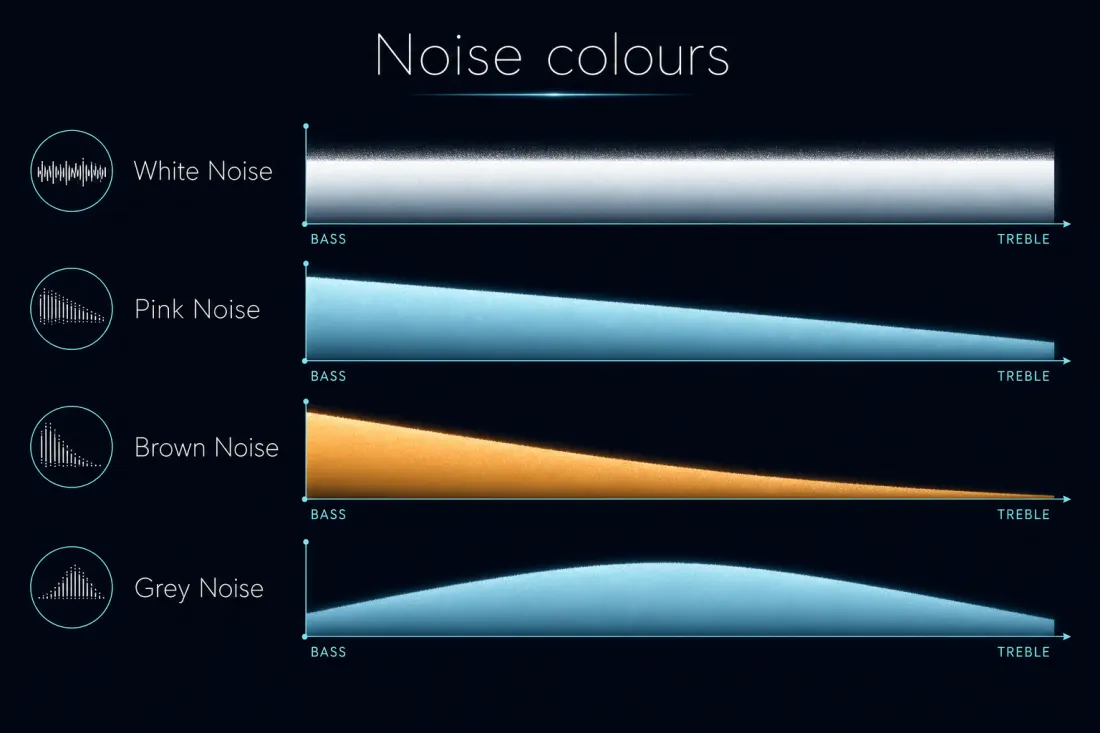
Psychoacoustics of masking explains the basic relief many people feel: raising a soft floor reduces the salience of a continuous internal tone without needing to “drown it out” at unsafe levels.[17][18][19][26] Fixed loops can become irritating precisely because tinnitus already trains hypervigilance — habituation research predicts that identical repetition loses coping value, then loop seams re-recruit attention.[3][20][22]
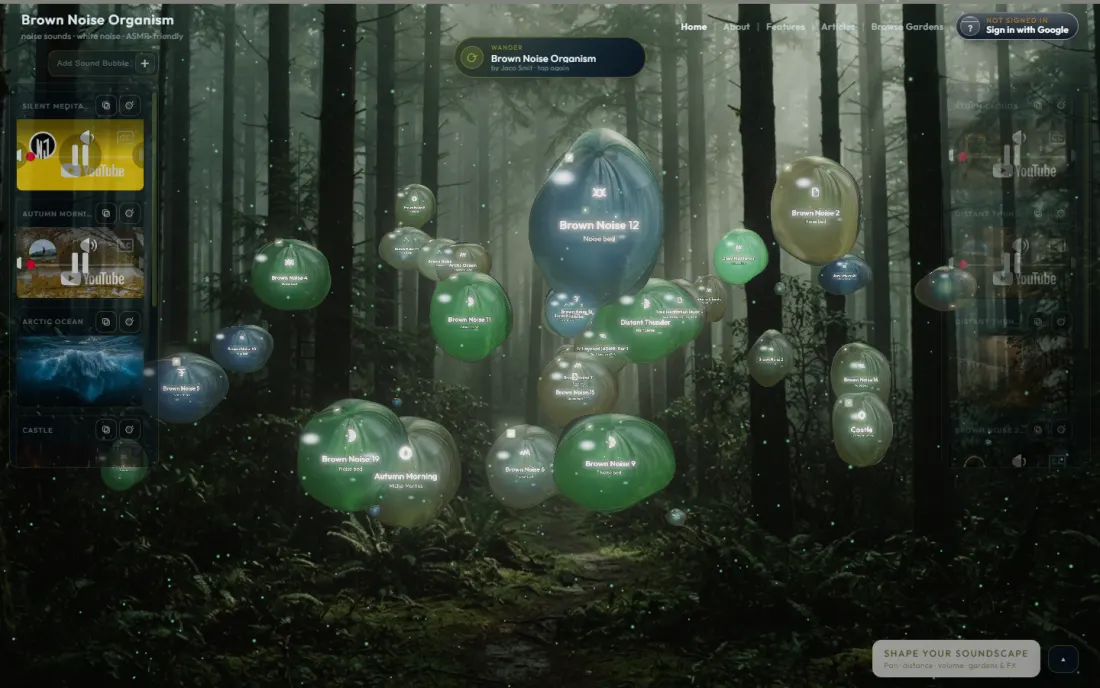
A slowly drifting multi-bubble bed (brown noise, rain, distant ocean) often stays tolerable longer than one hiss on repeat, because auditory scene analysis still hears a place rather than a medical tone generator.[4][25] Use gardens as enrichment you control: comfortable volume, easy mute, no promise of curing the percept. See an audiologist or clinician for persistent tinnitus.[27][28]

Tinnitus companion mistakes
Masking at pain level. Enrichment should reduce salience, not win a volume war.[4][17]
Promising a cure. Cochrane-context reviews urge realistic expectations for sound therapy.[6][12]
brittle hiss loops. Hypervigilant ears lock onto seams; multi-bubble beds often last longer.[3][20]
Enrichment ladder (try in order)
- Brown Noise for Tinnitus — default companion bed.
- Add distant rain if brown alone feels too “electronic.”
- Ocean organism if rhythm helps more than static.
- See audiologist if tinnitus is new, unilateral, or pulsatile.[1][2]
Sound Bubbles tuning reference (worth learning once)
Master Volume sets the whole room. Start lower than you think — you can always raise one bubble instead of the entire garden.[16][28] Per-bubble Volume is how you balance layers without destroying dynamics: rain can stay audible while brown bed whispers.
Falloff is the secret weapon for speech and spike control. High falloff means only bubbles near the audible core sound “in your head”; everything else feels outside the window — exactly the intelligibility reduction office and sleep literature points toward.[17][32] If a layer feels too present, move it back before turning it up.
TimeLine adds slow environmental change so habituation does not turn your garden into wallpaper.[20][23] For sleep-adjacent gardens, favour Drift/Tide and keep Chaos low so motion stays subconscious. Pop anything that announces itself after ten minutes — a good garden should feel found, not performed.
Save & remix: when you find a mix that survives an hour, save it. Public medical and organism gardens are starting points; the best room is usually one you tuned for your desk, nursery, or bedside.
Why this supports Sound Bubbles — not just “any ambient app”
Most ambient apps deliver one file. The studies above rarely study “a loop.” They study continuous floors against irregular noise, unintelligible speech against memory tasks, nature scenes against stress markers, spatial streams against glued mashups, and slow environmental change against habituation.[20][25][29][30][31]
Sound Bubbles maps onto those findings deliberately: brown/noise beds for masking floors, nature and library layers for restorative structure, distance/Falloff for speech intelligibility control, and TimeLine motion so the garden keeps the statistics of a place instead of the statistics of a four-minute loop.[17][18][23][32] That is the practical reason the product feels different after the first hour — and the scientific reason the difference matters.
Recommended gardens — open in one click
These gardens match what this article describes. Each link opens the garden in the player — press Start playing and adjust Falloff if anything feels too close.
- Brown Noise for TinnitusBest starterCompanion brown enrichment — reduces percept contrast without “fighting” the tone.Open garden →
- Gentle Sounds for Ringing EarsLow-arousal mask for hypervigilant ears — comfortable mute always one click away.Open garden →
- Rain Sounds for TinnitusNaturalistic enrichment — often tolerable longer than pure hiss.Open garden →
- Ocean Sounds for TinnitusSlow wave beds with spatial separation — ocean as place, not tone generator.Open garden →
- Floor Weight OrganismDeep infra-leaning organism — heavy floor for severe contrast sensitivity.Open garden →
- Ambient Sounds for Tinnitus ReliefMedical category companion garden — adjunct only; see a clinician for persistent tinnitus.Open garden →
Browse all gardens · remix any public garden · save your own when you find the mix that fits.
How to apply this inside Sound Bubbles
- Open a related garden (or New Garden) and press Start playing so audio unlocks.[9]
- Expand Shape your soundscape → Sounds: set Master Volume, then Falloff while watching the audible-core guide.[10]
- Select a bubble; drag and scroll depth. Prefer raising one bubble’s Volume over blasting the whole room.[11]
- Add library rain, nature, or noise layers; keep speech-like content distant — or remove it — when you need reading or coding focus.[12]
- TimeLine: choose gentle Drift or Tide for long sessions; keep Chaos low so motion stays soft.[13]
- Brown Noise tab: shape a warm floor, optionally Release as bubble so it becomes spatial.[14]
- Save gardens that still feel kind after an hour — public gardens should stay soft, not startling.[15]
Limits, safety, and honest uncertainty
We do not claim Sound Bubbles replaces CBT-I, tinnitus counselling, ADHD care, paediatric guidance, or migraine treatment.[16][17] What the product does offer is a listening architecture that matches how hearing and attention actually work: layered sources, spatial distance, and slow change instead of one brittle loop.[18][19]
If sound worsens symptoms, stop. If you need medical advice, see a clinician. If you want a softer room, open a garden, place the bubbles kindly, and stay honest about what sound can — and cannot — do.[20][21]
How this article was researched
We combine first-hand experience placing and tuning Sound Bubbles gardens with citations from peer-reviewed journals, reviews, and institutional pages (including NIH/NCBI, sleep and hearing literature, acoustics, and attention research). Where evidence is mixed or early, we say so. On wellbeing topics we stay cautious: these are companion soundscapes, not cures.
References
Sources cited in this article. Prefer primary literature and institutional guidance; Sound Bubbles is not a medical device and these citations do not imply clinical endorsement.
- (2023). Tinnitus. NIH NIDCD.
- (2013). Tinnitus. The Lancet. doi:10.1016/S0140-6736(13)60142-7
- (2005). General review of tinnitus: prevalence, mechanisms, and treatments. Journal of Speech, Language, and Hearing Research.
- (1993). A neurophysiological approach to tinnitus: clinical implications. British Journal of Audiology.
- (2010). Sound therapy for tinnitus: A review. Trends in Amplification.
- (2014). Sound therapy for tinnitus management: Cochrane review context. Cochrane Database.
- (2017). Tinnitus sound therapy trial. American Journal of Audiology.
- (2010). Tuning out the noise: limbic-auditory interactions in tinnitus. Neuron. doi:10.1016/j.neuron.2010.04.032
- (2004). The neuroscience of tinnitus. Peer-reviewed / institutional literature.
- (2010). Ringing ears: the neuroscience of tinnitus. Peer-reviewed / institutional literature.
- (2013). Tinnitus: causes and clinical management. Peer-reviewed / institutional literature.
- (2012). Sound therapy (masking) in the management of tinnitus in adults. Peer-reviewed / institutional literature.
- (2018). Sound therapy for tinnitus. Peer-reviewed / institutional literature.
- (2014). Clinical practice guideline: tinnitus. AAO-HNS.
- (2020). Tinnitus: assessment and management. NICE.
- (2021). World report on hearing. WHO.
- (2012). An Introduction to the Psychology of Hearing (masking & loudness). Brill.
- (2024). Colors of noise (white, pink, brown definitions). Encyclopedic / signal processing.
- (2013). American National Standard acoustical terminology (masking). ANSI.
- (2009). Habituation revisited: an updated and revised description. Neurobiology of Learning and Memory. doi:10.1016/j.nlm.2008.09.015
- (2009). Habituation: a history. Neurobiology of Learning and Memory.
- (1963). Perception and the conditioned reflex (orienting response). Pergamon Press.
- (2010). The free-energy principle: a unified brain theory?. Nature Reviews Neuroscience. doi:10.1038/nrn2787
- (2013). Whatever next? Predictive brains, situated agents. Behavioral and Brain Sciences. doi:10.1017/S0140525X12000477
- (1990). Auditory Scene Analysis. MIT Press.
- (1999). Psychoacoustics: Facts and Models. Springer.
- (2014). Auditory and non-auditory effects of noise on health. The Lancet. doi:10.1016/S0140-6736(13)61613-X
- (2023). Noise and hearing loss prevention. CDC.
- (2005). The influence of white noise on sleep in subjects exposed to ICU noise. Sleep Medicine. doi:10.1016/j.sleep.2004.12.004
- (2001). Auditory distraction and short-term memory: Phenomena and practical implications. Human Factors. doi:10.1518/001872001775992390
- (2010). Stress recovery during exposure to nature sound and environmental noise. IJERPH. doi:10.3390/ijerph7031036
- (2005). A model predicting the effect of speech of varying intelligibility on work performance. Indoor Air. doi:10.1111/j.1600-0668.2005.00391.x