What sleep research actually shows about sound
Environmental noise is one of the best-documented disruptors of sleep continuity. Reviews linking night-time sound to arousals, fragmented sleep, and next-day effects — including WHO night-noise guidance for Europe — explain why a quieter, more predictable bedroom often helps even when you cannot eliminate every neighbour or street.[8][9][10][11][26]
Hospital and ICU studies make the mechanism concrete: irregular alarms and speech wake people; continuous broadband sound can reduce the contrast of those spikes. Classic work by Stanchina and colleagues found white noise could improve sleep in people exposed to ICU noise by raising the acoustic floor so sudden events stand out less.[1][12][13][14] Similar logic appears in coronary-care and other ward settings where overnight noise is harsh and unpredictable, including work on sleep quality and night-time blood pressure under white-noise conditions.[6]
Systematic reviews of “noise as a sleep aid” are more careful than social-media hype: benefits exist in some contexts, especially for masking disruptive sound, but effect sizes vary and methods differ.[2][15] Controlled work also shows broadband sound can shorten sleep-onset latency in healthy adults, and pink-noise style stimulation has been linked to more stable sleep physiology and, in some protocols, better overnight memory consolidation via slow-oscillation enhancement.[3][4][5][30]
Older clinical observations of white noise and sleep induction, plus autonomic studies of noise during sleep, reinforce the same practical picture: continuity and reduced contrast matter more than novelty or “special frequencies” marketed online.[7][60]
Medical context: insomnia care vs companion sound
Clinical insomnia care centres on behavioural treatments such as CBT-I and stimulus-control instructions — not on buying a louder speaker. European and US guideline summaries place psychological and behavioural therapy at the centre of chronic insomnia management.[17][18][19][23][24][25] Sleep hygiene guidance still matters: dark, cool, consistent timing, and avoiding startling media at bedtime.[20][21] Ambient gardens sit beside that work as an environmental tool: they can soften traffic, hallway chatter, or partner noise without claiming to treat an insomnia disorder classified in sleep nosology.[16][22]
Autonomic and arousal research helps explain why “soft but continuous” often beats silence in a noisy city: traffic noise can trigger brief autonomic arousals even when you do not fully wake, and predictable floors reduce how often those micro-events punch through.[27][28][59] Cardiovascular and public-health noise literature widens the stakes: chronic night noise is not only annoying — it is a recognised environmental health stressor.[47][58]

Spectrum choice: white, pink, and brown beds
Psychoacoustics texts define coloured noise by spectral slope; brown/red noise leans darker than white, which many sleepers find less hissy for all-night listening.[37][38][39] Pink-noise experiments on sleep stability sit between marketing fashion and real physiology — useful as a clue that darker-than-white floors deserve a seat at the bedside, not as a miracle frequency.[3][4]
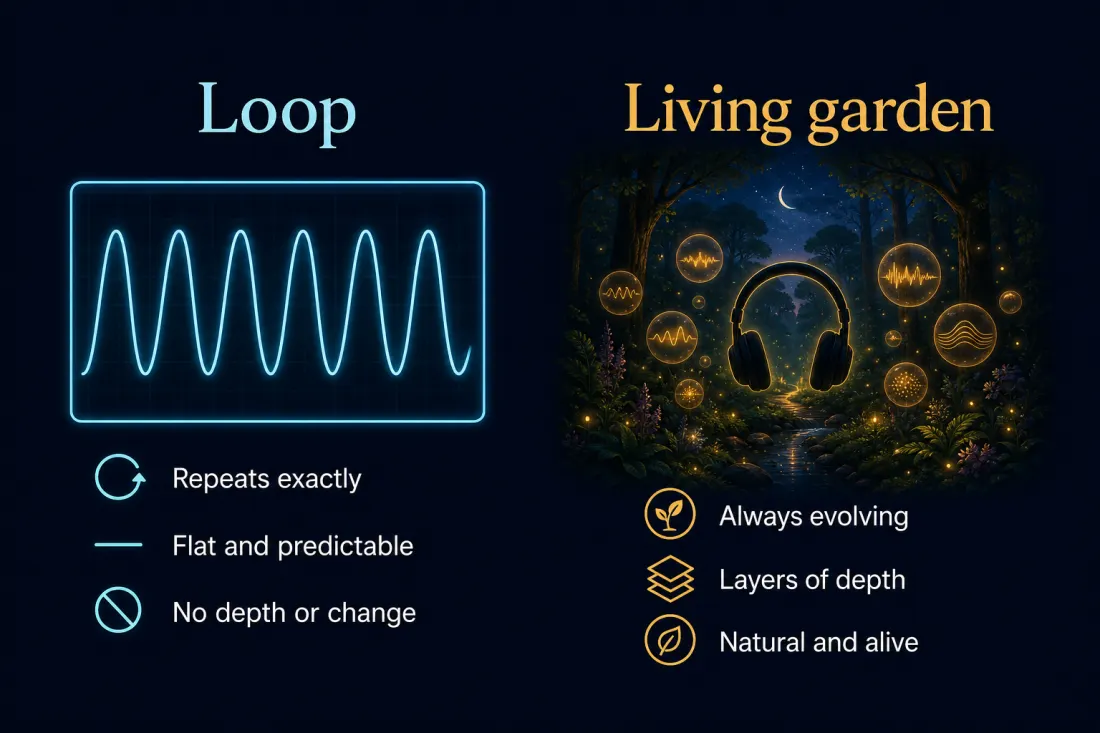
Why living gardens beat a single sleep loop
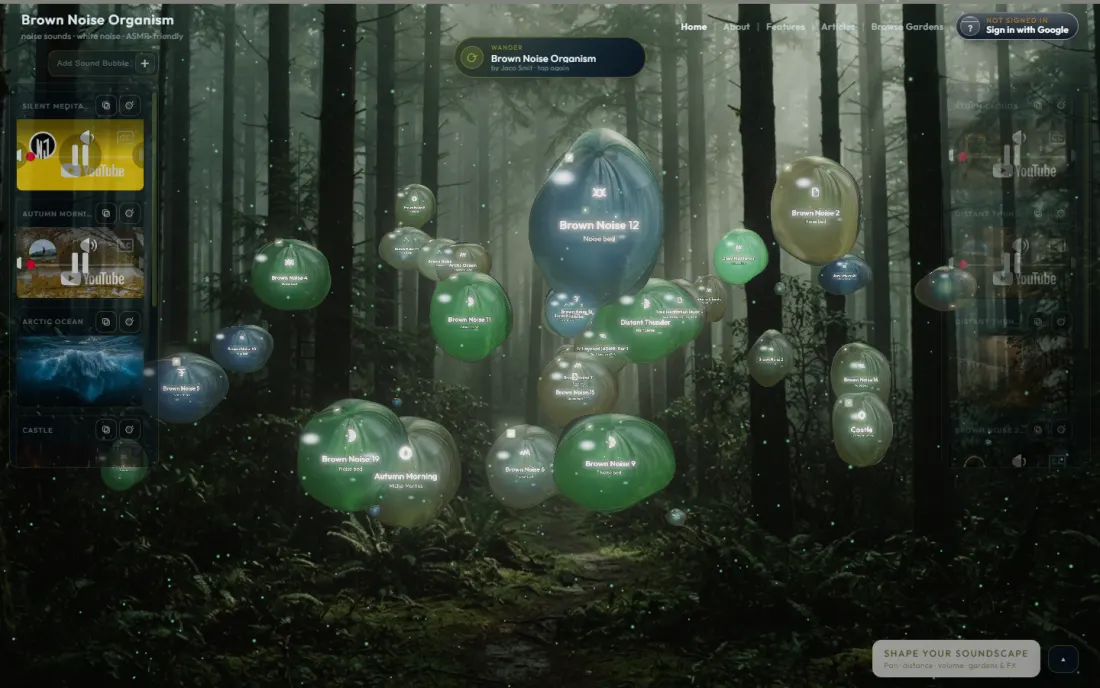
A fixed loop eventually becomes a pattern your brain predicts. Habituation research and predictive-processing accounts both point the same way: once the seam is learned, the sound stops functioning as a place and starts functioning as wallpaper — or worse, as a tiny alarm every time the loop restarts in awareness.[31][32][33][34][35] Sound Bubbles keeps a low floor while TimeLine drift slowly rearranges distance, so the masking stays useful without locking into one memorised phrase.[36][40]
Practical sleep rule of thumb from the literature and from nightly use: keep levels comfortable (never “blasting”), prefer continuous textures over sudden onsets, keep Chaos low, and place character sounds farther than the noise bed.[9][41][42]
Common sleep-sound mistakes (and fixes)
Turning it up until it “works.” ICU masking studies use controlled levels; infant sleep-machine research shows consumer devices can be dangerously loud up close.[1][54] Start quiet; raise only until traffic loses contrast.
Choosing a loop with a seam. Habituation turns a loop into wallpaper, then the seam becomes a micro-alarm.[31][34] Prefer living gardens with low Chaos.
White hiss all night. Equal-loudness curves make bright white fatiguing; brown/pink beds often feel kinder for hours.[3][38]
Treating sound as insomnia care. CBT-I and stimulus control remain first-line for chronic insomnia — sound is environmental support.[17][18][23]
Your first ten minutes at bedtime
- Open a recommended sleep garden and press Start playing.
- Set Master Volume so you can still hear a partner speaking softly across the room.
- Raise Falloff until only the nearest bubble feels “in the room” — everything else should feel outside the window.
- If anything has speech-like texture, push that bubble farther or pop it.
- Enable gentle Drift or Tide on TimeLine; keep Chaos low.
- Lie down for ten minutes and notice: are spikes gone? Is anything grabbing attention? Adjust once, then stop fiddling.
Interesting detail from the research
Pink-noise stimulation during sleep has been linked not only to more stable sleep physiology in some protocols, but also to better overnight memory consolidation when slow oscillations are enhanced — a reminder that “sleep sound” is not only about blocking traffic, it interacts with brain state during the night.[3][4][30] That does not make any app a memory treatment; it explains why spectral choice might matter beyond comfort.
Sound Bubbles tuning reference (worth learning once)
Master Volume sets the whole room. Start lower than you think — you can always raise one bubble instead of the entire garden.[41][42] Per-bubble Volume is how you balance layers without destroying dynamics: rain can stay audible while brown bed whispers.
Falloff is the secret weapon for speech and spike control. High falloff means only bubbles near the audible core sound “in your head”; everything else feels outside the window — exactly the intelligibility reduction office and sleep literature points toward.[37][45] If a layer feels too present, move it back before turning it up.
TimeLine adds slow environmental change so habituation does not turn your garden into wallpaper.[31][34] For sleep-adjacent gardens, favour Drift/Tide and keep Chaos low so motion stays subconscious. Pop anything that announces itself after ten minutes — a good garden should feel found, not performed.
Save & remix: when you find a mix that survives an hour, save it. Public medical and organism gardens are starting points; the best room is usually one you tuned for your desk, nursery, or bedside.
Why this supports Sound Bubbles — not just “any ambient app”
Most ambient apps deliver one file. The studies above rarely study “a loop.” They study continuous floors against irregular noise, unintelligible speech against memory tasks, nature scenes against stress markers, spatial streams against glued mashups, and slow environmental change against habituation.[1][31][36][43][44]
Sound Bubbles maps onto those findings deliberately: brown/noise beds for masking floors, nature and library layers for restorative structure, distance/Falloff for speech intelligibility control, and TimeLine motion so the garden keeps the statistics of a place instead of the statistics of a four-minute loop.[34][37][38][45] That is the practical reason the product feels different after the first hour — and the scientific reason the difference matters.
Recommended gardens — open in one click
These gardens match what this article describes. Each link opens the garden in the player — press Start playing and adjust Falloff if anything feels too close.
- Brown Noise for SleepBest starterDark continuous floor tuned for bedside masking — traffic and hallway spikes lose contrast without bright hiss.Open garden →
- Deep Sleep SoundscapesLow-motion beds with minimal sharp onsets — built for staying kind past the first hour.Open garden →
- Rain Sounds for SleepingRain texture farther than the noise floor — restorative structure plus masking in one garden.Open garden →
- Ocean Sounds for SleepSlow wave rhythm with spatial distance — many sleepers prefer organic motion over flat static.Open garden →
- Night Bed OrganismLiving brown organism with gentle TimeLine drift — resists loop habituation better than a single file.Open garden →
- Pillow Storm OrganismThunder-weighted but soft — for city sleepers who need contrast reduction, not drama.Open garden →
- Pink Noise for SleepBetween white and brown spectrally — worth A/B testing beside brown if white feels too sharp.Open garden →
- Ambient Sounds for InsomniaCompanion room for insomnia-adjacent listening — not CBT-I, but a softer environmental floor to audition.Open garden →
Browse all gardens · remix any public garden · save your own when you find the mix that fits.
How to apply this inside Sound Bubbles
- Open a related garden (or New Garden) and press Start playing so audio unlocks.[9]
- Expand Shape your soundscape → Sounds: set Master Volume, then Falloff while watching the audible-core guide.[10]
- Select a bubble; drag and scroll depth. Prefer raising one bubble’s Volume over blasting the whole room.[11]
- Add library rain, nature, or noise layers; keep speech-like content distant — or remove it — when you need reading or coding focus.[12]
- TimeLine: choose gentle Drift or Tide for long sessions; keep Chaos low so motion stays soft.[13]
- Brown Noise tab: shape a warm floor, optionally Release as bubble so it becomes spatial.[14]
- Save gardens that still feel kind after an hour — public gardens should stay soft, not startling.[15]
Limits, safety, and honest uncertainty
We do not claim Sound Bubbles replaces CBT-I, tinnitus counselling, ADHD care, paediatric guidance, or migraine treatment.[16][17] What the product does offer is a listening architecture that matches how hearing and attention actually work: layered sources, spatial distance, and slow change instead of one brittle loop.[18][19]
If sound worsens symptoms, stop. If you need medical advice, see a clinician. If you want a softer room, open a garden, place the bubbles kindly, and stay honest about what sound can — and cannot — do.[20][21]
How this article was researched
We combine first-hand experience placing and tuning Sound Bubbles gardens with citations from peer-reviewed journals, reviews, and institutional pages (including NIH/NCBI, sleep and hearing literature, acoustics, and attention research). Where evidence is mixed or early, we say so. On wellbeing topics we stay cautious: these are companion soundscapes, not cures.
References
Sources cited in this article. Prefer primary literature and institutional guidance; Sound Bubbles is not a medical device and these citations do not imply clinical endorsement.
- (2005). The influence of white noise on sleep in subjects exposed to ICU noise. Sleep Medicine. doi:10.1016/j.sleep.2004.12.004
- (2021). Noise as a sleep aid: A systematic review. Sleep Medicine Reviews. doi:10.1016/j.smrv.2020.101385
- (2012). Pink noise: effect on complexity synchronization of brain activity and sleep stabilization. Journal of Theoretical Biology. doi:10.1016/j.jtbi.2012.05.038
- (2017). Acoustic enhancement of sleep slow oscillations and concomitant memory improvement in older adults. Frontiers in Human Neuroscience. doi:10.3389/fnhum.2017.00109
- (2017). Broadband sound administration improves sleep onset latency in healthy subjects. Frontiers in Neurology. doi:10.3389/fneur.2017.00586
- (2021). The effects of white noise on sleep quality and night-time blood pressure. Sleep Medicine.
- (1990). White noise and sleep induction. Archives of Disease in Childhood. doi:10.1136/adc.65.1.135
- (2014). Auditory and non-auditory effects of noise on health. The Lancet. doi:10.1016/S0140-6736(13)61613-X
- (2009). Night noise guidelines for Europe. WHO Regional Office for Europe.
- (2007). Environmental noise, sleep and health. Sleep Medicine Reviews. doi:10.1016/j.smrv.2006.09.001
- (2014). Environmental noise and sleep disturbances: A threat to health?. Sleep Science. doi:10.1016/j.slsci.2014.11.003
- (2012). Sleep disruption due to hospital noise. Annals of Internal Medicine.
- (2001). Patient perception of sleep quality and ICU noise. American Journal of Respiratory and Critical Care Medicine.
- (2016). Effect of white noise on sleep in patients admitted to a coronary care unit. Journal of Caring Sciences.
- (2018). Systematic review: auditory stimulation and sleep. Geriatric Nursing.
- (2002). Epidemiology of insomnia. Sleep Medicine Reviews.
- (2006). Psychological and behavioral treatment of insomnia. Sleep.
- (2011). Stimulus control instructions for insomnia. Sleep Medicine Clinics.
- (2002). A cognitive model of insomnia. Behaviour Research and Therapy.
- (2003). Use of sleep hygiene in treatment of insomnia. Sleep Medicine Reviews.
- (2022). Sleep deprivation and deficiency. NIH NHLBI.
- (2014). International Classification of Sleep Disorders (ICSD-3) overview. AASM.
- (2017). European guideline for the diagnosis and treatment of insomnia. Peer-reviewed / institutional literature.
- (2016). Management of chronic insomnia disorder in adults. Peer-reviewed / institutional literature.
- (2015). Cognitive behavioral therapy for chronic insomnia. Peer-reviewed / institutional literature.
- (2018). WHO environmental noise guidelines: evidence on sleep. IJERPH.
- (2008). Autonomic arousals related to traffic noise. Sleep Medicine.
- (1995). Predicting noise-induced sleep disturbance. Journal of the Acoustical Society of America.
- (2013). Auditory closed-loop stimulation of the sleep slow oscillation enhances memory. Neuron. doi:10.1016/j.neuron.2013.03.006
- (2009). Habituation revisited: an updated and revised description. Neurobiology of Learning and Memory. doi:10.1016/j.nlm.2008.09.015
- (2009). Habituation: a history. Neurobiology of Learning and Memory.
- (1963). Perception and the conditioned reflex (orienting response). Pergamon Press.
- (2010). The free-energy principle: a unified brain theory?. Nature Reviews Neuroscience. doi:10.1038/nrn2787
- (2013). Whatever next? Predictive brains, situated agents. Behavioral and Brain Sciences. doi:10.1017/S0140525X12000477
- (1990). Auditory Scene Analysis. MIT Press.
- (2012). An Introduction to the Psychology of Hearing (masking & loudness). Brill.
- (2024). Colors of noise (white, pink, brown definitions). Encyclopedic / signal processing.
- (1999). Psychoacoustics: Facts and Models. Springer.
- (2013). American National Standard acoustical terminology (masking). ANSI.
- (2021). World report on hearing. WHO.
- (2023). Noise and hearing loss prevention. CDC.
- (2001). Auditory distraction and short-term memory: Phenomena and practical implications. Human Factors. doi:10.1518/001872001775992390
- (2010). Stress recovery during exposure to nature sound and environmental noise. IJERPH. doi:10.3390/ijerph7031036
- (2005). A model predicting the effect of speech of varying intelligibility on work performance. Indoor Air. doi:10.1111/j.1600-0668.2005.00391.x
- (2002). The noise/stress concept and cardiovascular disease. Noise & Health.
- (2014). Infant sleep machines and hazardous sound pressure levels. Pediatrics. doi:10.1542/peds.2013-2808
- (2018). Environmental noise and the cardiovascular system. Journal of the American College of Cardiology.
- (2006). Effects of road traffic noise on sleep. Journal of the Acoustical Society of America.
- (2018). Effect of noise on sleep and autonomic activity. Sleep Medicine Reviews.