
Contrast: why spikes shout in silent rooms
Masking theory defines detection as signal-to-background ratio — in near-zero noise floors, even quiet house sounds produce large relative jumps. Sokolov's orienting response work showed novel stimuli trigger automatic attention capture; silence maximises novelty when the fridge compressor kicks.[11][18] Stanchina demonstrated adding continuous noise improved sleep against ICU spike recordings — the floor compressed dynamic range.[22]
Halperin reviewed environmental noise and sleep, noting irregular events dominate disturbance — a silent room is the ultimate irregular-event canvas when building systems cycle on and off.[1]
Insomnia, hypervigilance, and the quiet brain
Harvey's cognitive model of insomnia emphasises conditioned arousal and monitoring — listeners hyper-attend to internal and external cues in bed.[2] Absolute silence removes external competition, leaving endogenous thoughts and somatic sensations foregrounded. Riedy's noise-as-sleep-aid review noted some healthy listeners benefit from noise during onset specifically — consistent with needing a gentle external anchor.[3]
Predictive processing accounts add nuance: Clark and Friston describe brains that minimise prediction error — in silence, any unexpected sound generates large error signals; a stable predictable floor suppresses error for constant statistics while still masking spikes.[5][6][12][13]
When silence helps versus when floors help
Silence wins in quiet rural bedrooms, during hyperacusis flares, and when masking itself becomes the focus of attention. Floors help in urban noise, partner-snore environments, and insomnia with high somatic monitoring — provided volumes stay low and spectra stay non-harsh.[4][19] Morin's behavioural insomnia treatment still prioritises stimulus control and scheduled sleep — masking is adjunct, not replacement.[8]
Basner's population health review reminds us chronic night noise harms health — the goal is not louder bedrooms globally, but controlled low-level statistics that prevent contrast explosions.[4]
Anxiety, salience, and "listening for danger"
Quiet rooms feel threatening to anxious listeners because auditory gain increases when external input drops — every distant footstep might matter. Alvarsson showed nature sound accelerated stress recovery versus generic noise after laboratory stressors — soft biophilic floors may signal safety context rather than empty vigilance.[24] Banbury documented unattended speech disrupting cognition; during insomnia, internal speech does similar work — external non-linguistic floors can occupy bandwidth without narrative.[23]
Practical experiment: silence versus soft floor
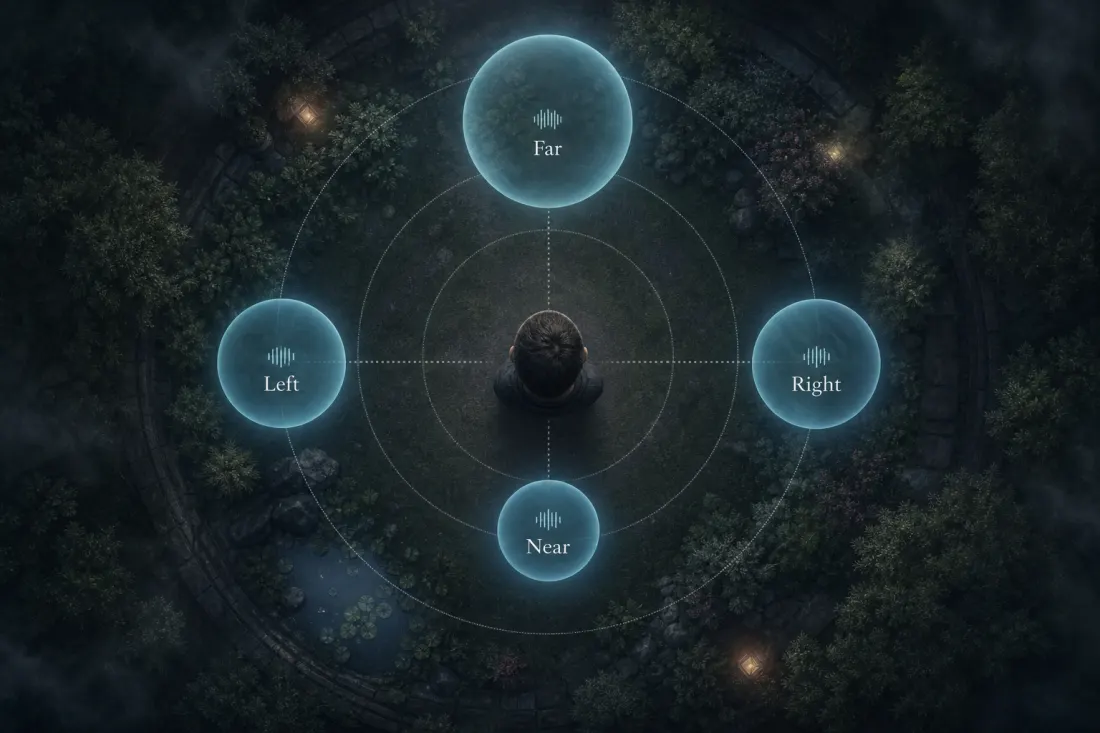
- Track three nights silent, three nights with distant brown at minimal volume — log onset latency and wake counts.[3]
- If silence wins, keep it — do not force noise culture.[8]
- If floors help, tune Falloff high so nothing feels in-head.[14]
- Stop if tinnitus or anxiety worsens — silence may be medically preferable.[20]
Hypervigilance, anxiety, and the quiet that amplifies thought
Insomnia with comorbid anxiety often features catastrophic interpretation of normal night sounds — pipe ticks become threat signals in silence.[6][12] A soft floor gives the auditory cortex patterned input that competes with worry loops without demanding semantic processing. This is not avoidance; it is attentional load management.
Tinnitus sufferers report silence makes ringing louder via lack of masking — the same mechanism that makes absolute quiet feel "loud."[15][18] Gentle brown beds near threshold can restore perceptual balance. If anxiety dominates, combine environmental sound with CBT-I or clinical support rather than expecting noise alone to fix 3am rumination.
Predisposing factors include trauma history, shift work, and bedroom associations with work stress — the bed becomes a performance stage for sleep effort.[6][12] A soft external soundscape can break that association by giving the nervous system something besides "try harder to sleep." Keep volume below the level you actively listen to; the bed should be felt, not attended.
Companion listening in Sound Bubbles
Research above concerns clinical and laboratory sound — not a playlist guarantee. Sound Bubbles offers adjustable living gardens: spatial layers, coloured noise beds, Medical & Wellbeing rooms, and easy mute. Use the recommended gardens below as environmental support alongside medical care when appropriate.[20]
Not treatment. See clinicians for diagnosis, medication, CBT, neurologic music therapy, or tinnitus programmes. Keep volume comfortable; stop if symptoms worsen.
Why this supports Sound Bubbles — not just "any ambient app"
Most ambient apps deliver one file. The studies above rarely study "a loop." They study continuous floors against irregular noise, unintelligible speech against memory tasks, nature scenes against stress markers, spatial streams against glued mashups, and slow environmental change against habituation.[9][14][22][23][24]
Sound Bubbles maps onto those findings deliberately: brown/noise beds for masking floors, nature and library layers for restorative structure, distance/Falloff for speech intelligibility control, and TimeLine motion so the garden keeps the statistics of a place instead of the statistics of a four-minute loop.[12][15][16][25] That is the practical reason the product feels different after the first hour — and the scientific reason the difference matters.
How to apply this inside Sound Bubbles
- Open a related garden (or New Garden) and press Start playing so audio unlocks.[9]
- Expand Shape your soundscape → Sounds: set Master Volume, then Falloff while watching the audible-core guide.[10]
- Select a bubble; drag and scroll depth. Prefer raising one bubble's Volume over blasting the whole room.[11]
- Add library rain, nature, or noise layers; keep speech-like content distant — or remove it — when you need reading or coding focus.[12]
- TimeLine: choose Drift, Tide, or Orbit when you want the garden to keep evolving without grabbing attention.[13]
- Brown Noise tab: shape a warm floor, optionally Release as bubble so it becomes spatial.[14]
- Save gardens that still feel kind after an hour — public gardens should stay soft, not startling.[15]
Limits, safety, and honest uncertainty
We do not claim everyone should abandon silence, that masking treats insomnia disorders, or that quiet anxiety equals psychiatric diagnosis.[2][8] What the product does offer is a listening architecture that matches how hearing and attention actually work: layered sources, spatial distance, and slow change instead of one brittle loop.[18][19]
If sound worsens symptoms, stop. If you need medical advice, see a clinician. If you want a softer room, open a garden, place the bubbles kindly, and stay honest about what sound can — and cannot — do.[20][21]
How this article was researched
We combine first-hand experience placing and tuning Sound Bubbles gardens with citations from peer-reviewed journals, reviews, and institutional pages (including NIH/NCBI, sleep and hearing literature, acoustics, and attention research). Where evidence is mixed or early, we say so. On wellbeing topics we stay cautious: these are companion soundscapes, not cures.
References
Sources cited in this article. Prefer primary literature and institutional guidance; Sound Bubbles is not a medical device and these citations do not imply clinical endorsement.
- (2014). Environmental noise and sleep disturbances: A threat to health?. Sleep Science. doi:10.1016/j.slsci.2014.11.003
- (2002). A cognitive model of insomnia. Behaviour Research and Therapy.
- (2021). Noise as a sleep aid: A systematic review. Sleep Medicine Reviews. doi:10.1016/j.smrv.2020.101385
- (2014). Auditory and non-auditory effects of noise on health. The Lancet. doi:10.1016/S0140-6736(13)61613-X
- (2013). Whatever next? Predictive brains, situated agents. Behavioral and Brain Sciences. doi:10.1017/S0140525X12000477
- (2010). The free-energy principle: a unified brain theory?. Nature Reviews Neuroscience. doi:10.1038/nrn2787
- (2006). Psychological and behavioral treatment of insomnia. Sleep.
- (2009). Habituation revisited. Neurobiology of Learning and Memory. doi:10.1016/j.nlm.2008.09.015
- (2009). Habituation: a history. Neurobiology of Learning and Memory.
- (1963). Perception and the conditioned reflex. Pergamon Press.
- (2010). The free-energy principle. Nature Reviews Neuroscience. doi:10.1038/nrn2787
- (2013). Whatever next? Predictive brains. Behavioral and Brain Sciences. doi:10.1017/S0140525X12000477
- (1990). Auditory Scene Analysis. MIT Press.
- (2012). An Introduction to the Psychology of Hearing. Brill.
- (2024). Colors of noise. Encyclopedic.
- (2013). Acoustical terminology (masking). ANSI.
- (2014). Auditory and non-auditory effects of noise on health. The Lancet. doi:10.1016/S0140-6736(13)61613-X
- (2021). World report on hearing. WHO.
- (2023). Noise and hearing loss prevention. CDC.
- (2005). White noise on sleep with ICU noise exposure. Sleep Medicine. doi:10.1016/j.sleep.2004.12.004
- (2001). Auditory distraction and short-term memory. Human Factors. doi:10.1518/001872001775992390
- (2010). Stress recovery with nature sound. IJERPH. doi:10.3390/ijerph7031036
- (2005). Speech intelligibility and work performance. Indoor Air. doi:10.1111/j.1600-0668.2005.00391.x